
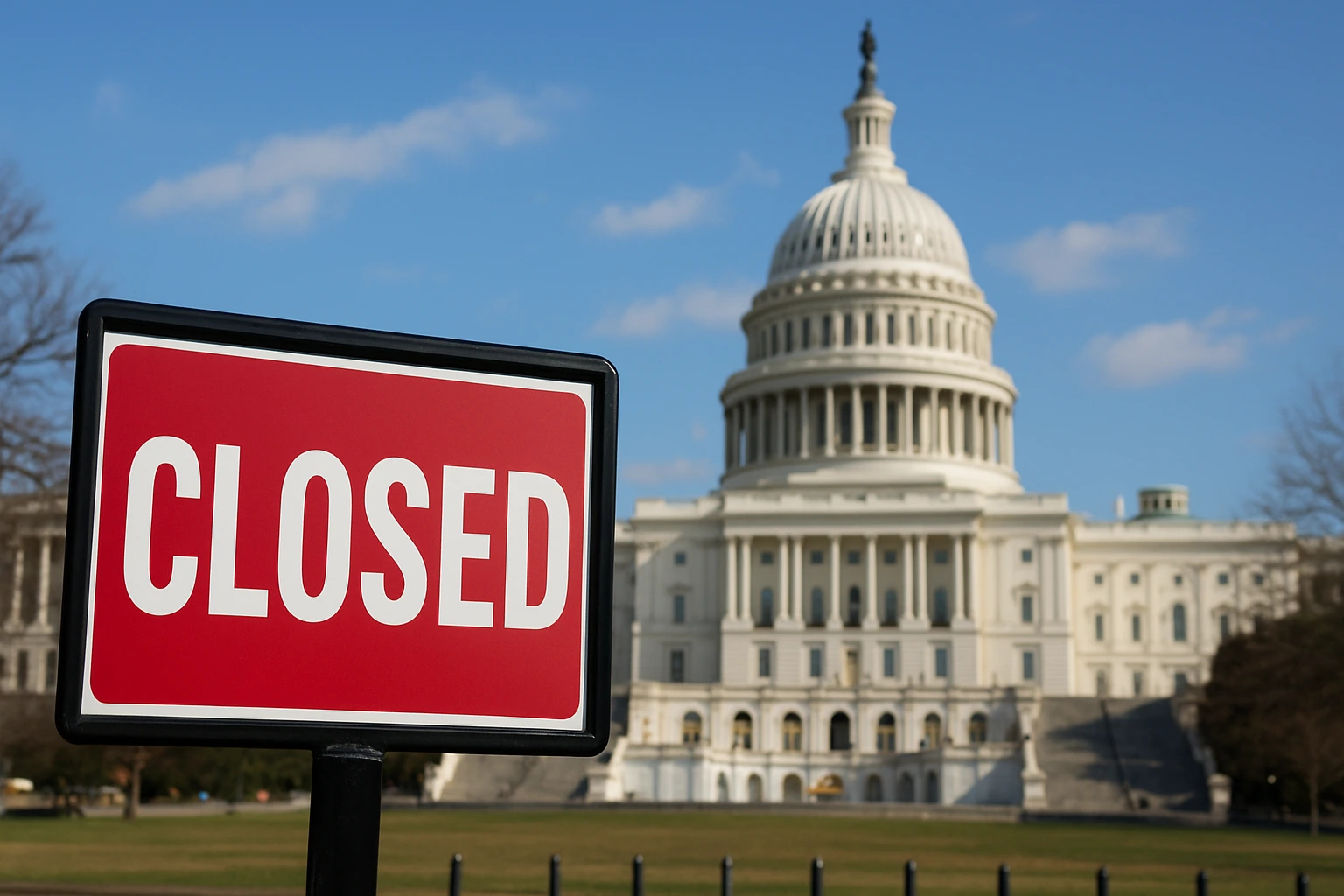
WASHINGTON — The federal government shutdown has entered uncharted territory, becoming the longest in US history as lawmakers struggle to find common ground.
The record breaking stoppage, which surpassed the previous mark set during President Donald Trump’s first term, has begun to ripple through nearly every corner of American life from airports to grocery store aisles.
Bipartisan talks on Capitol Hill showed faint signs of progress Wednesday, but congressional leaders remain gridlocked over spending priorities tied to healthcare and social aid.
President Trump, addressing reporters at the White House, blamed the ongoing shutdown for Republican losses in this week’s elections, while Democrats pointed to healthcare policy as a key factor in their victories.
The government has now been partially closed for more than five weeks, halting pay for hundreds of thousands of federal workers and suspending a range of public services.
The impasse stems from disagreements over funding allocations tied to Affordable Care Act subsidies and other domestic programs.
Saturday marked the beginning of a new open enrollment period for healthcare exchanges, but some premiums are set to double next year without new subsidies a sticking point for Democrats.
Republicans have resisted the expansion, calling it fiscally unsustainable. White House Press Secretary Karoline Leavitt said the administration “remains committed to protecting working families” but insisted the president would “not approve a deal that worsens the deficit.”
Policy analysts warn that the extended shutdown could leave lasting economic scars. “The longer Washington’s stoppage continues, the greater the risk of a systemic slowdown,” said Dr. Melissa Crane, a senior economist at the Brookfield Policy Institute.
“Federal workers are not spending, contractors are idled, and the uncertainty is dampening private investment.” The Congressional Budget Office previously estimated that a month long shutdown could shave up to 0.2 percentage points off quarterly GDP growth.
With the current stoppage surpassing that duration, those projections may soon require revision. Air travel has emerged as one of the most visible pressure points.
Transportation Secretary Sean Duffy warned that continued unpaid absences among air traffic controllers and security screeners could force “partial airspace closures,” creating what he described as “mass chaos.”
This shutdown, now the longest in US history, surpasses the 35 day record from late 2018 to early 2019. According to the Office of Management and Budget, roughly 800,000 federal employees have been affected, with nearly half required to work without pay.
Passenger delays at major airports have tripled compared to the same period last year, according to the Federal Aviation Administration.
The Supplemental Nutrition Assistance Program (SNAP) has resorted to partial benefit payments, affecting nearly one in eight Americans.
The US Chamber of Commerce estimates small business loan approvals from federal lenders have fallen by 60 percent since the shutdown began.
“This stoppage is more disruptive than many realize,” said Mark Evans, a senior fellow at the Peterson Economic Center. “It’s not just federal paychecks. It’s the lost consumer spending, halted contracts, and ripple effects through every supply chain tied to government operations.”
In airports, offices, and neighborhoods across the country, frustration has deepened. “I’ve been a TSA officer for nine years,” said Angela Moreno, who works at Dallas/Fort Worth International Airport.
“We’re proud to serve, but this is the first time I’ve had to visit a food bank to feed my kids.” In Maryland, where many federal workers reside, local businesses are feeling the impact.
We’ve seen a drop in lunch orders and deliveries since the second week of the shutdown, said James Porter, owner of a small deli near Silver Spring. “When federal workers don’t get paid, the whole community feels it.”
Even in rural areas, the consequences are visible. “SNAP benefits help keep our small town grocery stores afloat,” said Carla Jenkins, a store manager in western Kentucky. “If those payments stop entirely, people will go hungry, and some stores may close.”
Senate Majority Leader John Thune suggested this week that negotiations could soon yield an “off ramp,” hinting at a short term funding measure to reopen the government.
The proposed plan, still under discussion, would extend funding through early December to allow further debate on healthcare and budget reforms.
Still, deep divisions remain. Democrats are pushing for an extension of Affordable Care Act subsidies and stronger protections for low-income families, while Republicans continue to prioritize spending restraint and deficit reduction.
Political analysts warn that even a temporary reopening might offer only limited relief. “Unless the two sides agree on broader fiscal principles, this could be a recurring battle,” said political strategist Karen Bell of the Atlantic Policy Group.
As Washington’s stoppage stretches into record territory, the nation faces mounting economic and social costs. From delayed paychecks to strained public programs, the shutdown’s impact has reached beyond politics and into the daily lives of millions.
Whether Congress can chart a path forward remains uncertain, but both parties face growing pressure to act. For now, the longest government shutdown in US history continues a stark reminder of the nation’s deep divisions and the heavy toll of political stalemate.


