
NEW YORK — US stocks fell sharply Friday after former President Donald Trump threatened to impose significantly higher tariffs on Chinese imports, accusing Beijing of “becoming very hostile” and tightening control over its rare earth metal exports.
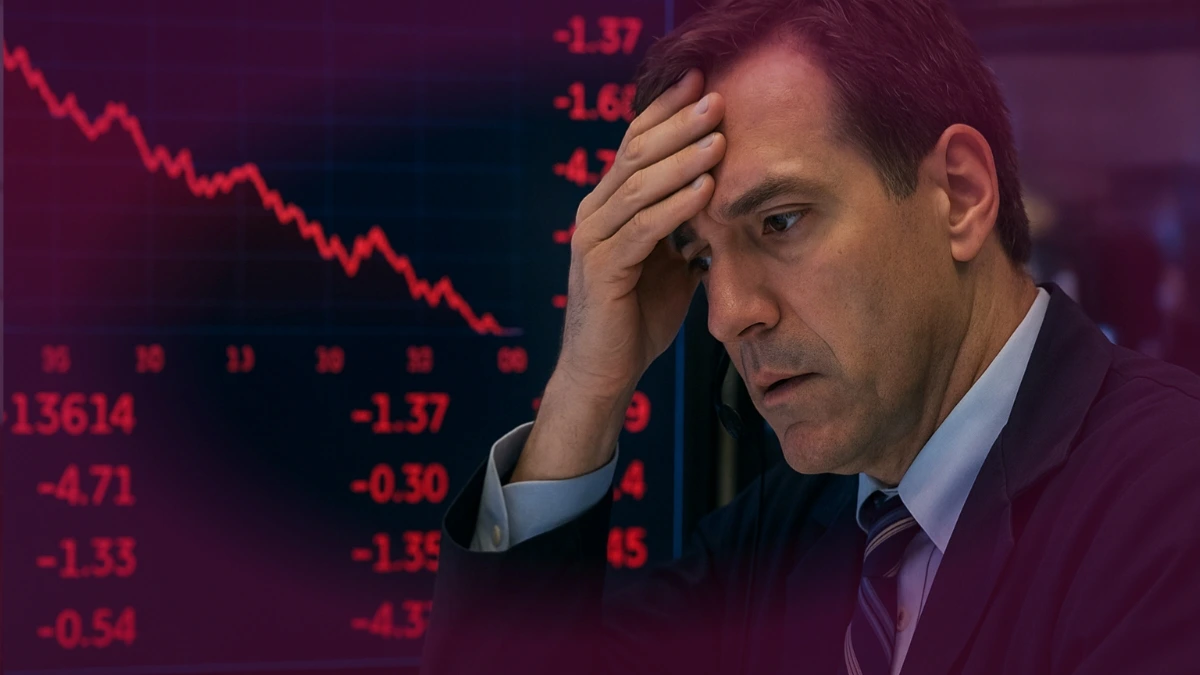
The Dow Jones Industrial Average dropped 449 points, or roughly 1%, in a sudden midday selloff that erased earlier gains and rattled investors already wary of prolonged economic uncertainty.
The S&P 500 slid 1.4%, and the Nasdaq Composite tumbled 2%, reversing from a record intraday high earlier in the session. Technology shares, heavily dependent on Chinese manufacturing and supply chains, led the declines.
Trump’s comments, posted Friday morning on Truth Social, reignited long dormant fears of a trade conflict with the world’s second largest economy.
He stated that he had been scheduled to meet Chinese President Xi Jinping at the upcoming APEC Summit in South Korea but “saw no reason” to proceed following Beijing’s recent policy moves.
“One of the policies that we are calculating at this moment is a massive increase of tariffs on Chinese products coming into the United States of America,” Trump said, warning that China’s tightening control over rare earth exports was “holding the globe captive.”
Earlier this week, China announced new export licensing rules requiring foreign entities to seek government approval before exporting products containing more than 0.1% of rare earth elements.
The move, described by Beijing as a matter of “national resource security,” immediately drew concern in Washington and across major technology and defense industries that rely heavily on these materials for manufacturing semiconductors, batteries, and advanced weaponry.
“Expectations for a China trade deal just got swept off the table,” said Jeff Kilburg, founder and chief executive of KKM Financial. “Profit takers are out in full force today, and the tone shifted dramatically after Trump’s remarks.”
Art Hogan, chief market strategist at B. Riley Wealth, said the technology sector’s exposure to China made it especially vulnerable.
It’s not surprising to see tech stocks down the most today, Hogan said. “They’re exposed both through supply chains and customer bases in China. Clearly, our relationship with the second largest economy in the world just got more difficult.”
Trade experts noted that the timing of Trump’s comments amid a 10 day government shutdown may have amplified market volatility. “Investors were already uneasy with Washington gridlock,” said Diane Swonk, chief economist at KPMG.
“When you combine fiscal uncertainty with the specter of another tariff war, you get a quick selloff driven more by fear than fundamentals.”
Friday’s losses erased the S&P 500’s gains for the week, putting the benchmark index on track to fall about 1% for the period. The Dow Jones Industrial Average, which had gained nearly 300 points earlier in the session, swung more than 700 points from its high to its low in a matter of hours.
Among major stocks, Nvidia slipped more than 1%, AMD fell 5%, and Tesla dropped nearly 3%. Semiconductor and hardware companies with substantial production or consumer exposure in China faced the steepest declines.
Rare earth metals including neodymium, dysprosium, and terbium are critical components in electric vehicles, wind turbines, and military grade technology. China controls more than 70% of the global rare earths supply chain, giving it substantial leverage in trade negotiations.
“Even small changes in China’s export policies can ripple through global industries,” said Victor Lane, an analyst at Evercore ISI. “A 0.1% export threshold may sound technical, but it’s a message that Beijing is willing to use rare earths strategically.”
Investors and business leaders expressed frustration at the reemergence of geopolitical trade tensions that had been largely dormant in recent years.
“I just started seeing recovery in manufacturing orders after months of slowdown,” said Janet Doyle, owner of a small electronics parts supplier in Ohio. “Now my clients are asking if prices will go up again if tariffs return. It feels like déjà vu from 2019.”
At the New York Stock Exchange, traders described the selloff as “swift but expected.” “Once Trump mentioned tariffs, it was like a switch flipped,” said Anthony Mendez, a floor trader at Morgan Securities. “Everyone knows how sensitive this market is to trade rhetoric.”
Meanwhile, American farmers voiced concern about potential retaliatory measures from China. “We paid the price last time when soybeans got hit with tariffs,” said Bill Carlson, a corn and soybean farmer in Iowa. “We can’t afford another round of that.”
While Trump’s comments do not represent official US policy, analysts said they could still influence markets if investors believe a trade confrontation is plausible under a future administration.
“Markets trade on expectations as much as on actions,” said Liz Ann Sonders, chief investment strategist at Charles Schwab. “If there’s a perception that tariffs could return, companies start hedging, delaying investment, and tightening budgets.”
With the government shutdown entering its second week and no resolution in sight, analysts warned that continued political uncertainty could deepen investor unease. “We’re seeing a classic flight to safety,” said Kilburg. “Treasuries and gold are higher, while risk assets are taking the hit.”
Friday’s market drop underscored how fragile investor sentiment remains in the face of renewed trade threats and political instability.
While no new tariffs have been formally announced, Trump’s remarks alone were enough to jolt Wall Street and reawaken memories of previous trade wars that disrupted global markets.
As traders brace for more volatility, attention now turns to whether Beijing or Washington will offer clarification in the coming days or if this latest flare up marks the beginning of another turbulent chapter in US And China economic relations.


