
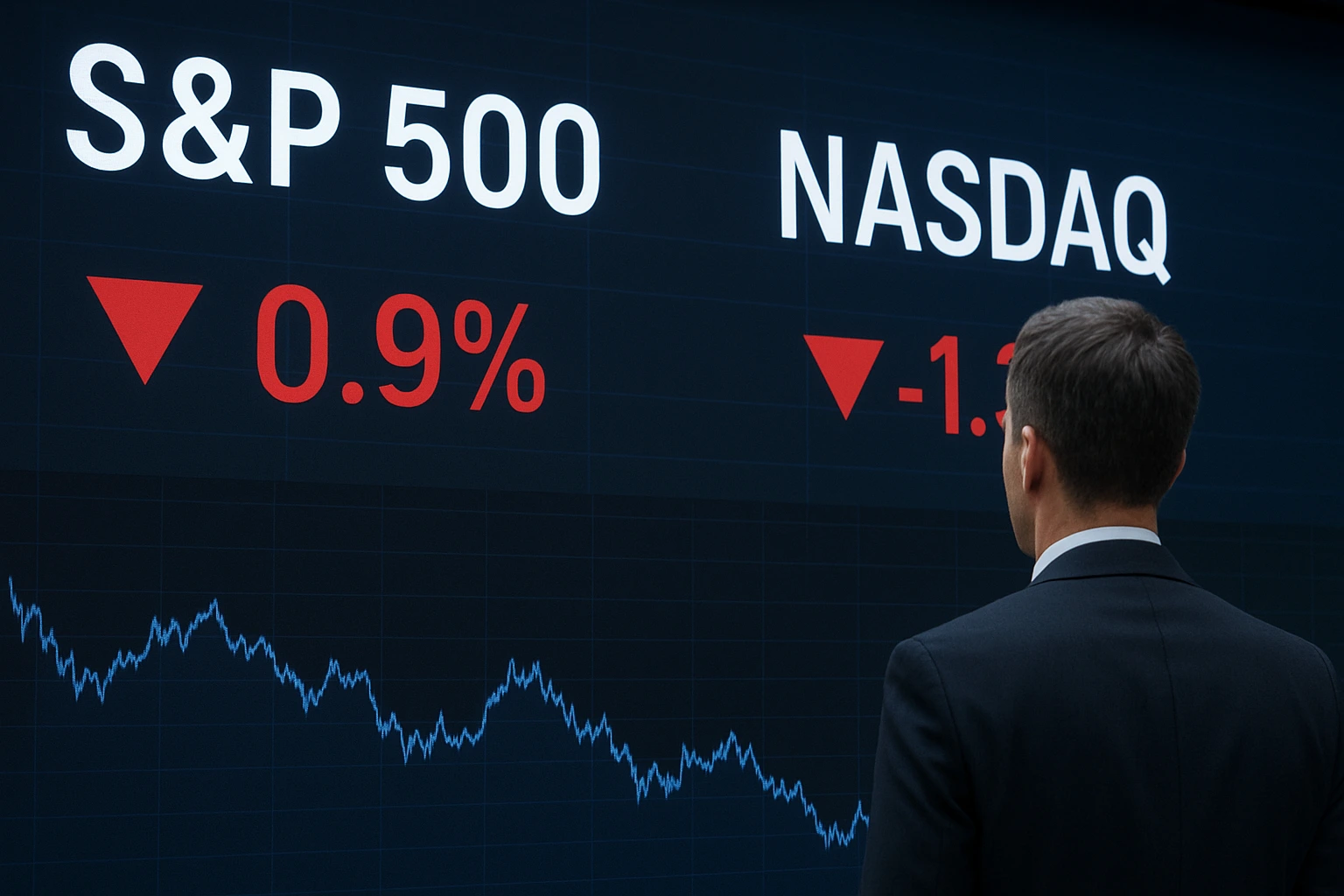
NEW YORK — US stock futures fell sharply Tuesday as investor skepticism grew over whether the recent tech driven rally on Wall Street can continue.
Futures tied to the S&P 500 dropped 0.9%, while contracts for the tech heavy Nasdaq 100 fell about 1.3%. Dow Jones Industrial Average futures slipped 0.6%, reflecting broader caution across markets.
The pullback comes a day after a mixed session that saw artificial intelligence optimism lift the S&P 500 and Nasdaq Composite to modest gains, with Amazon closing at a record high following its new AI partnership with OpenAI.
Technology shares have dominated Wall Street’s gains in recent months, driven by enthusiasm for AI and strong corporate earnings from major firms.
The so called “Magnificent Seven” Apple, Microsoft, Amazon, Alphabet, Meta, Nvidia, and Tesla have accounted for a disproportionate share of the S&P 500’s advance in 2025.
But that concentration has also made the market vulnerable to sudden swings when sentiment turns.
Palantir Technologies, a prominent AI military contractor, fell more than five percent in premarket trading Tuesday despite beating third quarter expectations. Analysts warned that valuations across the sector may have stretched too far.
“The market’s reliance on a handful of big tech names is creating a fragile foundation,” said Daniel Kerr, a senior strategist at Horizon Capital Management.
“Investors are realizing that strong earnings don’t always justify sky high multiples, especially when economic data remains uncertain.” Analysts pointed to growing investor fatigue with AI linked stocks that have surged since early 2024.
While cloud computing and semiconductor firms reported robust spending on AI infrastructure, some investors are questioning whether that growth can sustain the broader market rally.
“AI remains an important long term theme, but short term sentiment is overextended,” said Lisa Raymond, an equity analyst at Barclays.
“The divergence between earnings growth and market performance is widening, which could mean a period of consolidation for tech stocks.”
The uncertainty has been compounded by delays in key US economic reports amid a partial government shutdown, leaving traders without critical data on jobs, inflation, and manufacturing.
The Labor Department’s employment report, initially scheduled for release this week, has been postponed, adding to the market’s unease.
“Data dependency is the backbone of the Federal Reserve’s decision making,” said Raymond. “Without clear indicators, markets are left guessing about the next policy move, which increases volatility.”
The S&P 500 futures’ 0.9% slide marks one of the largest premarket drops in recent weeks, following a period of resilience. On Monday, the S&P 500 gained 0.2% and the Nasdaq Composite rose nearly 0.5%, led by Amazon’s 2.3% climb.
In contrast, smaller cap indices and cyclical sectors lagged, underscoring the narrow leadership driving the rally. Palantir’s five percent drop was accompanied by weakness in semiconductor and cloud stocks ahead of key earnings reports.
Advanced Micro Devices (AMD), Uber Technologies (UBER), Spotify (SPOT), and Super Micro Computer (SMCI) are among the more than one hundred companies set to release quarterly results this week.
Historically, the S&P 500’s performance during earnings season has correlated closely with revisions to corporate profit expectations.
According to FactSet data, aggregate third quarter earnings are expected to rise about 4.2% year over year, with information technology leading the gains.
In New York’s financial district, traders and fund managers expressed cautious optimism but admitted that the mood has shifted from exuberance to vigilance.
“Last month everyone was talking about AI as the new gold rush,” said Amanda Foster, a portfolio manager at SilverLine Investments. “Now the focus is on sustainability whether these companies can keep delivering the growth investors are pricing in.”
Retail investors, who poured billions into tech heavy exchange traded funds earlier this year, have also begun pulling back. “I’ve started rebalancing toward dividend stocks,” said Michael Tran, a small investor from San Francisco. “AI feels like a long-term bet, but the short term swings are too wild.”
With another wave of earnings reports on deck, market observers expect volatility to remain high. Attention is likely to center on results from AMD and Super Micro Computer, two companies closely tied to the AI hardware boom.
Economists also warn that the delayed government data could distort market expectations for Federal Reserve policy. The central bank has kept rates steady since midyear, emphasizing a data driven approach to future moves.
“If we get softer corporate results combined with missing macro indicators, investors may retreat to safety,” said Kerr. “That means more money flowing into bonds and defensive sectors until the outlook clears.”
Longer term, analysts remain divided on whether the tech rally has reached its peak. Some believe that AI investments will continue to reshape industries and support corporate profits, while others warn that valuations could trigger a broader correction.
As Wall Street grapples with uncertainty, the decline in S&P 500 and Nasdaq futures underscores a growing unease about the durability of the tech fueled market rally.
With economic data delayed and earnings season in full swing, investors are treading cautiously, weighing optimism about artificial intelligence against the realities of valuation and volatility.


