
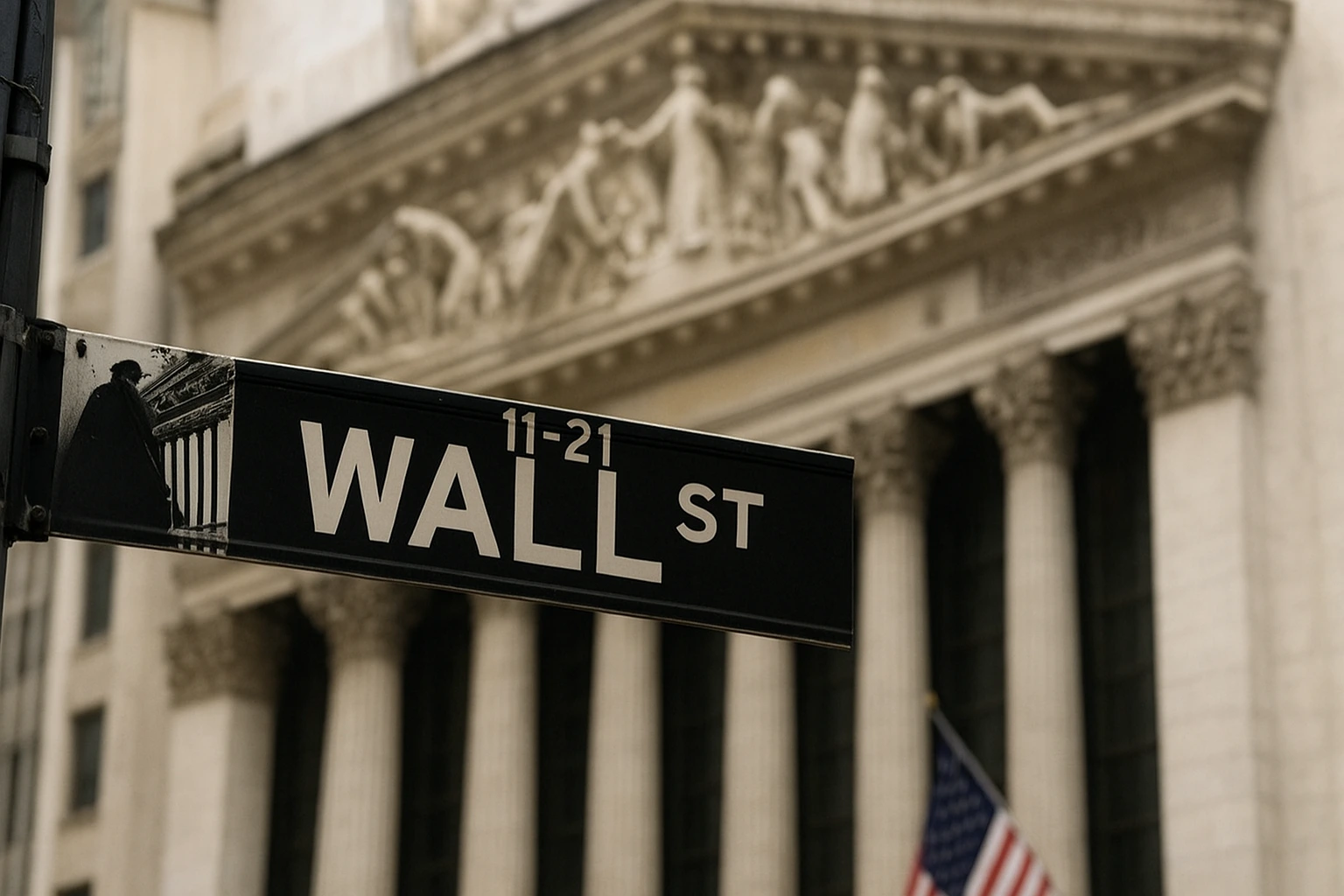
NEW YORK — Wall Street closed mixed Friday as banking stocks rallied on stronger than expected earnings, even as rising US China trade tensions and new port fees rattled global markets.
The S&P 500 dipped modestly, the Nasdaq slid, but gains in industrials and financials propped up the Dow. Investors remain cautious of the evolving tariff debate and its potential to disrupt supply chains and trade flows.
The markets’ turbulence came after the United States and China each began charging additional port fees on ocean shipping firms, affecting everything from consumer goods to crude oil shipments. The move escalates trade friction at a moment when global equities were already under pressure.
Over the weekend, President Donald Trump threatened to impose 100 percent tariffs on Chinese goods after Beijing enacted controls on rare earth mineral exports, though he appeared to ease his rhetoric later.
“The market is really struggling with where this shakes out,” said Ross Mayfield, investment strategist at Baird Private Wealth Management.
“If the administration feels like ramping up these tensions again, the market looks pretty expensive right now for that sort of fight, especially if 100 percent tariffs and other measures are back on the board.”
Meanwhile, Federal Reserve Chair Jerome Powell, in remarks prepared for a National Association for Business Economics conference, acknowledged that the US labor market remained in a sluggish phase, with hiring and firing both subdued.
Yet he added that the broader economy “may be on a somewhat firmer trajectory than expected,” offering a mild note of optimism.
Analysts see the combination of renewed tariff talk and the port fee escalation as a dual risk to global trade, corporate profits and investor confidence.
“Tariffs remain the focus keyword in global markets every investor is watching whether the escalation is rhetorical or real,” said Caroline Xu, senior economist at Pacific Trade Analytics.
Xu pointed out that the new port fees, though not outright tariffs, function similarly by increasing the cost of moving goods across oceans, especially for manufacturers and exporters.
Firms already facing tight margins may pass on these costs or suffer margin compression. That feeds into earnings risk, she said. Others note that the banking rally signals investor appetite for sectors with strong earnings resilience even as broader markets waver.
“We’re seeing rotation into financials on solid reports, while more rate sensitive or growth names are under pressure,” said Marcus Lee, portfolio manager at Harbor Capital.
According to preliminary data, the S&P 500 lost 9.73 points, or 0.15 percent, to finish at 6,644.38. The Nasdaq Composite fell 175.76 points, or 0.77 percent, to 22,518.84, while the Dow Jones Industrial Average gained 205.41 points, or 0.45 percent, to 46,272.99.
In sector performance, industrial and financial shares buoyed the Dow. Caterpillar surged after J.P. Morgan raised its price target, and several regional banks posted revenue and net interest margin beats.
Retail giant Walmart also made headlines by announcing a partnership with OpenAI to allow customers and Sam’s Club members to shop directly within ChatGPT.
Globally, markets in Asia and Europe posted losses as exporters felt immediate heat from the port fee changes and escalating tariff rhetoric. Shipping indexes dropped, and freight forwarders warned of added burdens on supply chains.
On the docks in the Port of Long Beach, California, freight logistic manager Maria Hernandez said the new fees “feel like hidden tariffs.” She added, “We are already juggling labor costs, regulatory changes and energy prices. These surcharges complicate our quoting and make clients nervous.”
At a midsize manufacturer in Shenzhen, China, operations manager Li Wei said his company is holding off on large export orders until the tariff signals stabilize.
We don’t know what additional duties are coming. If port costs and tariffs stack up, many of our overseas buyers may shift to nearer sources, Li said.
In New York, small business owner and importer Amanda Jacobs said the uncertainty is forcing her to delay purchasing decisions. “My suppliers in Asia are raising quotes already. I’m wary of locking in now and getting hit later,” she said.
Investors now face a narrow path: parsing whether the renewed tariff threats are tactical bargaining or prelude to implementation.
If the White House moves forward with 100 percent tariffs, that could trigger broad retaliation, supply chain disruptions, and sharply higher input costs for many US sectors.
Absent further escalation, some market watchers expect a return to baseline trade tensions, which have been a feature of markets over several years. Others warn that any further surprises around rare earth export limits or port fees could reignite volatility.
Monetary policy remains a key wildcard. Powell’s hints of a firmer economic trajectory may embolden more hawkish rate stances. But weak labor dynamics and trade risk could give the Fed room to pause.
In either case, markets may remain range bound and sensitive to newsflow. Wall Street’s mixed finish reflected a tug of war between strong bank results and rising concerns over tariffs and shipping costs.
The Wall Street ends tariffs looms large in investor thinking as markets grapple with the twin pressures of global trade frictions and macro uncertainty. Portfolio flows, corporate guidance and policy signals will likely dictate near term momentum.


