
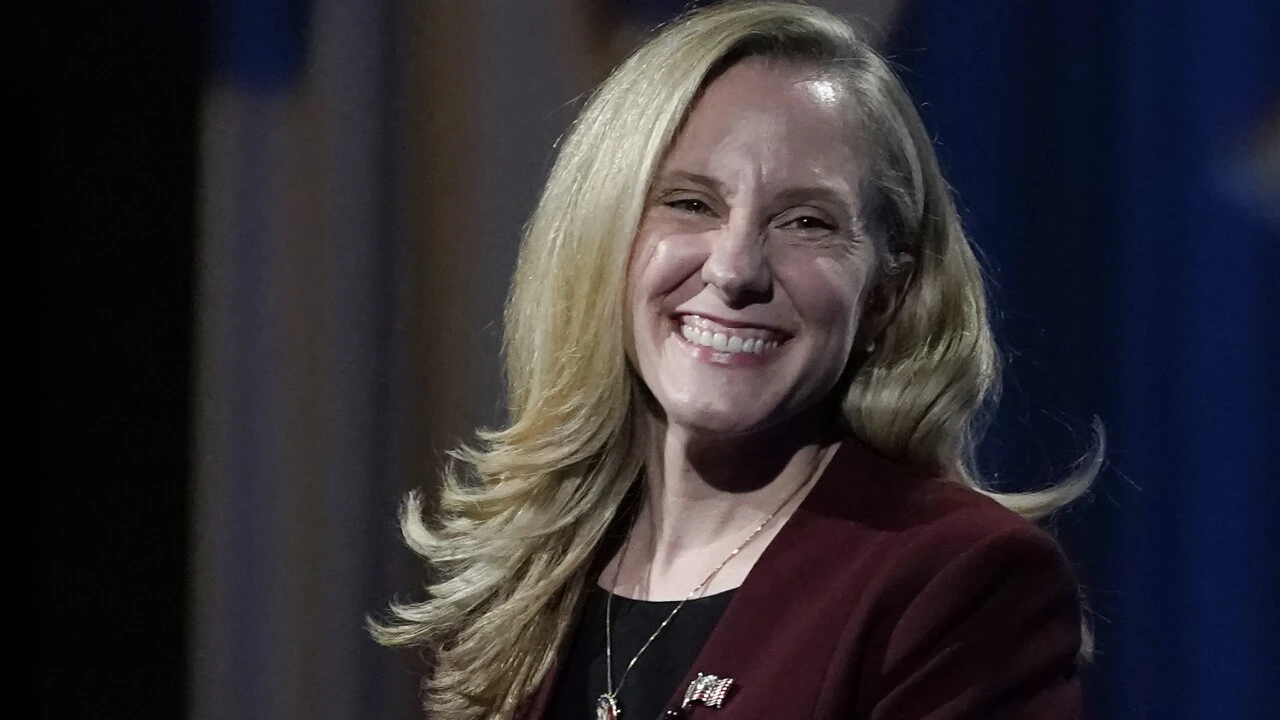
RICHMOND, Va. — Democrat Abigail Spanberger won the Virginia governor’s race Tuesday, becoming the first woman to lead the commonwealth and marking a major victory for Democrats in a state that has steadily shifted blue.
The Associated Press projected Spanberger’s victory over Republican Lt. Gov. Winsome Earle Sears after partial results showed her leading 55% to 45% with about one third of votes counted.
Spanberger, a former CIA officer and three term congresswoman, will succeed Republican Gov. Glenn Youngkin, who was barred from seeking consecutive terms.
“This is not just my win it’s Virginia’s win,” Spanberger told supporters in Richmond. “Tonight, we proved that practical leadership and compassion can overcome division.”
Spanberger, 45, represented Virginia’s 7th Congressional District after flipping a Republican held seat in 2018. Known for her bipartisan style, she built her campaign around affordability, healthcare, and public service.
Her opponent, Earle Sears, the first woman of color elected to statewide office in Virginia, campaigned with the backing of former President Donald Trump and focused on cultural and ideological issues.
Despite strong support from conservative rural areas, she struggled to match Spanberger’s appeal in suburban counties. Virginia’s gubernatorial races often mirror national trends.
Since 1976, the party not occupying the White House has typically won the governor’s mansion, with one exception. Spanberger’s win breaks that pattern, signaling potential Democratic momentum ahead of the 2026 midterms.
“Spanberger’s victory shows Virginia’s ongoing transformation from a battleground to a reliably Democratic state,” said Mark Rozell, dean of George Mason University’s Schar School of Policy and Government. “She succeeded by appealing to moderates and independents who want stable governance.”
Analysts viewed the Spanberger Virginia race as a test of centrist politics in a polarized era. Her disciplined campaign emphasized results over rhetoric, focusing on lowering living costs, strengthening healthcare access, and improving education.
“She kept her distance from national controversies and instead highlighted her record as a problem solver,” said Dr. Natalie Jennings, a political analyst at the University of Virginia. “That approach resonated with suburban voters who are tired of partisanship.”
While Spanberger avoided direct criticism of Trump, her opponent leaned heavily on his endorsement. The Democrat’s campaign team described that as a key contrast between “governing for all Virginians” and “governing for a faction.”
Spanberger also benefited from the presence of former President Barack Obama, who joined her at a late campaign rally in Norfolk. “We do not need leaders who dismiss real economic struggles,” Spanberger said at the event. “We need leaders who understand public service as duty, not division.”
According to early data from the Virginia Department of Elections, turnout was high in the state’s Democratic strongholds particularly in Fairfax, Loudoun, and Henrico counties. Spanberger led Earle Sears by wide margins in suburban regions, while Republicans dominated rural counties in the southwest.
Pre-election polling showed Spanberger maintaining a stable lead of eight to ten points throughout October, driven largely by women and independent voters.
Democrats also appeared poised to expand their narrow one seat majority in the House of Delegates. In the attorney general race, Democrat Jay Jones held a narrow edge over Republican incumbent Jason Miyares, with 35% of votes counted.
Virginia’s shifting demographics have favored Democrats in recent cycles, as suburban growth and younger voters reshape the electorate. Spanberger’s victory underscores that long term trend.
In Henrico County, school administrator Carol Miller said Spanberger’s message of “steady, thoughtful governance” won her vote.
“She doesn’t yell or attack people she listens,” Miller said. “That’s refreshing in today’s politics.”
In contrast, Earle Sears supporter and Navy veteran James Carter of Norfolk said he felt disappointed but not surprised. “Winsome fought hard, but Trump’s shadow hurt her. A lot of people just want calm again,” he said.
For many Virginians, Spanberger’s background as an intelligence officer and law enforcement official lent credibility to her campaign promises.
“She’s tough but level headed,” said Aisha Reynolds, director of the Richmond Women’s Civic Coalition. “Her win is symbolic for women across the state and practical for families who want results.”
Spanberger will take office in January with a Democratic controlled legislature and a long policy agenda focused on affordability, infrastructure, and healthcare expansion. Her team has also indicated plans to review education funding and housing policy.
“She inherits a politically divided state but also a real opportunity,” Rozell said. “If she governs effectively, Spanberger could become a major national figure in the Democratic Party.”
Republicans, however, have vowed to resist what they describe as “big government overreach.” Earle Sears, in her concession speech, said she would “continue to fight for the families and freedoms that make Virginia strong.”
Observers believe Spanberger’s bipartisan tone will be key to navigating the challenges ahead. Her emphasis on service and pragmatism could help her build coalitions across party lines a skill honed during her time in Congress.
Abigail Spanberger’s election as governor marks a new chapter in Virginia’s political history one defined by shifting demographics, moderate leadership, and the growing power of women in government.
Her victory in the Spanberger Virginia race highlights the enduring appeal of centrist politics in a divided era and signals a potential roadmap for Democrats seeking to reconnect with suburban and independent voters nationwide.
As the commonwealth turns the page, Spanberger faces the challenge of translating her historic win into lasting progress for the people she now governs from Richmond’s Capitol Square to the Blue Ridge and beyond.


