
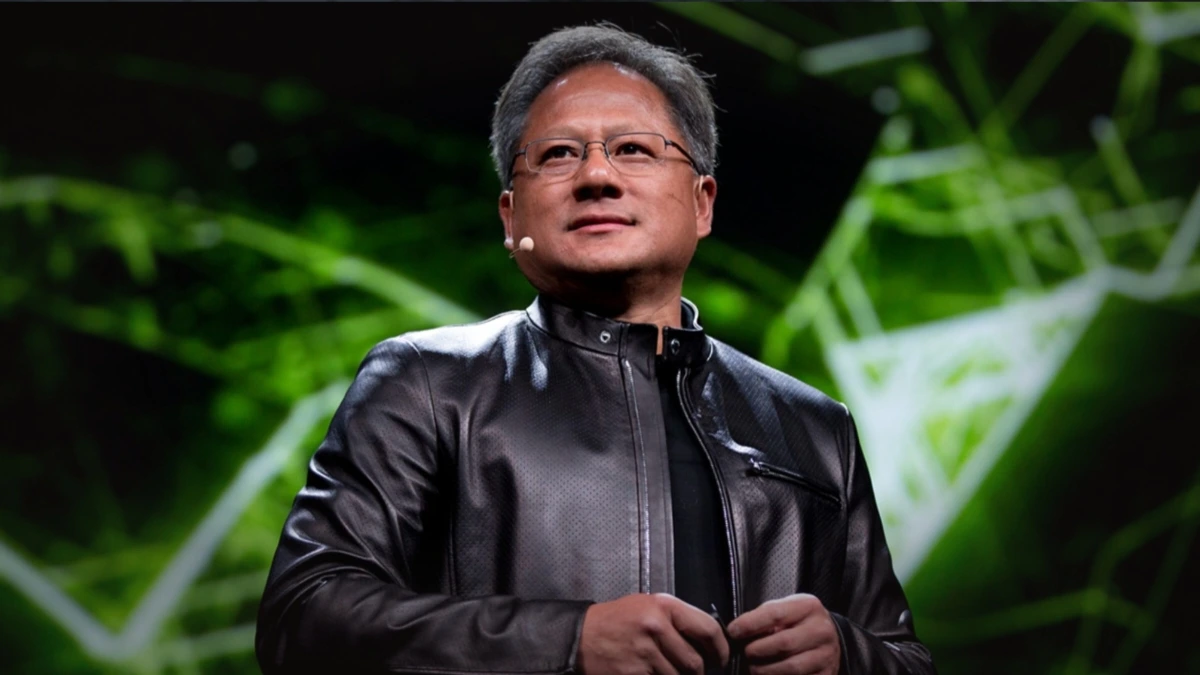
Nvidia Corp. Chief Executive Officer Jensen Huang reacted to the AMD OpenAI deal, calling it “imaginative” but “surprising” after Advanced Micro Devices Inc. offered OpenAI a warrant for up to 160 million AMD shares roughly 10% of the company.
Speaking on CNBC’s Squawk Box on Wednesday, Huang said he was taken aback by AMD’s move to tie equity to chip deployment milestones.
“I saw the deal. It’s imaginative. It’s unique and surprising considering they were so excited about their next generation product,” Huang said. “I’m surprised that they would give away 10% of the company before they even built it. Anyhow, it’s clever, I guess.”
The AMD OpenAI deal allows OpenAI to gain equity based on performance targets linked to AMD’s upcoming AI accelerators. The partnership follows OpenAI’s $100 billion infrastructure collaboration with Nvidia, announced last month, aimed at building next generation AI systems.
AMD’s Chief Executive Officer Lisa Su said the collaboration represents a “strategic alignment” to accelerate AI deployment. “This partnership enables us to expand our role in global AI infrastructure and meet growing demand for advanced computing,” Su said in a statement.
The arrangement highlights how chipmakers are competing not just with technology but with innovative deal structures to win partnerships with leading AI developers.
Market experts have described the AMD OpenAI deal as both creative and risky. While it could cement AMD’s role as a key supplier for OpenAI, it also exposes the company to potential dilution.
“AMD’s decision to offer up to a 10% equity stake is bold,” said Kevin Tanaka, a semiconductor analyst at CFRA Research. “It shows they’re serious about establishing themselves in AI hardware, but shareholders may question the cost of such a commitment.”
Some analysts, including short seller James Chanos, have warned that equity based agreements could complicate valuation metrics. “AMD is essentially trading ownership for promise,” Chanos said. “If the AI market cools, this may not age well.”
Huang, in contrast, said Nvidia’s relationship with OpenAI remains straightforward. “This is the first time we’re going to sell directly to them,” he said. “By doing so, we can help them prepare for the day they become a self-hosted hyperscaler.”
Nvidia continues to dominate the AI chip market with an estimated 80% global share, according to Omdia, while AMD holds less than 10%. Nvidia’s GPUs, such as the H100 and upcoming B200, remain the preferred choice for training large language models.
AMD’s MI300X accelerator central to the AMD OpenAI deal aims to close that performance gap. Analysts predict that if successful, AMD could capture up to 20% of the AI data center market by 2026.
“Nvidia still leads in both hardware and software integration,” said Elena Martinez, senior researcher at IDC. “But partnerships like AMD’s with OpenAI could help diversify the AI ecosystem and reduce Nvidia’s monopoly.”
Industry insiders and entrepreneurs are divided on the AMD OpenAI deal. “This move signals how aggressive AMD has become,” said Ahmed Khan, founder of an AI chip startup in San Francisco. “They’re giving OpenAI a real reason to invest in their hardware ecosystem.”
Others were more cautious. Ten percent is a lot of equity to give away, said Lauren McBride, a venture capital investor at Silicon Valley Capital. AMD may be overextending just to compete with Nvidia’s momentum.
Still, some engineers see the partnership as transformative. If AMD’s MI300X chips deliver, this could redefine the balance of power in AI computing, said Rakesh Patel, an Austin based AI hardware engineer.
As the AI chip arms race accelerates, both companies are preparing new product launches in 2025. Nvidia is focused on full-stack solutions from GPUs and CPUs to networking and software while AMD continues to emphasize openness and strategic alliances.
“We’re the only company in the world today that really focuses on building the entire AI infrastructure,” Huang said.
AMD, on the other hand, is betting that collaboration with developers like OpenAI can help close the performance gap faster. Analysts expect more hybrid equity and supply partnerships to emerge as AI demand skyrockets.
“AMD’s deal could set a precedent,” said Tanaka. “We might see chipmakers linking ownership with infrastructure commitments more often.”
Jensen Huang’s surprise at the AMD OpenAI deal underscores how unconventional the partnership is but also how fast the AI landscape is changing.
As AMD experiments with equity based collaborations and Nvidia doubles down on direct sales and infrastructure dominance, both companies are redefining what competition looks like in the trillion dollar AI era.
The success or failure of AMD’s gamble may ultimately depend on one thing: whether OpenAI’s next generation of AI systems runs faster, cheaper, and smarter on AMD chips.


