
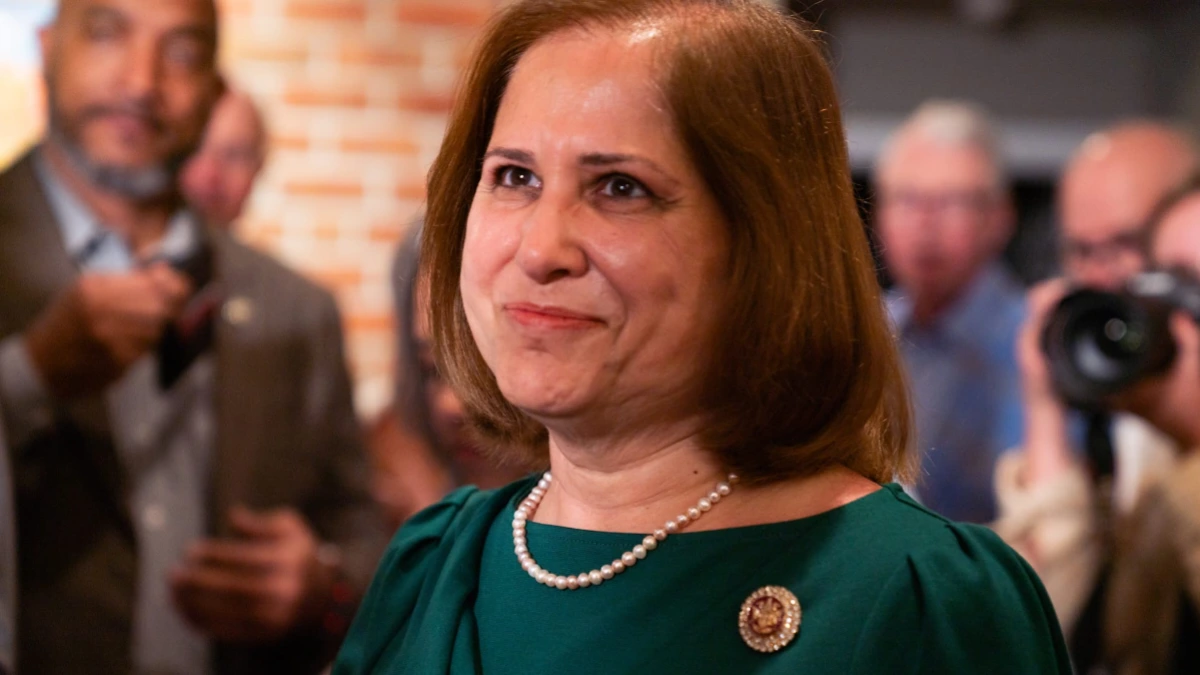
RICHMOND, Va. — Virginia state Sen. Ghazala Hashmi has been elected lieutenant governor, becoming the first Muslim American woman to win statewide office in the United States.
Her victory marks a historic milestone in both Virginia’s political landscape and the nation’s evolving record of representation in public office.
NBC News and the Associated Press projected Hashmi’s win Tuesday night, as results showed the Democrat defeating Republican candidate John Reid in a closely watched race.
The election took place alongside another historic outcome former Rep. Abigail Spanberger’s victory in the governor’s race, making her the first woman to serve as Virginia’s governor.
Hashmi, 61, first entered Virginia politics in 2019 when she became the first Muslim American woman elected to the state Senate.
Born in Hyderabad, India, she immigrated to the United States as a young woman and later earned a doctorate in English from Emory University.
Before entering politics, she worked as an educator and administrator in Virginia’s higher education system for more than two decades.
Her campaign for lieutenant governor emphasized economic relief, affordable childcare, and quality education. “We’re showing that Virginia embraces diversity and progress,” Hashmi said in her victory speech Tuesday night in Richmond.
“This win belongs to every community that has ever felt unseen or unheard.” Hashmi will succeed Lt. Gov. Winsome Earle Sears, the Republican who made history in 2021 as the first Black woman elected to statewide office in Virginia.
The lieutenant governor of Virginia presides over the state Senate and can cast tie breaking votes on legislation. The position is also the first in line to assume the governorship in case of death, resignation, or removal of the sitting governor.
Although the office carries limited executive authority, political strategists often view it as a springboard to higher office. Several former lieutenant governors, including Tim Kaine and Don Beyer, later ran for governor or Congress.
“While the position itself doesn’t drive policy, it provides a valuable platform,” said Dr. Laura Bennett, a political science professor at Virginia Commonwealth University.
“Ghazala Hashmi’s election is about more than symbolism it positions her as a key figure in shaping future Democratic leadership in Virginia.”
Virginia’s political environment has shifted dramatically over the past two decades, transforming from a reliably Republican state to a competitive battleground.
Hashmi’s campaign built on that trend by mobilizing suburban voters, young people, and immigrant communities in Northern Virginia and Richmond.
Her opponent, John Reid, a conservative talk-radio host, campaigned on reducing taxes and increasing parental rights in education.
Despite a competitive race, analysts said Hashmi’s message of inclusivity and economic opportunity resonated with an increasingly diverse electorate.
“Hashmi’s campaign reflected the priorities of modern Virginia education, affordability, and inclusion,” said Jamal Peters, a policy analyst at the Brookings Metro Center.
“Her appeal went beyond identity politics. She connected with working families who felt the pressure of rising costs.” Experts say Hashmi’s win carries broader implications for representation and party strategy ahead of the 2026 midterms.
Her success may inspire more Muslim Americans and women of color to run for office, particularly in states where representation remains limited.
“This victory underscores how demographic changes and civic engagement are reshaping American politics,” said Dr. Kevin Morales, an expert on political behavior at George Mason University.
“The fact that Virginia voters chose a Muslim woman for a statewide office reflects an electorate that values qualifications and shared issues more than background.”
Democratic National Committee Chair Ken Martin congratulated Hashmi, calling her campaign “a focused effort on lowering costs, expanding educational access, and strengthening Virginia’s economy.”
Republican strategists, meanwhile, acknowledged the challenge of regaining ground in suburban counties that have leaned Democratic in recent elections.
“We underestimated how much demographic change would impact turnout,” said one GOP consultant who worked on the Reid campaign.
Preliminary results show Hashmi receiving roughly 54 percent of the statewide vote, outperforming Democratic expectations in several swing regions.
She performed strongly in Northern Virginia’s suburban districts, Richmond’s urban core, and parts of Hampton Roads. Exit polls indicated strong support among women, first time voters, and college educated independents.
Among Muslim and South Asian voters, turnout reached record levels, according to early data from the Virginia Department of Elections.
Virginia’s increasing diversity is also reflected in its leadership Hashmi joins Spanberger in forming the state’s first all female executive team.
This follows a national pattern of rising representation among women, Muslim Americans, and immigrants at all levels of government.
Reactions across Virginia reflected a mix of pride, hope, and cautious optimism. “This is a powerful moment for my daughters,” said Aisha Khan, a Fairfax County resident.
“They see someone who looks like them winning not just because she’s different, but because she’s qualified.” Others emphasized Hashmi’s record over her background.
“I supported her because she worked hard for our community,” said Thomas Greene, a retired teacher from Chesterfield. “She’s focused on real issues schools, small businesses, and cost of living.”
Even some opponents expressed respect for her achievement. “We might disagree on policy, but her campaign was disciplined and authentic,” said Mike Harrison, a Republican voter in Virginia Beach. “That earns respect.”
Hashmi will be inaugurated in January 2026, joining Governor elect Abigail Spanberger in leading a state that continues to serve as a political bellwether.
Her immediate priorities include tackling the rising cost of childcare, improving access to education, and supporting small business growth.
Political observers say Hashmi’s next challenge will be translating her historic win into tangible legislative impact. “She’ll have to navigate a politically divided Senate while managing expectations that come with being a trailblazer,” said analyst Martha Lewis.
Hashmi has not ruled out future statewide ambitions, but for now, she says her focus is on governing. “This election wasn’t about me it was about us,” she said during her victory speech. “Virginia showed the country that unity and progress are stronger than fear.”
Ghazala Hashmi’s election as lieutenant governor marks a defining moment for both Virginia and the nation. As the first Muslim American woman elected to statewide office in the United States, her win symbolizes growing inclusivity in American democracy.
The months ahead will test how she turns that symbolism into action, but for many Virginians, her victory already stands as proof of a state and a nation ready to embrace change.


