
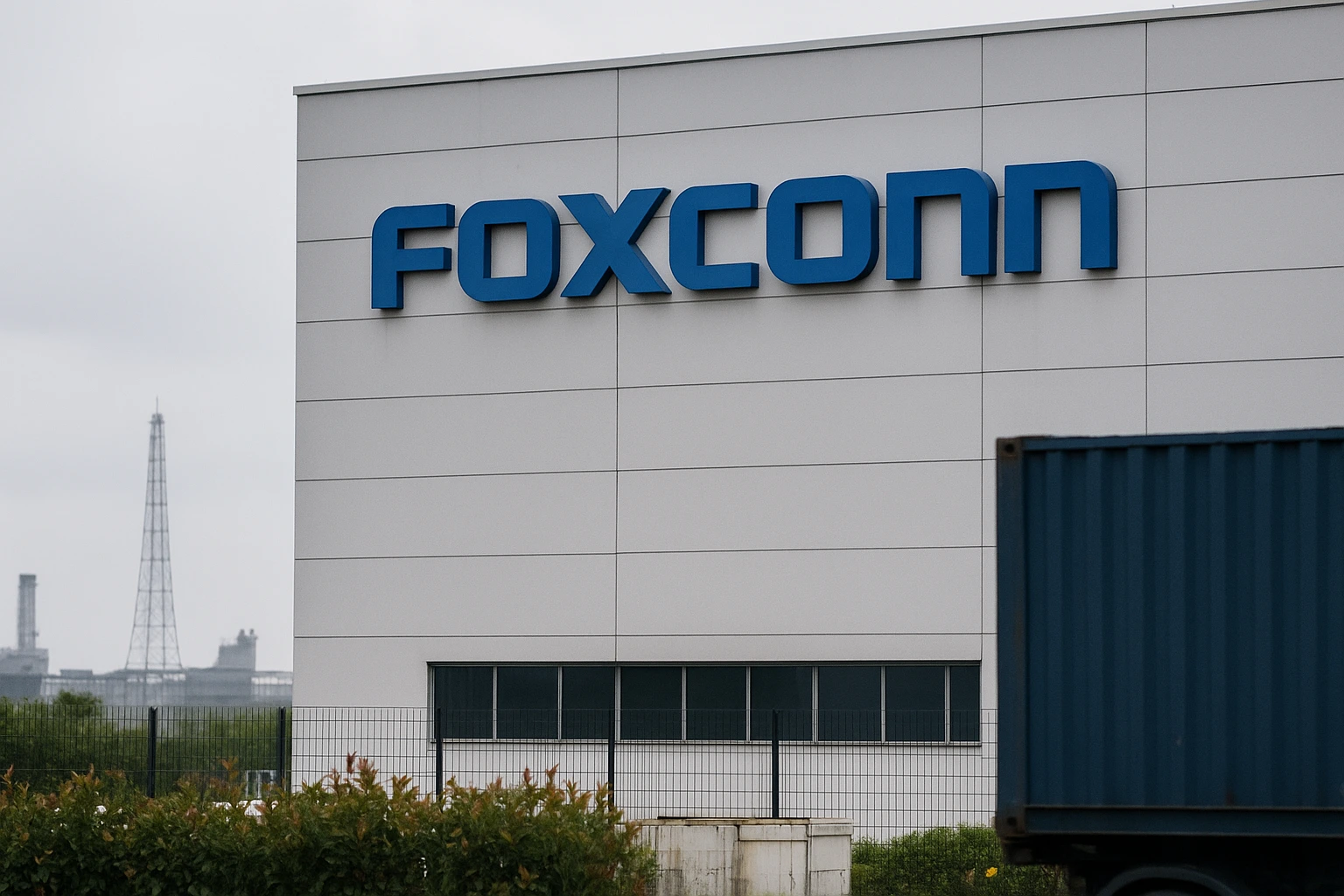
TAIPEI — Taiwan’s Foxconn said Wednesday it expects little immediate disruption from China’s newly expanded rare earth export restrictions, though company officials warned that prolonged trade tensions could eventually affect global industries.
“If the ongoing restrictions continue to escalate tensions, it will impact industries across the board, not just Foxconn,” Chairman Young Liu told reporters in Taipei. “In the short term, the current impact is likely limited.”
Foxconn, officially known as Hon Hai Precision Industry Co., is the world’s largest contract electronics manufacturer, assembling products for major technology firms such as Apple and Nvidia.
The company’s reassurance comes as China expands its control over rare earth exports critical elements used in semiconductors, batteries, and electric vehicles.
China’s latest move adds five new rare earth elements to its restricted export list and introduces stricter oversight for semiconductor related shipments.
The measures are part of Beijing’s broader strategy to tighten control over high tech supply chains as geopolitical friction with the United States intensifies.
China currently accounts for about 70% of global rare earth production, giving it significant leverage over industries that depend on these materials.
The export curbs follow US restrictions on advanced semiconductor technology sales to Chinese firms, further heightening trade tensions between the world’s two largest economies.
“China’s dominance in rare earths has long been both an asset and a political tool,” said Dr. Mei-Ling Chen, a trade expert at National Chengchi University in Taipei. “These latest curbs send a signal to Washington that Beijing still holds critical cards in the global tech game.”
Analysts believe Foxconn’s vast global footprint and diversified sourcing strategy will cushion it from immediate supply shocks.
The company maintains multiple supply chains across Asia and has expanded production outside China in recent years, including new facilities in India and Vietnam.
“Foxconn is better positioned than smaller manufacturers to absorb temporary supply disruptions,” said James Wu, senior analyst at TrendForce, a Taipei based research firm.
“But if export controls persist or rare earth prices surge, no one in the electronics sector will be completely immune.”
Rare earth materials such as neodymium and dysprosium are essential to producing high performance magnets, batteries, and chips.
Even a small delay or cost increase can disrupt production cycles for companies like Foxconn, which makes Nvidia’s AI servers and Apple’s iPhones.
Foxconn recently posted record third quarter revenue, boosted by strong demand for AI hardware and next generation consumer devices.
However, global investors remain cautious about how escalating trade restrictions could affect long term supply stability.
According to the US Geological Survey, China exported around 51,000 metric tons of rare earth compounds and metals in 2024, representing nearly two thirds of global exports.
Taiwan sources approximately 15% of its rare earth imports directly or indirectly from China. When China last restricted rare earth exports in 2010 after a diplomatic dispute with Japan, global prices surged more than 200% within six months.
Industry analysts warn that a similar shock could occur if the latest curbs intensify. “Even limited restrictions can ripple through global markets,” said Alex Tan, chief economist at the Taiwan Institute for Industrial Economics.
“Manufacturers begin to stockpile materials, driving up costs, and that pressure spreads across the supply chain.” On Foxconn’s production lines in Taoyuan, Taiwan, the mood remains calm but cautious.
“For now, we haven’t experienced any disruption in materials,” said Li Wei, a mid level operations manager at one of Foxconn’s facilities.
“Still, everyone knows that if tensions rise further, the effects could come quickly.” Smaller suppliers, however, worry they could face bigger challenges.
We don’t have Foxconn’s buying power, said Kevin Huang, who runs a small electronics component company in Taipei. “If customs checks tighten or prices spike, it could delay shipments and hurt our profit margins.”
Chairman Liu revealed that he recently met with OpenAI CEO Sam Altman to explore potential areas of collaboration, signaling Foxconn’s growing interest in AI infrastructure and data center technology.
Although Liu provided few details, analysts view the talks as part of Foxconn’s effort to diversify away from heavy reliance on consumer electronics manufacturing.
Foxconn is positioning itself for the AI era, said Dr. Chen. “If rare earth supply becomes unpredictable, pivoting toward advanced computing and cloud hardware could provide a strategic buffer.”
Beijing has yet to clarify whether its new export rules will extend to refined rare earth products or finished components containing these materials.
For now, the uncertainty has prompted global manufacturers to reassess sourcing and consider alternatives from the United States, Australia, and Southeast Asia.
“China’s policy may not bite immediately, but it has created a climate of anxiety in global supply chains,” said Wu. “Foxconn’s measured response shows both confidence and awareness of the risks ahead.”
Foxconn’s calm response to China’s rare earth export curbs reflects a broader resilience within Taiwan’s high tech sector, built over years of navigating geopolitical uncertainty.
Still, the company’s warning about potential long term repercussions underscores how fragile the global electronics supply chain remains.
For now, the impact appears limited but the situation could shift quickly if political tensions escalate or if China expands its export restrictions.
As one of the world’s most critical links in the technology ecosystem, Foxconn is walking a careful line between stability and vigilance.


