

SUMMARY
- Willie Colón helped shape the New York salsa sound during the genre’s formative decades.
- His 1978 collaboration “Siembra” remains one of the best selling salsa albums in history.
- Colón bridged salsa, Latin jazz and later reggaeton, influencing generations of Latin artists.
Willie Colón, the trombonist, bandleader and producer whose brassy arrangements and streetwise image helped define New York salsa music, died Saturday at age seventy five, his family announced on Facebook. No cause of death was provided.
Colón’s death marks the passing of a central architect of modern salsa, a genre that emerged in New York City during the politically charged nineteen sixties.
As a performer and producer associated with Fania Records, he helped transform Caribbean dance rhythms into a global commercial force rooted in Latino identity and urban experience.
Born William Anthony Colón Román on April 28, 1950, in the South Bronx, Colón was raised by his Puerto Rican grandmother, who introduced him to traditional island music.
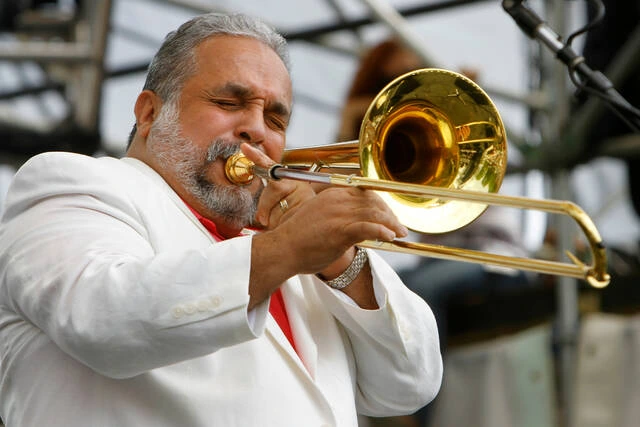
He began playing trumpet at eleven before switching to valve trombone at fourteen, drawn to what he described in a 2006 interview with The Miami Herald as its “roar.”
At seventeen, he recorded his debut album, “El Malo,” launching a partnership with Puerto Rican singer Héctor Lavoe.
The pairing combined Lavoe’s improvisational vocals with Colón’s trombone heavy arrangements, producing hits that reflected barrio life and urban struggle.
In 1978, Colón partnered with Panamanian singer songwriter Rubén Blades on “Siembra,” widely regarded as a landmark of socially conscious salsa.
The album included “Pedro Navaja,” inspired in part by The Threepenny Opera, and expanded salsa’s narrative scope beyond dance music.
Colón later recorded with artists including Celia Cruz and Tito Puente. In 2004, the Latin Recording Academy honored him with a lifetime achievement award. In 2015, Billboard named him among the thirty most influential Latin artists.
Frances R. Aparicio, professor emerita of Latino and Latin American studies at Northwestern University, said Colón’s arrangements “shifted salsa from ballroom elegance to urban assertion,” embedding trombone driven textures that conveyed grit and immediacy.
Wayne Marshall, ethnomusicologist at Berklee College of Music, said Colón’s collaborations “institutionalized the New York salsa sound while keeping it politically resonant.”
He noted that “Siembra” arrived during debates about Latino representation in US cities and provided “a soundtrack for diasporic identity.”
Marshall added that Colón’s later embrace of reggaeton demonstrated continuity rather than rupture. “He recognized in reggaeton the same street level innovation that fueled early salsa,” he said.
Rosa Torres, executive director of the Bronx Music Heritage Center, said Colón’s career “validated the creative power of working class Latino neighborhoods.”
“He made the South Bronx audible to the world,” Torres said. Miguel Pérez, a New York based salsa bandleader who performed Colón’s arrangements, said his trombone lines remain foundational.
“When young musicians learn salsa phrasing, they are still studying Willie Colón,” Pérez said. Music historians said Colón’s catalog is likely to remain central to academic study and digital streaming audiences as interest in classic salsa endures globally.
Cultural institutions in New York and Puerto Rico have increasingly archived salsa-era recordings to preserve the genre’s history.
Willie Colón’s career spanned nearly six decades, shaping the New York salsa sound through innovation, collaboration and cultural advocacy.
From “El Malo” to “Siembra,” his work helped define salsa as both dance music and a vehicle for Latino expression, securing his place in the history of popular music.
NOTE! This article was generated with the support of AI and compiled by professionals from multiple reliable sources, including official statements, press releases, and verified media coverage. For more information, please see our T&C.


