
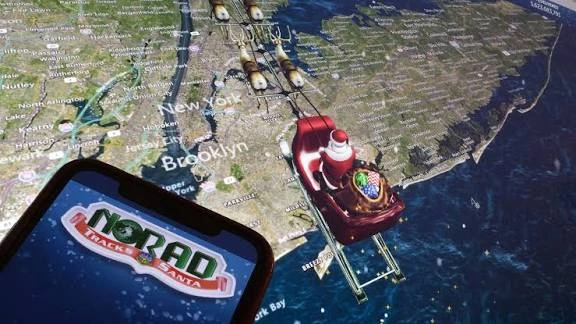
As families around the world settle in on Christmas Eve, a familiar question returns Where is Santa right now? For millions, the answer comes from the NORAD Santa tracker, a decades old holiday tradition run by the North American Aerospace Defense Command that monitors Santa Claus’ global gift giving journey in real time.
Beginning at midnight on Dec. twenty-four, NORAD’s online platform uses satellite imagery, radar simulation and animated graphics to chart Santa’s sleigh as it departs the North Pole and travels across continents.
By early evening, the tracker showed Santa had delivered more than one point three billion gifts worldwide, according to NORAD’s website.
The NORAD Santa tracker traces its roots to nineteen fifty five, when a Colorado newspaper advertisement mistakenly printed the unlisted phone number of the Continental Air Defense Command instead of a Santa hotline.
A child dialed the number expecting Santa Claus. Rather than dismiss the call, Air Force Col. Harry Shoup instructed his staff to check radar systems for Santa’s location.
The gesture became an annual tradition, carried forward when NORAD was formally established in nineteen fifty eight as a joint US Canadian military organization.
“NORAD was built to watch the skies for threats,” said Maj. Gen. Emily Larson, a NORAD spokesperson. “Once a year, we use those same capabilities to create something joyful and unifying.”
While the tracker is symbolic, experts say its endurance reflects how institutions can humanize complex systems.
“Military organizations are often viewed as distant or technical,” said Dr. Alan Brewster, a historian at the University of Denver who studies Cold War era defense agencies.
“The NORAD Santa tracker reframes surveillance technology into a story of imagination, which helps build public trust in a subtle way.”
Brewster noted that the tracker also serves as an early introduction to geography and time zones for children. “It’s education wrapped in wonder,” he said.
NORAD officials said the tracker attracts tens of millions of visitors annually from more than two hundred countries.
Last year, the program logged roughly twenty million website visits and more than three hundred thousand phone calls to its dedicated hotline, 877-HI-NORAD.
The operation relies on about one thousand volunteers each Christmas Eve, including military personnel and civilian partners.
Volunteers provide updates by phone, email and social media, offering location details based on the NORAD Santa tracker’s animated data feed.
Compared with early versions that relied on radio broadcasts, today’s system integrates high resolution mapping, cloud-based servers and multilingual support.
For families, the experience remains personal. “My kids track Santa every year before bed,” said Maria Gonzalez, a mother of two in San Antonio. “It’s one of the few traditions that feels the same no matter how much technology changes.”
In Toronto, eight year old Liam Chen said he checks the tracker “to make sure Santa already went to Europe before coming here.”
NORAD volunteers say those moments are why they participate. “You hear kids whispering so Santa won’t hear them on the phone,” said retired Air Force technician Mark Reynolds, who has volunteered for six years. “It reminds you why traditions matter.”
NORAD officials said the Santa tracking program will continue to evolve with technology but remain free and accessible.
“We adapt the platform each year,” Larson said.
“But the mission stays the same: to bring a little joy and connection on a night that means so much to so many.”
The organization has explored expanded accessibility features and additional language support as international interest grows.
From a misprinted phone number to a global digital tradition, the NORAD Santa tracker has become a fixture of Christmas Eve for generations.
As Santa’s animated sleigh moves across time zones, the tracker continues to blend history, technology and storytelling into a shared seasonal ritual, quietly reminding millions where Santa is right now.


