
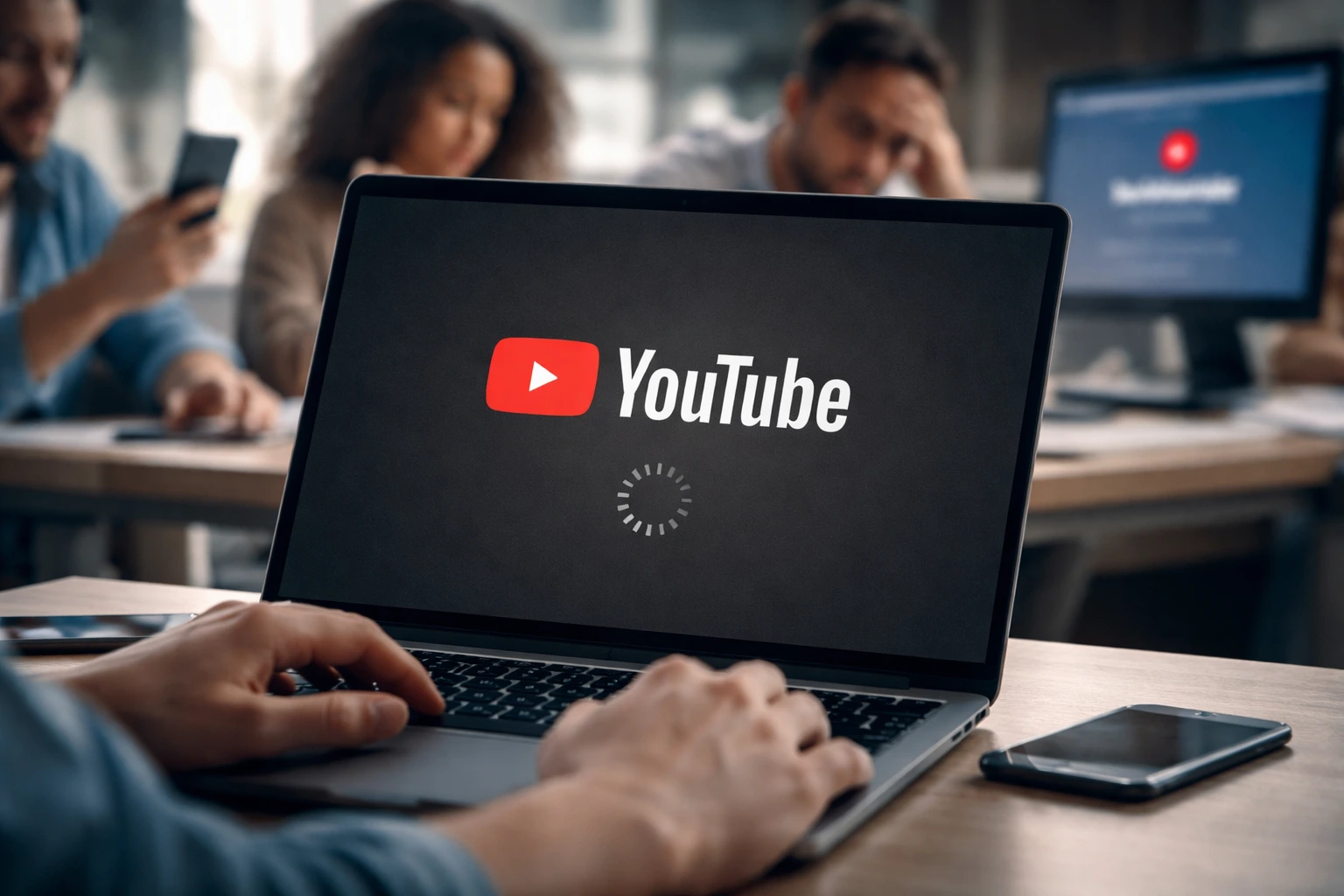
YouTube down reports surged across the United States early Friday after thousands of users said they were unable to access the popular video streaming platform, according to outage tracking website Downdetector.
The disruption affected both mobile and desktop users and appeared to peak during morning hours on the East Coast, raising concerns about the reliability of one of the world’s largest digital platforms.
Downdetector recorded more than ten thousand eight hundred user reports of problems with YouTube as of eight fifteen a.m. Eastern Time. The reports included complaints about videos failing to load, buffering issues and complete service outages.
Google, YouTube’s parent company, acknowledged awareness of the issue and said engineers were working to determine the cause.
YouTube, owned by Alphabet Inc.’s Google, is one of the most widely used streaming services globally, with billions of users relying on it daily for news, entertainment and educational content.
Any interruption, even brief, can have ripple effects across media, advertising and creator communities. Service disruptions are not uncommon for major technology platforms, though large scale outages often draw scrutiny due to their economic and social impact.
Friday’s incident follows a series of high profile outages across the tech sector in recent months, affecting platforms ranging from social media to cloud computing services.
In a brief statement, Google said it was “aware that some users were experiencing issues accessing YouTube” and that teams were investigating. The company did not immediately provide details on the root cause or estimated time for full restoration.
Technology analysts said the YouTube down event highlights how dependent users have become on centralized digital platforms.
“When a service as dominant as YouTube goes offline, even temporarily, it exposes how fragile digital infrastructure can be at scale,” said Daniel Mercer, a senior analyst at Silicon Valley based firm NetWatch Research.
“Most outages are resolved quickly, but the perception of instability can still affect user trust.” Cybersecurity and network experts cautioned against speculation, noting that outages can stem from routine system updates, traffic surges or internal configuration errors rather than cyberattacks.
“At this stage, there is no public evidence suggesting malicious activity,” said Priya Nandakumar, a network resilience consultant. “Most large platforms experience intermittent failures as part of managing enormous volumes of data.”
Downdetector data showed the majority of reports came from major metropolitan areas including New York, Los Angeles, Chicago and Dallas. Roughly sixty percent of users reported video playback issues, while others cited problems logging into their accounts or accessing YouTube’s homepage.
Compared with previous YouTube outages, Friday’s disruption appeared moderate in duration but significant in volume. In November last year, a similar incident generated fewer than eight thousand reports nationwide before services stabilized.
The spike in reports suggested the outage may have coincided with peak morning usage, when users often turn to YouTube for news updates, music and podcasts during commutes.
For many users, the outage caused inconvenience rather than alarm.
“I use YouTube every morning to watch market updates while getting ready for work,” said Marcus Hill, a financial analyst in Boston. “Everything just kept buffering, and then nothing would load.”
Content creators also felt the impact, particularly those who rely on early day uploads for visibility.
“When YouTube is down, even for an hour, it affects views and ad revenue,” said Elena Rodriguez, a lifestyle content creator based in Austin. “It’s a reminder that creators don’t control the platform they depend on.”
Some educators said the outage disrupted planned lessons, especially in schools that integrate online video into classrooms.
Google did not say whether the outage would prompt changes to YouTube’s infrastructure or redundancy systems. Industry observers expect the company to publish a post incident report if the issue is traced to internal systems.
As digital platforms continue to scale, experts say occasional outages are likely unavoidable, though transparency and rapid response remain critical.
“Users understand that systems fail,” Mercer said. “What matters is how quickly companies communicate and restore service.”
By late morning, Downdetector reports showed a gradual decline, suggesting that YouTube services were stabilizing for many users, though some continued to experience intermittent issues.
The YouTube down incident on Friday disrupted access for thousands of users across the United States, underscoring the widespread reliance on major streaming platforms.
While Google moved to address the problem, the outage served as a reminder of the challenges inherent in maintaining always on digital services at global scale.


