
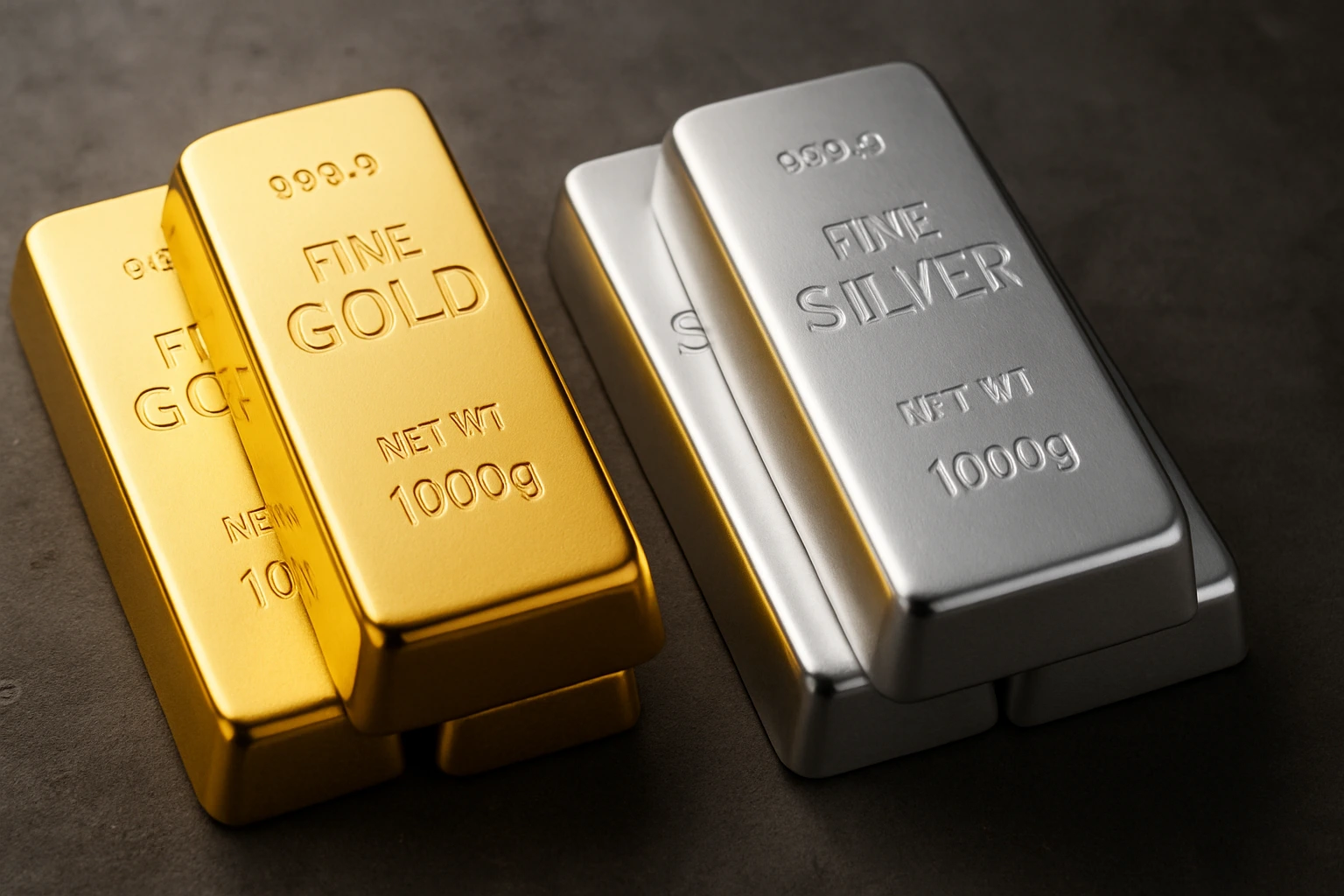
Gold slipped on Thursday after the Federal Reserve delivered a divided interest rate cut that left markets questioning how aggressively policymakers will ease next year.
The move contrasted sharply with silver, which surged to another all time high on strong industrial demand and dwindling inventories.
The developments come as investors digest mixed signals from the Fed and brace for key US economic data in the weeks ahead. Gold slips after Fed rate cut appeared prominently in early trading commentary.
Spot gold fell 0.4 percent to $4,210.88 per ounce by late morning in Asia, retreating from a near one week high reached earlier in the session.
US gold futures for February delivery rose 0.3 percent to $4,238.10, reflecting cautious buying despite the uncertainty. The decline followed the Fed’s decision late Wednesday to lower its benchmark rate by twenty five basis points, a move approved by a narrow majority.
While most policymakers indicated they expect to cut rates again in the coming year, six officials opposed the move, marking one of the most divided votes in recent history.
Fed Chair Jerome Powell emphasized that inflation “remains somewhat elevated” and declined to offer guidance on the timing of any additional reductions.
Lower rates typically support precious metals by reducing the opportunity cost of holding non yielding assets, but analysts noted that the split decision and vague outlook muted enthusiasm.
“Gold has been unable to kick on with things today because the Fed’s message was essentially that any further rate cuts could be few and far between,” said Tim Waterer, chief market analyst at KCM Trade.
He added that the hesitation reflected lingering inflation concerns and a labor market that has not yet cooled decisively.
Ilya Spivak, head of global macro at Tastylive, said silver’s behavior diverged sharply from gold despite the same macro backdrop.
“Silver hasn’t really paid attention to things outside and has been rallying all by itself,” he said. “I don’t think there’s anything here that would necessarily suggest that silver is going to turn.”
Analysts noted that the dynamic illustrated a broader theme this quarter: gold slips after Fed rate cut uncertainty, while silver benefits from structural industrial demand.
Dr. Mariam Lee, a fictional commodities economist at the University of Melbourne, said the Fed’s fragmentation could weigh on gold for several weeks.
“Markets prefer clarity. The divided vote reinforces the perception that the Fed is struggling to identify a clear path forward,” she said. Silver rose 0.2 percent to $61.90 per ounce after climbing to a record $62.88 earlier in the day.
Its gains this year now total 113 percent, driven by shrinking global inventories, rising demand from solar panel manufacturers and electronics producers, and its recent addition to the US critical minerals list.
Gold, meanwhile, has traded in a narrower range despite geopolitical tensions and steady investor inflows. Analysts said the contrasting performance reflects differing supply demand dynamics more than monetary policy alone.
“Gold slips after the Fed rate cut because the market sees limited catalysts in the near term,” said Fahad Noor, a Karachi-based metals trader. “Silver has a real story behind it. Gold is waiting for one.”
Upcoming US data may influence both markets. Investors are watching November jobs numbers, inflation readings and a revised third quarter GDP report for clues about whether the Fed will maintain a cautious stance.
Local jewelers and investors across Asia reported mixed reactions to the Fed decision. In Dubai’s Gold Souk, shop owner Rahim Siddiq said customers appeared hesitant.
“People thought the rate cut might push gold higher quickly, but the divided vote created confusion,” he said. “Some are waiting to see what happens with the jobs report next week.”
In Singapore, retail investor Anne Chow said she was shifting part of her portfolio toward silver. “Gold slips after Fed rate cut uncertainty, but silver is moving because factories need it,” she said. “It feels like the more resilient bet right now.”
Meanwhile, manufacturers in South Korea noted the strain of rising silver prices. “Our raw material costs have doubled in a year,” said Park Soo-min, who manages a solar components factory near Busan. “We are watching every economic signal closely.”
Economists expect precious metals to remain sensitive to shifts in Fed expectations. If inflation cools and labor market data softens, traders anticipate the central bank may deliver one or two additional cuts next year.
However, a stronger than expected data cycle could push policymakers toward a more hawkish posture, keeping gold subdued.
Silver’s outlook appears more firmly tied to industrial expansion. Analysts expect solar manufacturing capacity to grow sharply in 2025, placing sustained pressure on tight inventories.
“Gold slips after Fed rate cut decisions like this because the market is starved for direction,” said economist Lee. “Silver has direction already, and that is what makes its rally more durable for now.”
The Fed’s divided rate cut reshaped sentiment across precious metals markets, sending gold modestly lower while silver continued its record breaking ascent.
As investors await key US data, both metals remain poised for volatility, though analysts believe silver’s industrial driven boom may keep it outperforming gold in the near term.


