
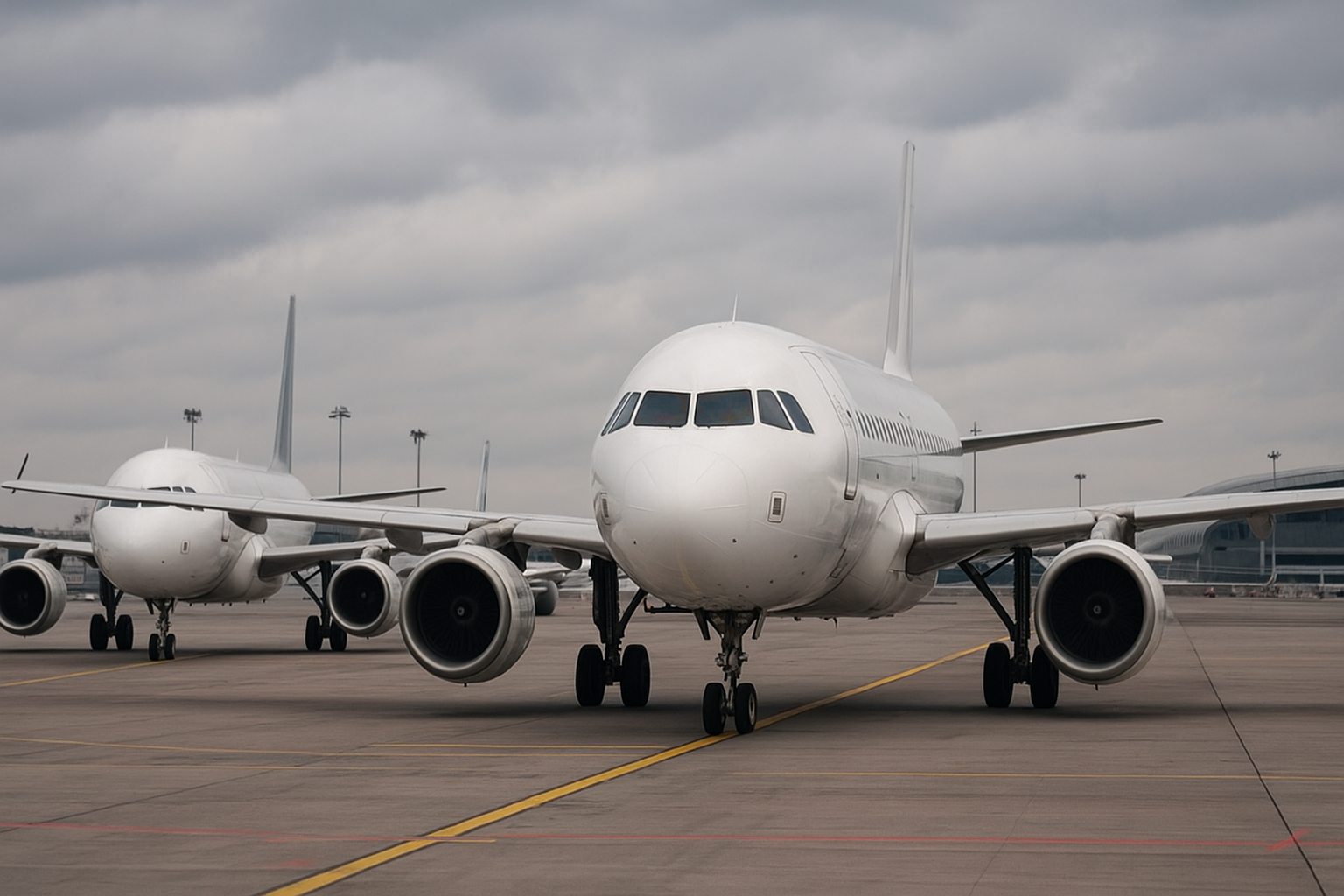
Flights across several continents began returning to normal on Saturday after an Airbus warning grounded planes for hours, disrupting thousands of passengers during one of the busiest travel periods of the year.
Airlines and transport officials said a rapid global push to install software updates helped restore most Airbus A320 family aircraft to service by early morning.
Airbus said the temporary grounding was triggered by a risk that intense solar radiation could interfere with flight control computers on certain models, prompting what officials described as one of the largest aviation disruptions in recent memory.
The grounding followed an incident in October, when a JetBlue flight traveling between the United States and Mexico suddenly lost altitude and made an emergency landing.
Investigators later traced the problem to corrupted data within the aircraft’s elevation calculation system, which Airbus determined could be caused by bursts of solar radiation.
The warning affected roughly 6,000 Airbus A320 family aircraft, including the A318, A319, A320 and A321. Airbus said more than 5,000 aircraft required only a brief software update, while about 900 older jets needed a full onboard computer replacement.
French Transport Minister Philippe Tabarot said the update rollout across Europe “went very smoothly,” adding that Airbus had assured him fewer than one hundred planes still required the fix.
“Software updates were already rolled out overnight on virtually all devices,” Tabarot said in comments to French media. By early Saturday, delays at major European hubs were tapering off.
Heathrow Airport reported no cancellations related to the alert, and disruptions at Gatwick were described as “limited.” In Germany, Frankfurt Airport officials said operations were “nearing normal levels” by late morning.
Aviation analysts said the grounding highlighted both the resilience and the vulnerabilities of modern aircraft, which increasingly rely on highly sensitive digital systems.
Dr. Marianne Keller, an aerospace safety researcher at the University of Zurich, said the incident shows how rare environmental events can trigger cascading impacts.
“Solar radiation at high altitudes is not new, but the density and unpredictability of solar storms have increased,” Keller said.
“What happened this week demonstrates how crucial it is for flight computers to be shielded against data corruption.”
She added that the Airbus response was “swift and appropriate” given the potential safety risk. “Grounding is always the last resort, but in this case the risk warranted decisive action.”
Retired commercial pilot Aaron Hughes said similar computer vulnerabilities have been identified in other aircraft families in the past, but not on this scale.
“What set this apart was the fleet size involved and the timing,” Hughes said. “Rolling out a global fix during a peak travel weekend is extremely challenging, but it appears airlines managed it better than expected.”
Airbus said the grounding affected approximately, 6,000 A320 family aircraft. 5,100 models requiring software updates, 900 older jets requiring hardware replacement.
In the United States, American Airlines reported that about 340 aircraft were impacted, while Delta Air Lines said disruptions would likely remain limited.
The rollout coincided with the Thanksgiving holiday weekend, one of the heaviest travel periods of the year for US airlines. The disruptions were felt unevenly around the world.
Europe: Mostly resolved within hours
United States: “Some operational delays,” according to American Airlines
Australia: Jetstar canceled ninety flights and warned of ongoing impacts
India and Middle East: Minimal disruptions reported
Compared with previous aircraft wide groundings, such as the Boeing 737 Max in 2019, analysts said this event was shorter but broader, affecting more flights over a condensed time window.
For travelers, the abrupt grounding created confusion, particularly in cities already overwhelmed with holiday congestion.
“I was supposed to fly to Dallas for a family reunion, but the airline told us the plane needed a software update before boarding,” said Nathan Ortiz, a passenger waiting at Chicago O’Hare International Airport.
“I’ve never heard of something like this happening, but the staff kept us updated and we eventually got out.” In Paris, travelers described similar delays.
It wasn’t chaotic, but there were a lot of people asking questions, said Marie Lefevre, who missed her connection to Rome after waiting two hours for her flight to depart. The airlines seemed as surprised as we were.
Airline workers also felt the strain. “We were getting instructions almost minute by minute,” said Sara Mitchell, a gate agent for a U.K. budget carrier. “Everyone wanted the same answer: when will the planes fly again? We could only say once the update finished.”
Airbus said it is working with carriers to speed up the replacement of computers on older jets. The timeline will depend largely on how quickly those components can be manufactured and distributed.
Keller, the safety researcher, said the incident may accelerate conversations about reinforcing digital systems across fleets. “This will likely push regulators to consider new standards for radiation resistant computing,” she said.
Airlines expect lingering disruptions for aircraft awaiting hardware replacement, particularly in regions with smaller fleets and limited maintenance capacity.
Jetstar in Australia warned that disruptions could extend into next week, even though most of its affected aircraft have already been updated.
Despite the challenges, aviation authorities stressed that safety protocols worked as intended. “Grounding planes is never ideal, but the system functioned exactly as it should,” said a spokesperson for the European Union Aviation Safety Agency.
A risk was identified, assessed and mitigated quickly. Operations across most major airports were stabilizing Saturday as airlines completed repairs triggered by the Airbus warning grounded planes incident.
While a small number of older jets will remain offline until computer systems are replaced, officials said the majority of the fleet has returned to normal service.
The episode underscored the growing complexity of modern aircraft and the importance of rapid global coordination when technical risks emerge.


