
SUMMARY
- Global participation in World Quantum Day signals rising public and policy interest in quantum technologies.
- Governments and private firms are increasing funding amid concerns over cybersecurity disruption.
- Education and workforce gaps remain a critical barrier to large scale quantum adoption.
The rapid transition of quantum science from theoretical physics to early stage commercial deployment has intensified global attention in 2026.
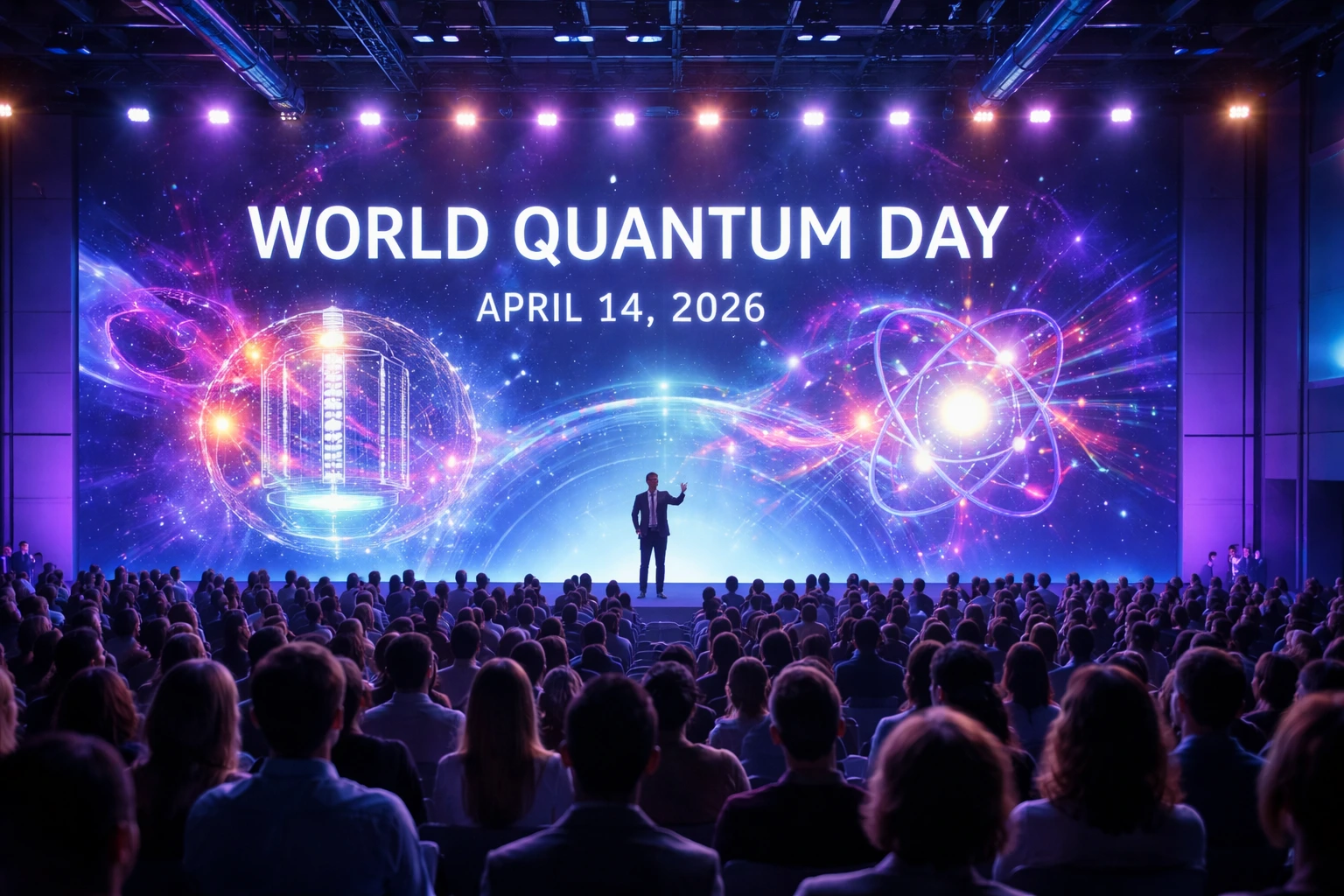
World Quantum Day serves as a focal point for public engagement at a time when governments and corporations are investing billions into quantum research.
While policymakers confront its disruptive implications for cybersecurity and economic competitiveness.
Launched in 2021 by an international coalition of researchers, World Quantum Day quickly evolved into a decentralized global event.
The initiative gained momentum following the United Nations’ designation of 2025 as the International Year of Quantum Science and Technology, marking a century since foundational breakthroughs.
By 2026, participation spans more than sixty-five countries, reflecting a shift from academic observance to mainstream awareness.
Quantum technologies are entering a critical phase of development. “We are moving from proof of concept systems to early industrial applications,” said Dr. John Preskill, professor of theoretical physics at the California Institute of Technology.
He noted that hybrid quantum classical systems are already demonstrating advantages in optimization and materials science.
At the policy level, governments are accelerating national strategies. Dr. Celia Merzbacher, executive director of the Quantum Economic Development Consortium, said workforce shortages remain a pressing challenge.
“Demand for quantum skilled professionals is outpacing supply, which could slow commercialization timelines,” she said. An underreported trend is the convergence of quantum investment with geopolitical competition.
Data from the Organisation for Economic Co-operation and Development shows that public funding across the United States, China and the European Union has surpassed $40 billion collectively.
This surge reflects concerns over quantum computing’s potential to compromise existing encryption standards, prompting parallel development of post quantum cryptography.
Private sector involvement is also reshaping the landscape. Companies such as IBM, Google and emerging startups are focusing on error correction and scalable architectures.
Industry leaders argue that commercial viability may depend less on raw qubit counts and more on system stability and integration with existing infrastructure.
At the University of Arizona, quantum outreach coordinator Dr. Maria Spiropulu emphasized education access. “Students are engaging earlier, but resources vary widely across regions,” she said.
In Brno, Czech Republic, event organizer Pavel Marek highlighted public curiosity. “People want practical explanations, not equations. That’s where engagement is growing fastest,” he said.
Meanwhile, in Hanoi, Vietnam, physics lecturer Nguyen Thi Lan pointed to regional disparities. “Emerging economies see quantum as an opportunity, but funding gaps remain significant,” she said.
Over the next six to twelve months, analysts expect continued progress in quantum error correction and pilot deployments in logistics and pharmaceuticals.
The US National Institute of Standards and Technology is set to advance post quantum encryption standards, influencing global cybersecurity frameworks.
However, widespread commercial adoption is likely to remain limited to niche applications as technical and workforce barriers persist.
World Quantum Day underscores a pivotal moment in the development of quantum science, bridging public understanding with accelerating technological progress.
As investment grows and applications expand, the initiative reflects a broader global effort to prepare societies for the opportunities and risks of the quantum era.
NOTE! This article was generated with the support of AI and compiled by professionals from multiple reliable sources, including official statements, press releases, and verified media coverage. For more information, please see our T&C.


