
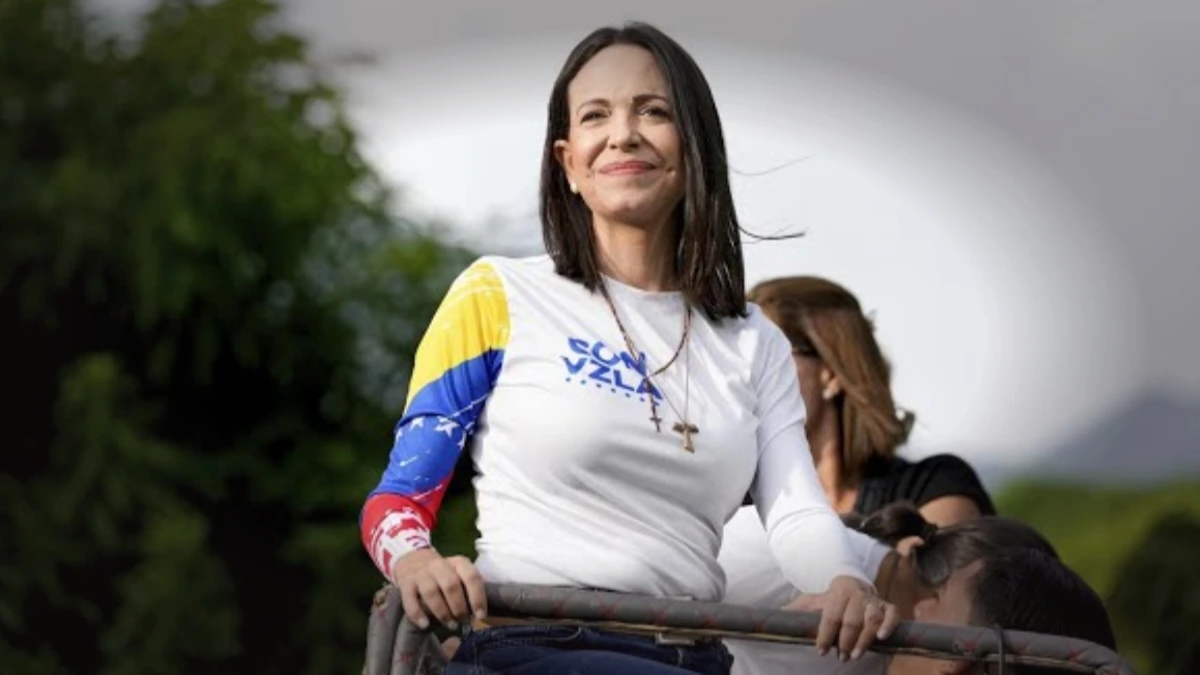
Oslo, Norway — Venezuelan opposition leader Maria Corina Machado will not appear in person to receive the Nobel Peace Prize at Wednesday’s ceremony in Oslo, the Norwegian Nobel Institute confirmed, with her current location unknown.
Machado, 58, was scheduled to accept the award at Oslo City Hall in front of King Harald, Queen Sonja, and a delegation of Latin American leaders including Argentine President Javier Milei and Ecuadorean President Daniel Noboa. The ceremony is set to begin at 1 p.m. local time.
“She is unfortunately not in Norway and will not stand on stage at Oslo City Hall at 1 pm when the ceremony starts,” Kristian Berg Harpviken, director of the Norwegian Nobel Institute and permanent secretary of the award body, told broadcaster NRK. When asked about Machado’s whereabouts, he said, “I don’t know.”
Instead, Machado’s daughter, Ana Corina Sosa Machado, will accept the prize and deliver the Nobel lecture on her mother’s behalf, Harpviken said. Machado has spent over a year in hiding to avoid arrest under a decade long travel ban imposed by Venezuelan authorities.
She won the Nobel Peace Prize in October for her efforts to promote democracy and human rights in Venezuela, a country that has faced economic collapse, hyperinflation, and political unrest under President Nicolas Maduro’s administration.
The Nobel Committee cited Machado’s “courage and commitment to peaceful political change” in a nation experiencing one of the hemisphere’s most severe political crises.
At the time of her win, Machado dedicated part of the award to former U.S. President Donald Trump, who has publicly suggested he deserved the prize himself.
President Maduro, in power since 2013, has characterized US involvement in Venezuela as an attempt to seize control of the country’s oil reserves, insisting that Venezuelan citizens and the military would resist foreign interference.
Political analysts said Machado’s absence underscores the ongoing political volatility in Venezuela. “Her inability to attend the Nobel ceremony highlights the severe restrictions on opposition figures in Venezuela,” said Claudia Fernandez, a Latin American politics expert at the University of Oslo.
“It also emphasizes the international community’s concern over human rights in the country.” Diplomats in Latin America noted that the optics of Machado’s missing presence could strengthen global attention on Venezuela’s political landscape.
“While the Nobel Peace Prize is symbolic, it sends a message to both the Venezuelan government and opposition that democratic advocacy is recognized and supported internationally,” said Alejandro Ruiz, a former Venezuelan ambassador to Norway.
Venezuela has consistently ranked near the bottom of democracy indices in Latin America. According to the 2025 Freedom House report, the country scored 23 out of 100 on political rights and civil liberties, placing it among the least free nations in the region.
By comparison, neighboring Colombia scored 73, and Ecuador scored 65 on the same index, illustrating stark regional contrasts.
Machado is not the first Venezuelan opposition leader Nobel Prize recipient unable to attend the ceremony. In past decades, several laureates have sent family members or representatives in their stead due to imprisonment, conflict, or political exile.
Locals in Caracas expressed mixed emotions about Machado’s award. “It is inspiring that the world is recognizing her struggle,” said Jose Alvarez, a teacher and opposition supporter.
“But it is sad she cannot be there herself.” Others noted that the prize may do little to change immediate conditions. “The recognition is symbolic,” said Maria Rojas, a market vendor. “Our daily struggles continue regardless of international awards.”
The Nobel Committee said the ceremony will proceed as planned, maintaining the focus on Machado’s achievements despite her absence.
Experts suggest that her recognition could embolden other political activists within Venezuela and in similar authoritarian contexts.
However, the security risks for Machado remain high, and it is unclear when or if she may travel abroad to accept the prize in person.
Machado’s daughter accepting the Nobel Peace Prize on her behalf highlights both the peril faced by opposition figures in Venezuela and the international community’s acknowledgment of their efforts.
While Machado remains in hiding, the award continues to signal global support for human rights and democratic advocacy in a country facing prolonged political and economic turmoil.


