
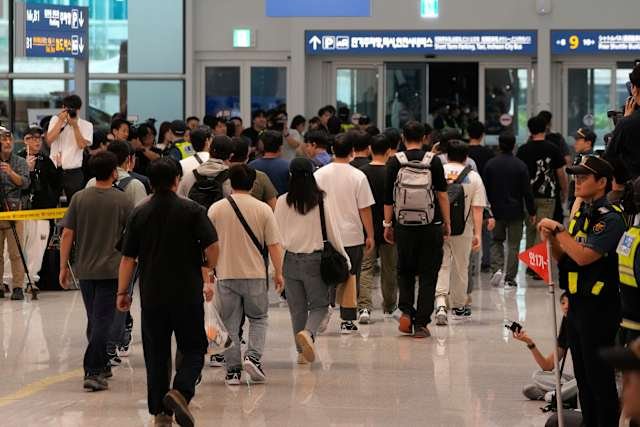
The US State Department said Friday it had significantly expanded its capacity at the US Embassy in Seoul to process more business visa applications from South Koreans.
The move comes after a September immigration raid on a major South Korean run factory in Georgia sparked outrage in Seoul and concerns that foreign investment could dry up.
The added capacity aims to support companies seeking to continue operations in the United States while restoring investor confidence.
Officials said the ramp up reflects “a commitment to support legitimate business travel and US reindustrialization,” even as broader immigration restrictions remain in place.
In September the US Immigration and Customs Enforcement agency led what was once described as the largest workplace raid in US history, detaining 317 South Korean workers at a battery plant in Ellabell, Georgia.
The plant is jointly owned by carmaker Hyundai Motor Group and battery maker LG Energy Solution. Witness images of workers in handcuffs and shackles reverberated in South Korea where many officials and business leaders condemned the operation as a violation of labor rights.
The backlash raised fears among South Korean firms that future US investments might be at risk. Some critics warned the raid would deter companies from hiring Korean workers or establishing new operations in the United States.
In response, the State Department has since begun reissuing visas to many of the former detainees and encouraging eligible individuals to apply for short term B‑1 business visas rather than rely on visa waiver programs.
Analysts say the decision to expand visa processing is an effort to ease diplomatic tensions and reassure investors. “What we are seeing now is a pragmatic balancing act,” said Jin‑woo Park, a Seoul based trade and investment analyst.
Washington wants to uphold its immigration enforcement agenda while also avoiding damage to critical supply chain ties.
A senior consular official at the embassy, speaking on condition of anonymity because the internal staffing changes had not yet been formally announced, said the embassy had added the capacity to conduct “more than five thousand interviews above normal levels.”
The official declined to specify how many additional staff were assigned, but emphasized the expansion was designed to handle the surge in demand for South Korean business visas.
At a recent investment forum in Washington the former US president, speaking in support of foreign skilled labor in strategic industries including battery manufacturing, underscored the administration’s dual priorities national security and industrial competitiveness.
“They are complex much more than people understand,” he said, referring to battery production, adding that South Korean companies had made “huge investments to build the factory.”
The State Department said wait times for South Koreans seeking B‑1 business visas had dropped to under two weeks on average.
That compares favorably with wait times in many other cities where visa interview appointments can take from weeks to more than a year, according to the department’s publicly posted visa wait time data.
However some visa consultants in Seoul say actual processing times remain unpredictable.
As of late October it was taking more than a month to get a business visa interview slot instead of the typical eight days, said Mira Park, who helps former detainees file new applications. “That backlog is now easing, but many applicants are still waiting.”
The shift to B‑1 visas intended for short term business travel such as meetings, site visits, or contract negotiations marks a change in protocol for many South Koreans who previously worked in the United States under nonimmigrant or visa waiver programs.
Legal experts note that B‑1 status imposes stricter limits on work related activities than long term work visas such as H‑1B.
For some former Georgia detainees the offer to return under new visas has been met with ambivalence. “I’m not sure I want to go back,” said one former worker who asked to remain anonymous citing fear of retaliation.
“I left for good reason.” Several other workers echoed that sentiment, saying the memories of detention and the stigma around the raid remained fresh.
But not all are hesitant. Another former employee, who returned earlier this month after receiving a B‑1 visa, said the alternative unemployment in Korea was unappealing.
“This job opportunity is one of the few that matches my skills and provides income comparable to living costs here,” he said. “I hope the process moves smoothly.”
Local visa consultants also report an uptick in inquiries from companies scouting new investment projects.
Several South Korean firms tell us they are rethinking planned expansions in the US until they see how this visa initiative unfolds, said consultant Yoo Min‑ja in Seoul.
“If the system works, confidence may return. If not, many will pause.” The expanded visa processing is likely to ease pressure on South Korean workers and firms in the short term.
If the State Department can maintain rapid interview scheduling and consistent visa approvals, some of the lost business momentum may be restored.
Yet the reliance on short term B‑1 visas may not satisfy companies seeking stable long term staffing, especially for specialized production roles.
Labor lawyers caution that extended use of B‑1 visas for manufacturing related duties could draw scrutiny from US regulators or trigger calls for stricter enforcement.
There are also signs of legal pushback. Several of the former Georgia detainees are reportedly preparing a class‑action lawsuit against US immigration authorities over their detention.
That could complicate efforts to bring workers back under new visas and further dampen investor confidence. Finally, much depends on broader US immigration policy.
The administration recently imposed a new $100,000 fee on new H‑1B visas intended for skilled workers. If that trend continues, firms may find long term staffing more expensive or shift hiring out of the United States entirely.
The State Department’s decision to boost capacity for processing South Korean business visas reflects an effort to address diplomatic fallout from the Georgia factory raid and to support continued foreign investment in critical industries.
The change has reduced wait times for B‑1 visas and provided an option for many former detainees to return legally to US work.
Still uncertainty remains over whether the initiative can deliver stable long term labor solutions for South Korean companies in the United States.
As legal challenges and broader immigration policy shifts take shape, the future of South Korean business visas and the investments they support remains unsettled.


