
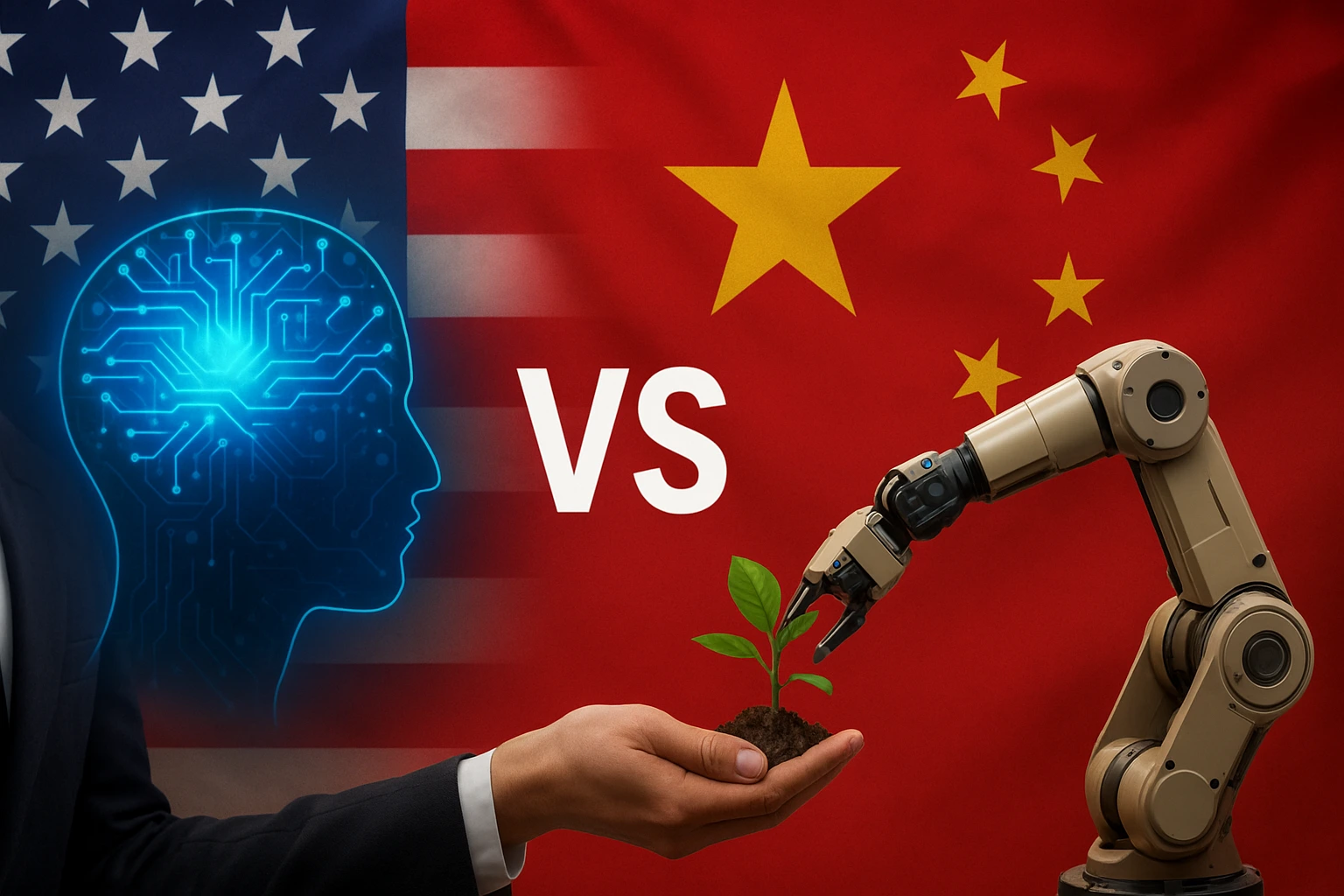
The race for artificial intelligence dominance is shaping the future of nations, industries, and everyday lives. Nowhere is this more visible than in the US vs China AI strategy, where two superpowers are taking fundamentally different paths.
The United States is pouring billions into the dream of Artificial General Intelligence (AGI) a superintelligent system that could rival or surpass human intelligence.
Meanwhile, China is betting on practical AI that solves problems today, from improving healthcare to helping farmers boost crop yields.
What You Will Learn in This Article:
1. Why the U.S. is chasing AGI while China emphasizes real world AI applications.
2. Case studies of how these strategies are already shaping industries, economies, and global politics.
3. The long term implications of the US vs China AI strategy for businesses, innovation, and society.
The US Pursuit of Artificial General Intelligence
For America, AGI has become the moonshot of the decade. Lawmakers and industry leaders argue that the first nation to achieve AGI will secure unmatched military, economic, and technological dominance.
Massive Investments A congressional panel even floated the idea of a Manhattan Project for AI, highlighting the scale of ambition. Billions of dollars are being directed toward US AI investments, particularly in large scale computing infrastructure and advanced model training.
Big Tech’s Gamble Companies like OpenAI, Google DeepMind, and Anthropic are locked in an arms race to build systems that go beyond narrow AI and reach AGI.
The GPT-5 Example When OpenAI unveiled its GPT-5 model, it was marketed as a leap toward AGI.
Many users felt underwhelmed, prompting CEO Sam Altman to admit the rollout was rough and to cool down sky high expectations.
This highlights a risk as more money pours in, investors are starting to ask if AGI is an ambitious breakthrough or the next tech bubble.
China’s Pragmatic Approach AI for Daily Life
In sharp contrast, China AI applications are rooted in immediate impact. President Xi Jinping has urged the industry to focus on tools that enhance productivity, efficiency, and everyday services.
Policy & Funding In January, China launched an $8.4 billion national fund, while local governments and banks added billions more under the AI+ initiative.
Schools are using AI models to grade exams. Farmers receive AI driven advice on planting and pest control. Police leverage AI to respond faster to cases. Tsinghua University is building an AI assisted hospital where virtual and human doctors collaborate.
Industrial Adoption Factories now employ intelligent robots to inspect textiles and assemble cars, while Xiong’an city has rolled out local AI tools for agriculture and weather forecasting.
This pragmatic drive shows that while the US is betting on the future, China is embedding AI into society today.
The Limits Shaping China’s AI Path
China’s strategy is also shaped by constraints. US export rules make it difficult for China to access cutting edge semiconductors critical for training frontier models.
As a result, Chinese developers rely heavily on, Smaller data centers spread across the country. Open source tools that encourage collaboration and resource efficiency.
Instead of trying to outgun the US with massive AGI projects, China aims to weave AI into its economy at every level, ensuring broad based adoption.
United States: Startups and labs are experimenting with AI powered drug discovery.
For example, Insilico Medicine used generative AI to design a new drug candidate in under 18 months a process that normally takes years. This aligns with the US dream that AGI could revolutionize medicine.
China: The Tsinghua University hospital project illustrates China’s focus on real world outcomes.
By combining human doctors with AI assistants, the goal is to improve patient throughput and reduce diagnostic errors.
Agriculture Innovation
United States: AI in agriculture is still experimental, focusing on predictive models for climate and soil conditions. Big tech is exploring AGI level solutions that might one day redesign food systems.
China: Farmers in provinces like Hebei already receive AI driven pest control recommendations via mobile apps. This simple, direct application improves yields and secures food supplies.
National Security
United States: Military strategists view AGI as a potential game changer in cyber defense, autonomous weapons, and intelligence analysis.
The Manhattan Project for AI framing shows just how central defense applications are in Washington’s plans.
China: While also exploring military AI, China emphasizes AI+ governance, with AI helping police and city officials manage security, logistics, and local administration. The US vs China AI strategy illustrates two competing philosophies.
US Vision: High risk, high reward. If AGI is achieved, it could unlock breakthroughs in medicine, defense, and climate change. But the path is uncertain and expensive.
China’s Vision: Incremental, widespread adoption. Even without AGI, AI can transform industries, improve public services, and boost economic resilience.
Actionable Insights for Businesses and Innovators
If you’re an entrepreneur, investor, or policymaker, here’s how to navigate this landscape. Don’t focus only on AGI moonshots. Balance high risk investments with practical AI projects that deliver value now.
The US shows the power of ambition, while China shows the power of pragmatism. Smart strategies blend both. Companies can start with narrow AI in customer service, logistics, or analytics before moving toward more advanced systems.
Export controls, government incentives, and regulations will shape where AI talent and capital flow.
Kai-Fu Lee, AI investor and author, once noted, The US leads in breakthrough research, but China leads in implementation speed.
Sam Altman, CEO of OpenAI, admitted after the GPT-5 rollout, We need to reset expectations progress is real but messy.
These perspectives underline the complementary strengths and weaknesses in the global AI race.
The Future of the AI Race
The US vs China AI strategy is more than a competition it’s a window into how nations prioritize risk, reward, and responsibility. The US bets that achieving AGI first will deliver unmatched global dominance.
China shows that immediate applications can transform industries and daily life, even without frontier breakthroughs.
The big takeaway? The future may not belong to either vision alone but to a blend of both. Nations and businesses that combine ambition with pragmatism will shape the next era of technology.
👉 Call to Action: What do you think? Should countries chase AGI at all costs, or focus on practical applications that improve lives today? Share your thoughts in the comments, and don’t forget to subscribe for more deep dive analysis on global tech trends.


