
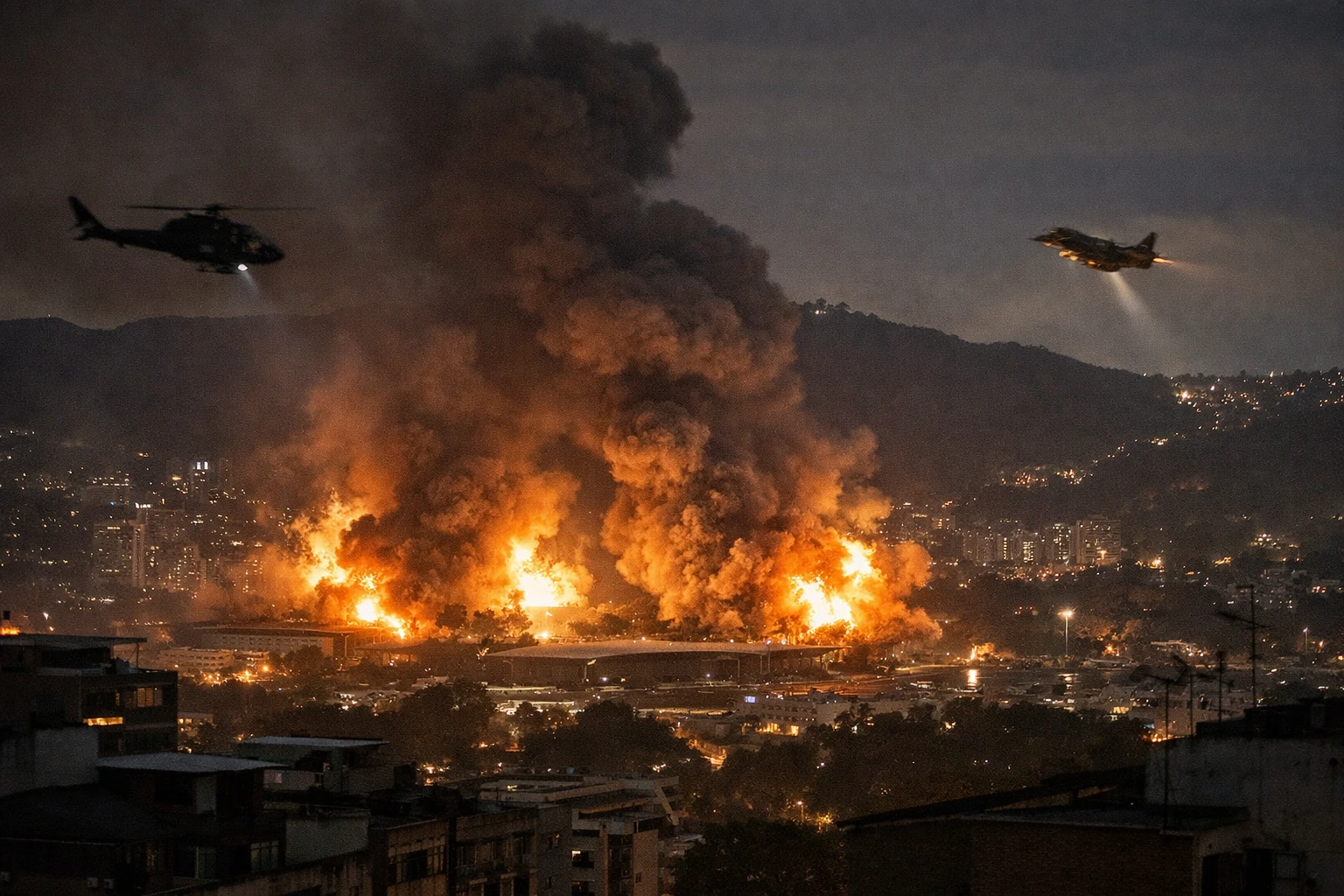
CARACAS, Venezuela — Explosions shook Venezuela’s capital early Saturday, prompting President Nicolás Maduro to declare a national state of emergency and accuse the United States of carrying out military strikes, allegations that Washington has not formally confirmed.
The blasts began shortly before two am local time, according to residents and Venezuelan officials, as aircraft and helicopters were reported flying low over parts of Caracas.
Power outages were reported in several neighborhoods, and plumes of dark smoke were visible above central districts of the city.
Venezuela’s government said the explosions affected strategic locations, including the La Carlota military airfield and the Fuerte Tiuna military complex.
One of the country’s largest armed forces installations. Independent verification of the targets was not immediately possible.
Key Points
- President Maduro declared a state of emergency and ordered nationwide mobilization
- Venezuela accused the United States of launching military strikes on Caracas
- US officials acknowledged military activity but offered no public details
The overnight explosions mark a sharp escalation in tensions between Washington and Caracas, pushing a long running political and diplomatic confrontation into a new and uncertain phase with potential regional consequences.
In a televised address, Maduro described the incident as an external attack on Venezuelan sovereignty and announced what he called a “state of external disturbance.”
He ordered the mobilization of the armed forces and allied civilian militias, urging unity in the face of what his government characterized as foreign aggression.
US Southern Command and the Department of Defense referred questions to the White House.
An American official, speaking on condition of anonymity due to the sensitivity of military operations, confirmed that US military activity involving Venezuela was underway but declined to provide details on targets or duration.
The Federal Aviation Administration issued an immediate ban on US commercial flights in Venezuelan airspace, citing ongoing military activity.
The agency also imposed temporary restrictions on airspace near the Caribbean island of Curacao, a key regional aviation corridor.
Security analysts said the reported strikes, if confirmed, would represent a departure from years of US policy that relied primarily on sanctions, diplomatic isolation and maritime enforcement rather than direct action on Venezuelan territory.
“The symbolic value of striking near Fuerte Tiuna is significant,” said Ricardo Ávila, a regional defense consultant based in Caracas.
“It is closely associated with military command structures. The message appears designed to demonstrate reach rather than inflict widespread damage.”
The incident follows months of increased US military presence in the Caribbean, where American forces have targeted vessels Washington says are linked to drug trafficking networks.
US officials have repeatedly accused Maduro’s government of cooperating with criminal organizations, claims Venezuela denies.
Residents described scenes of confusion and fear as explosions echoed across the city.
“The whole ground shook,” said Carmen Hidalgo, a twenty one year old office worker. “We heard explosions and aircraft at the same time. It felt like the air itself was hitting us.”
Venezuelan Information Minister Freddy Ñáñez urged citizens to mobilize in a message posted on Telegram, calling on political and social organizations to respond to what he described as an imperialist attack.
Colombian President Gustavo Petro called for an emergency meeting of the United Nations Security Council, writing on social media that the situation demanded immediate international attention. His statements could not be independently verified.
Diplomatic channels remained active as regional governments monitored developments and assessed potential spillover effects, including migration pressures and energy market disruptions.
Observers say the coming hours will be critical in determining whether the events represent a limited military operation or the opening stage of a broader campaign.
Any formal statement from the White House or additional military activity could significantly alter regional security dynamics.
With a state of emergency in effect and international airspace restrictions in place, the explosions in Caracas have transformed a longstanding political standoff into an active international crisis.
Global attention now centers on whether restraint or escalation will define the next phase of US Venezuela relations.
Author’s Perspective Adnan Rasheed
In my analysis, the most consequential element of the Caracas explosions is not the physical damage but the rapid normalization of military signaling in civilian airspace.
Evidenced by flight bans and regional aviation restrictions within hours.
I believe this response highlights how modern conflicts increasingly unfold through control of movement and information, long before sustained combat is confirmed.
I predict that similar confrontations will rely more heavily on airspace denial, maritime exclusion zones and short duration strikes designed to pressure military command structures without committing to prolonged campaigns.
Readers should closely track aviation notices, maritime advisories and insurance risk updates, as these operational signals often reveal the real scope and direction of a conflict earlier than official political statements.
NOTE! This report was compiled from multiple reliable sources, including official statements, press releases, and verified media coverage.


