
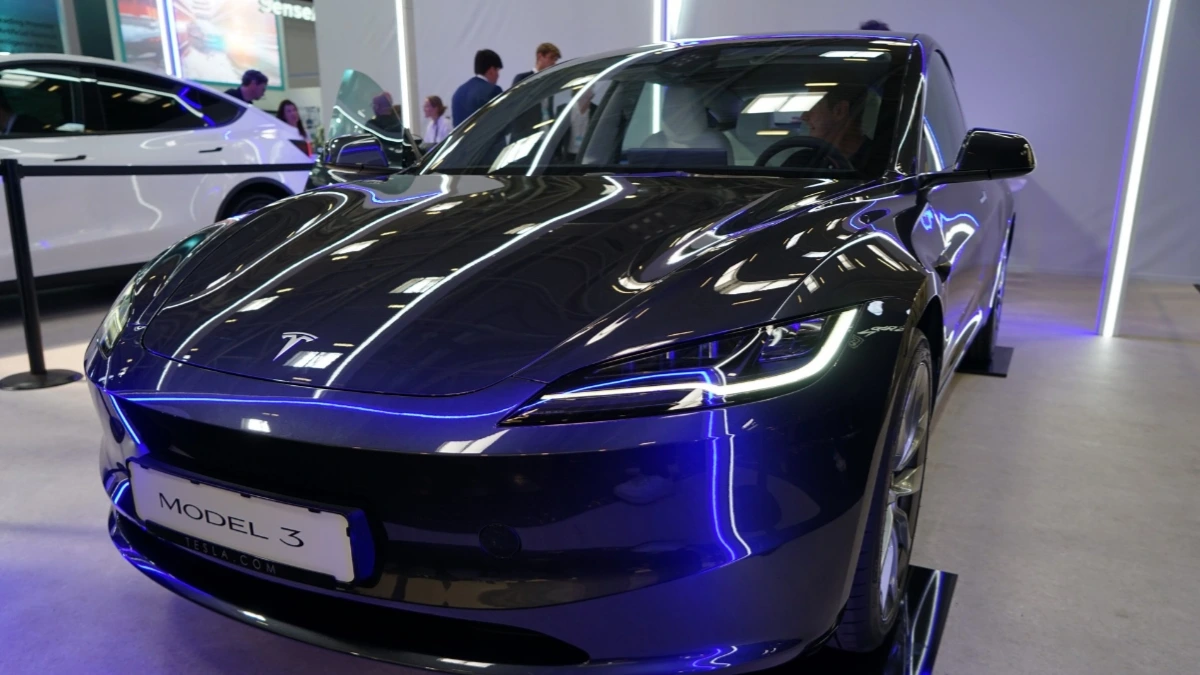
FRANKFURT, Germany — Tesla on Friday launched a lower priced version of its Model 3 electric car in Europe, two months after its debut in the United States, as the automaker seeks to reinvigorate sales amid slowing demand and intensifying competition.
The new Model 3 Standard, designed with a focus on affordability, drops some premium features but still offers a driving range exceeding 300 miles (480 kilometers).
Tesla has faced a slowdown in European markets this year, with new registrations declining despite updates to its Model Y line up.
Buyers are increasingly exploring alternatives such as Volkswagen’s ID.3 and BYD’s Atto 3, according to regional auto market analysts.
“Europe’s EV market is evolving rapidly,” said Lars Richter, an automotive industry analyst at Berlin based Mobility Insights.
“Consumers are price conscious, and competition from Chinese and European brands is putting pressure on Tesla to diversify its offerings.”
The new Model 3 Standard aims to address this shift, with a listed price of 37,970 euros ($44,300) in Germany, 330,056 Norwegian crowns ($32,700) in Norway, and 449,990 Swedish crowns ($47,820) in Sweden.
In comparison, Tesla’s second cheapest Model 3, branded as “Premium” in Germany, starts at 45,970 euros.
Tesla first introduced the Standard variant in the United States in October, priced at $36,990. Deliveries in Europe are expected to begin in the first quarter of 2026.
Tesla CEO Elon Musk has long spoken of producing mass market electric vehicles. However, last year he abandoned plans for a brand new $25,000 EV, opting instead to introduce lower priced versions of existing models.
Analysts caution this approach could risk cannibalizing sales of higher margin vehicles. While a lower cost Model 3 can increase volume, there is a delicate balance,” said Helena Berg, a senior automotive strategist at Nordic Auto Research.
“Tesla must maintain profitability while competing with sub $30,000 EVs from rivals like BYD and Volkswagen.”
Tesla has also been shifting its focus toward artificial intelligence applications, including robotaxis and humanoid robots, but the introduction of more affordable vehicles remains crucial for near term revenue growth, experts said.
European EV registrations have faced headwinds in 2025. In Germany, new electric car registrations fell by 12 percent through October compared with the same period last year, according to the European Automobile Manufacturers Association.
Norway and Sweden also experienced slight declines, reflecting both macroeconomic pressures and a growing selection of competitively priced EVs.
Tesla’s Model 3 Standard competes directly with the Volkswagen ID.3, which starts at around 29,000 euros, and the BYD Atto 3, priced similarly. Both models have been gaining market share in several European countries.
Consumers and dealers are cautiously optimistic about Tesla’s latest move. “I’ve been waiting for a more affordable Tesla,” said Johan Lindberg, a car buyer in Stockholm.
“The Model 3 Standard makes the brand more accessible, but price is just one factor. Range and charging network also matter.”
Dealership manager Marie Dubois in Paris noted, “We have seen strong interest in lower cost EVs this year. Tesla’s new pricing could attract buyers who were previously considering European competitors.”
Market analysts predict Tesla’s lower priced Model 3 may help the company defend its share in the face of rising competition.
However, the broader European EV landscape is expected to remain highly competitive, with several manufacturers introducing more affordable electric models in 2026.
“Tesla’s challenge will be to grow sales without eroding its premium brand image,” said Richter. “The Model 3 Standard is a step in the right direction, but execution in production and delivery will be key.”
Tesla’s launch of the low cost Model 3 variant in Europe reflects the company’s strategy to adapt to slowing demand and increasing competition.
With deliveries slated for early 2026, the move aims to make Tesla vehicles more accessible while navigating the pressures of a rapidly changing electric vehicle market.


