
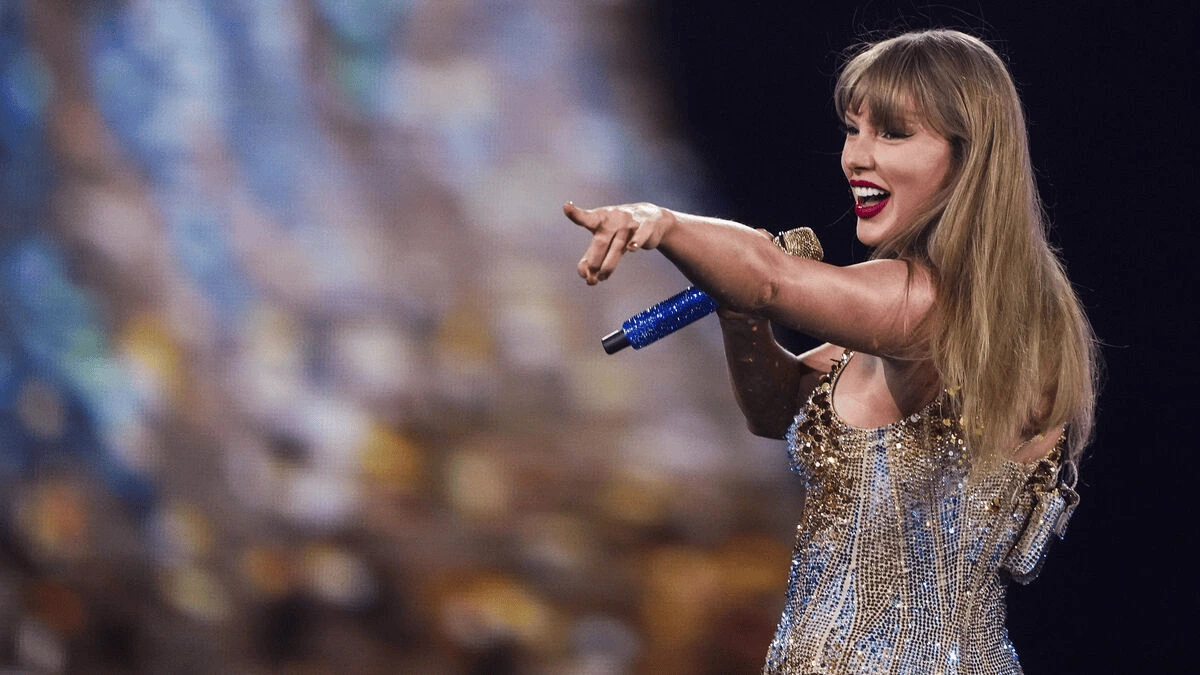
As the United States approached one of its most closely watched presidential elections in recent history, global pop star Taylor Swift offered a rare glimpse into how she navigated the political moment behind the scenes of her Eras Tour.
In Episode four of her Disney+ Eras Tour docuseries, Swift briefly addressed the national climate, framing her tour as a controlled space of escape amid political tension.
The episode follows the final US dates of the tour in Indianapolis, filmed just days before Election Day. While the Eras Tour itself largely avoided political commentary onstage, the docuseries includes a candid moment in which Swift reflected on her role during a polarized time.
Swift, whose career spans nearly two decades, has historically been selective about public political engagement.
The Eras Tour docuseries captures her traveling to Lucas Oil Stadium when she remarked that providing emotional refuge for fans was the one thing she could fully control.
“The one thing I can provide for people is an escape,” Swift said in the episode, adding that for several hours, the audience could focus solely on music and shared experience.
The comment stood out because the Eras Tour itself remained intentionally apolitical, even as Swift publicly endorsed Vice President Kamala Harris and her running mate, Minnesota Gov.
Tim Walz, earlier in the fall. That endorsement came shortly after the Sept. ten presidential debate between Harris and former President Donald Trump.
Media analysts say the Taylor Swift politics Eras Tour docuseries moment reflects a broader strategy seen among high profile entertainers who balance civic engagement with audience inclusivity.
“Swift appears to separate her personal political voice from her performance space,” said Dr. Elaine Porter, a professor of media studies at Northwestern University. “That distinction allows her to participate as a citizen while preserving concerts as neutral ground.”
Political communication experts note that the approach reduces alienation among diverse audiences while still allowing public statements to exist outside entertainment settings.
Over her eighteen year career, Swift has publicly endorsed only a small number of candidates. She supported President Joe Biden in twenty twenty and Democratic Senate candidate Phil Bredesen in Tennessee in twenty eighteen.
By comparison, many artists with similar reach regularly integrate political messages into performances or tours. According to data from the Pew Research Center, celebrities who comment on elections often do so through social media rather than live events, a trend Swift has largely followed.
The Taylor Swift politics Eras Tour docuseries reinforces that distinction by placing her comments in a documentary format rather than onstage.
Fans attending the Indianapolis shows described the concerts as intentionally removed from outside concerns.
“It felt like a break from everything on the news,” said Rachel Moreno, a twenty nine year old fan from Ohio who attended the show. “I knew where she stood politically, but the concert was just about the music.”
Local officials echoed that sentiment. “The Eras Tour brought economic energy and emotional uplift to the city,” said Indianapolis tourism spokesperson Mark Ellison. “The focus was on the event, not the election.”
With the US leg of the Eras Tour concluded, industry observers say Swift is likely to maintain the same separation between art and politics.
The Taylor Swift politics Eras Tour docuseries suggests her political engagement will remain concentrated in controlled settings such as social media statements or interviews.
“As long as her audience remains broad and global, neutrality during performances makes sense,” said Porter.
The Taylor Swift politics Eras Tour docuseries offers a limited but notable insight into how one of the world’s most influential artists navigated a tense political moment.
By acknowledging the election without centering it, Swift framed her role as providing consistency and escape rather than commentary.
The episode adds context to her selective political history while underscoring the deliberate boundaries she maintains between civic participation and live performance.


