
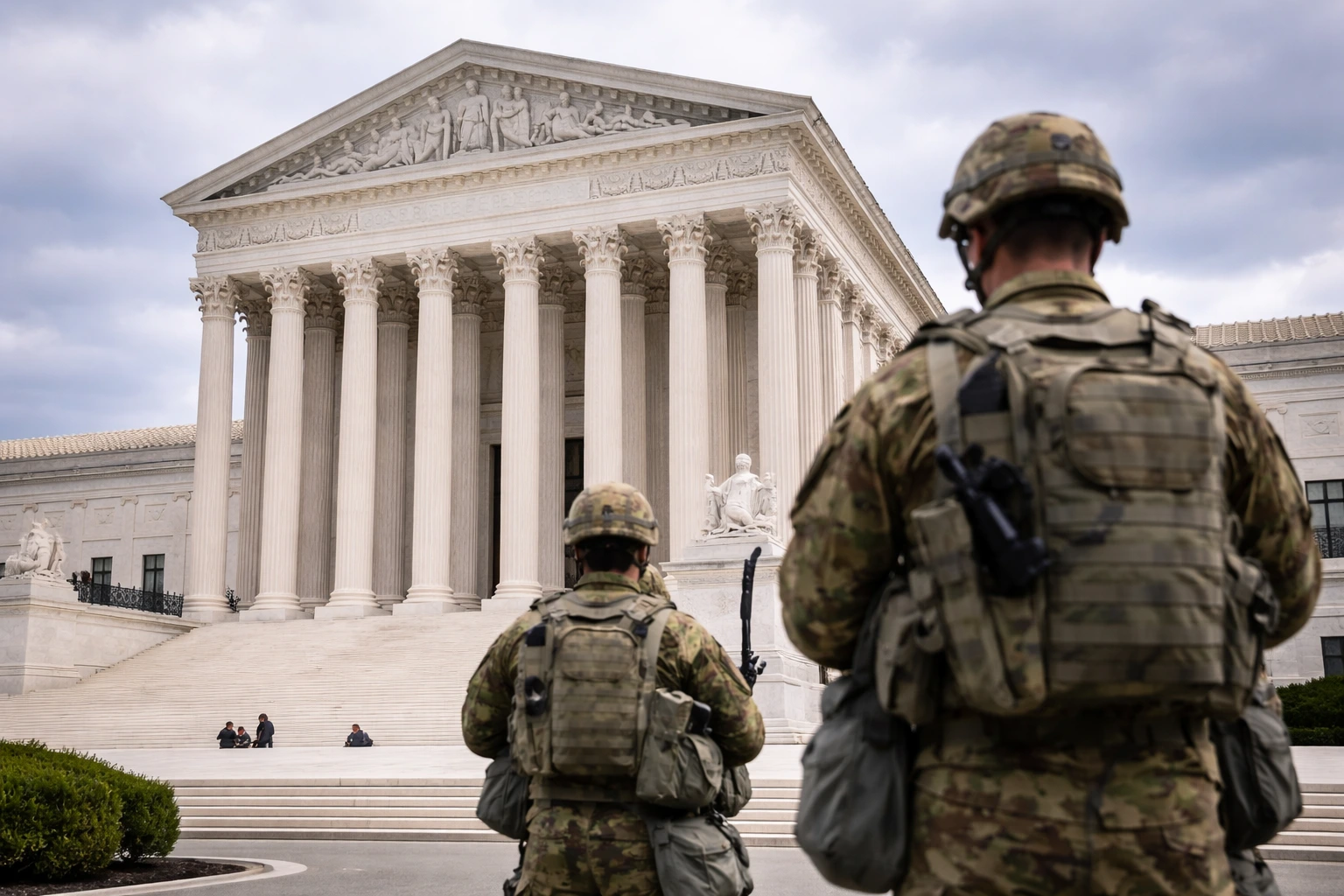
WASHINGTON — The Supreme Court on Tuesday rejected an emergency request from the Trump administration seeking to deploy National Guard troops in Illinois over the objections of state and local officials, delivering a rare setback for President Donald Trump on an issue central to his immigration agenda.
In an unsigned order, the court said the administration had not shown it had legal authority to federalize the National Guard in Illinois to protect federal immigration agents operating in the Chicago area.
The ruling temporarily halts the deployment and places new limits on presidential power in domestic military operations.
The decision applies only to Illinois but is expected to influence similar legal challenges nationwide involving National Guard deployments ordered by the Trump administration.
The case arose after Trump ordered National Guard troops into Illinois, citing unrest linked to protests against stepped up federal immigration enforcement.
Illinois officials and the city of Chicago immediately challenged the move, arguing the situation did not meet the legal threshold required for federalizing the Guard.
Under federal law, the president may call the National Guard into federal service when there is a rebellion, a danger of rebellion or when regular military forces are unable to execute federal law.
The administration argued civilian law enforcement resources were insufficient to protect federal personnel. Lower courts rejected that view. US District Judge April Perry found “no credible evidence” of rebellion and issued a temporary restraining order.
The Seventh US Circuit Court of Appeals agreed, though it narrowed Perry’s ruling by allowing federalization but barring deployment. The Supreme Court’s order left that restriction in place.
The high court ruled that the administration failed to establish a legal basis for using the National Guard in Illinois under existing statutes.
The justices said the law’s reference to “regular forces” applies to active duty military forces, not the Guard, and that any such deployment would still be limited by the Posse Comitatus Act, which restricts military involvement in civilian law enforcement.
“At this preliminary stage, the Government has failed to identify a source of authority that would allow the military to execute the laws in Illinois,” the court wrote.
Three conservative justices Samuel Alito, Clarence Thomas and Neil Gorsuch dissented. Alito said the court improperly dismissed the president’s determination that civilian resources were insufficient.
“There is no basis for rejecting the President’s assessment of the operational realities on the ground,” Alito wrote.
Legal scholars said the ruling reinforces longstanding boundaries between federal and state power.
“This decision underscores that presidential authority over the National Guard is not unlimited,” said Mark Feldman, a constitutional law professor at Georgetown University.
“Courts still require concrete evidence of necessity.” Since two thousand twenty, federal courts have increasingly scrutinized domestic troop deployments.
According to data from the Brennan Center for Justice, more than a dozen legal challenges have been filed nationwide over federalized Guard use during protests and immigration operations.
Trump has sought National Guard deployments not only in Illinois but also in Los Angeles, Portland and Washington, DC.
Federal appeals courts have allowed the deployments in California and Oregon, while litigation over the District of Columbia deployment remains pending.
Hundreds of Guard members previously sent to Illinois and Oregon were scheduled to return to their home states following lower court rulings.
Illinois Gov. J.B. Pritzker welcomed the Supreme Court decision, calling it a validation of state authority.
“Our law enforcement agencies are capable of maintaining public safety,” Pritzker said in a statement. “The federal government overstepped.”
Chicago Mayor Brandon Johnson said residents feared the presence of troops would escalate tensions rather than calm them.
“We saw no conditions that justified a military response,” Johnson said.
Some federal officials disagreed.
A senior Department of Homeland Security official, speaking on condition of anonymity, said Guard support was requested to ensure agent safety amid threats and harassment.
Community members offered mixed reactions. Maria Torres, a Chicago resident who attended immigration protests, said the ruling eased concerns. “The Guard would have made things worse,” she said. “This was about intimidation.”
The Supreme Court emphasized that its decision was preliminary, leaving open the possibility of future action if conditions change. However, legal experts said the ruling raises the bar for similar deployments elsewhere.
Challenges to National Guard use in Washington, DC, where the federal government has broader authority, could yield different outcomes.
Still, the Illinois decision may shape how courts interpret presidential power during domestic enforcement operations.
The Supreme Court’s decision blocking the Trump National Guard deployment in Illinois reinforces judicial limits on federal authority and underscores the legal hurdles presidents face when using military forces in domestic matters.
While narrow in scope, the ruling signals that courts will closely examine claims of necessity before allowing such actions.


