
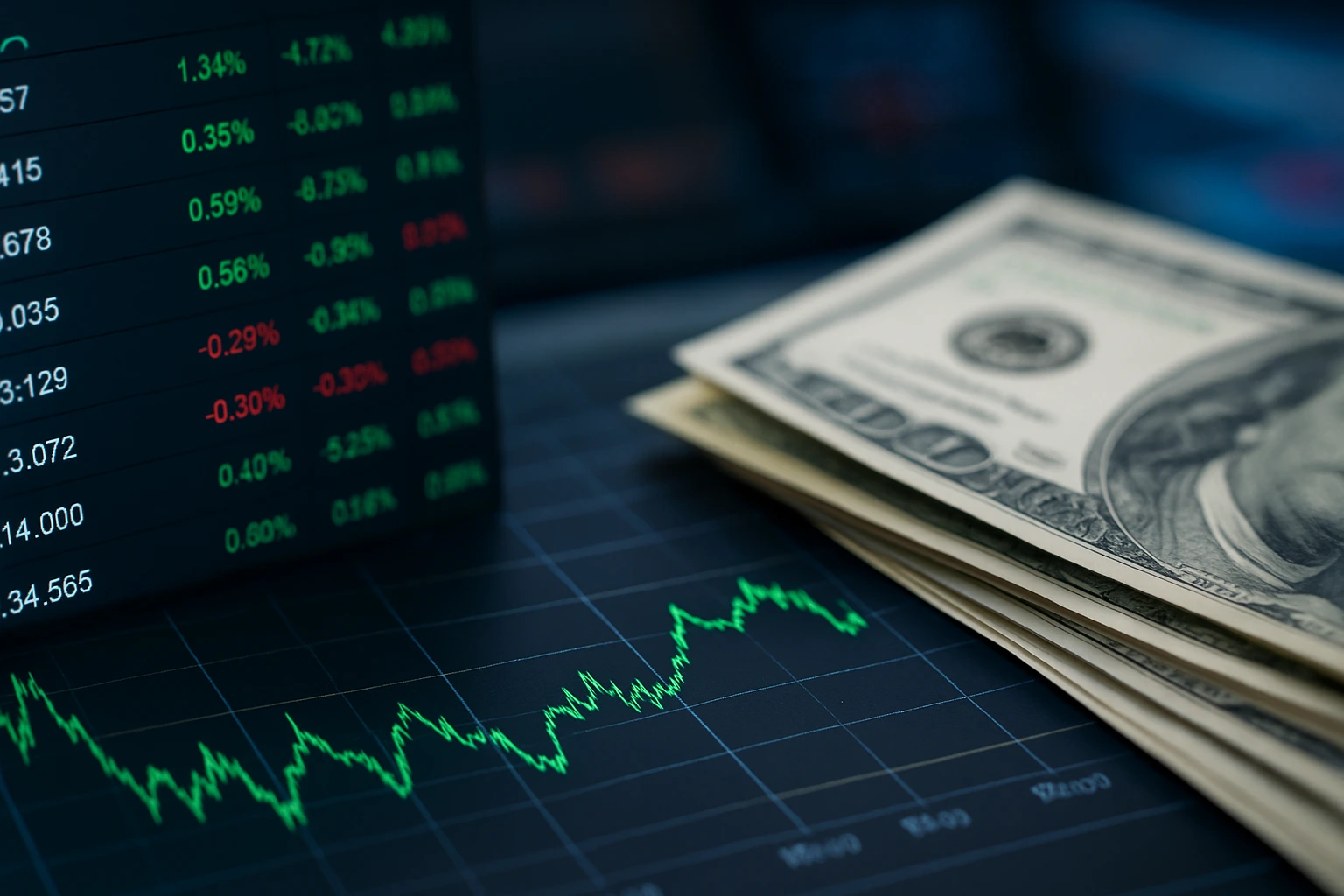
LONDON — Global stocks climbed Monday while the dollar slipped as investors grew more confident that the Federal Reserve could move toward a December Fed cut, even as policymakers remain split on the timing of further easing.
The cautious optimism set the tone for an event heavy week that includes US retail sales data, producer price figures and a high stakes budget announcement in Britain.
Markets were also watching geopolitical developments, including ongoing US and Ukrainian discussions on a revised plan to end the war with Russia. Analysts said any potential breakthrough could influence oil markets by easing pressure on global supply constraints.
European equities opened stronger, tracking a late rebound on Wall Street where tech stocks staged a recovery after a volatile week. The STOXX 600 rose nearly one half of a percent in early trading after ending last week down about two percent.
The potential for a December Fed cut gained momentum after Federal Reserve official John Williams said last week that rates could fall “in the near term,” a remark that investors interpreted as a signal of softer monetary policy ahead.
Goldman Sachs economist Jan Hatzius reiterated in a note that he expects a cut in December and two more in early 2026.
“The central question is whether inflation continues to trend lower,” Hatzius said. “The job market is showing signs of cooling, and that combination may encourage the Fed to move earlier rather than later.”
Meanwhile, political negotiations between Washington and Kyiv weighed on oil prices. Traders said the possibility of a diplomatic breakthrough that reduces sanctions on Russia could increase global supplies.
Market analysts said the rally reflected a mix of relief and caution. While the prospect of a December Fed cut supported risk appetite, many investors remain wary of uneven global growth.
“This is a market that wants to believe in a soft landing,” said Melissa Carver, senior strategist at Horizon Capital in New York. “But we still don’t have enough clarity from the Fed, and economic data later this week could either reinforce or undermine that optimism.”
Currency analysts noted that the dollar’s pullback was consistent with rate cut expectations. A weaker dollar typically supports equities and commodities by making them cheaper for foreign buyers.
“The dollar is reacting to shifting interest rate expectations and reduced geopolitical risk,” said Hiroshi Tanaka, currency analyst at Mizuho Securities in Tokyo. “If the Fed signals more confidence in disinflation, the sell-off in the dollar could deepen.”
Energy analysts said crude markets have become increasingly sensitive to geopolitical diplomacy as traders assess how potential sanctions relief might reshape global flows. Brent crude slipped in early trading as discussions about the Russia Ukraine framework continued.
Monday’s gains followed several turbulent sessions marked by concerns about overvalued technology shares and weaker than expected labor market indicators.
The STOXX 600 rose about 0.5 percent after a weekly decline of more than two percent.
Nasdaq futures gained nearly one percent, while S&P 500 futures rose about one half of a percent.
MSCI’s index of Asia Pacific shares outside Japan climbed almost one percent overnight.
The dollar index fell modestly, extending its decline from late last week.
Investors said the fresh momentum showed how sensitive markets remain to any signal about a possible December Fed cut.
Rate expectations have shifted repeatedly over the past several months as inflation moved lower but not uniformly across sectors.
“There is a growing belief that inflation is easing enough to justify policy adjustments,” said Chris Martinez, economist at GlobalRate Insights.
“But the Fed does not want to declare victory too soon, especially after misjudging price pressures earlier in the cycle.”
The US labor market is another source of uncertainty. Payroll growth has slowed in recent months, raising questions about whether higher borrowing costs are beginning to weigh on corporate hiring.
Outside financial hubs, business owners and workers expressed mixed emotions about the broader economic picture.
In Manchester, England, small manufacturing firm owner Liam Cooper said he hoped the anticipated December Fed cut would ease global financing pressures.
“Borrowing costs have been tough on smaller exporters like us,” Cooper said. “A rate cut would help stabilize currency swings and give us some breathing room.”
In Chicago, retail employee Sharon Walters said consumers are becoming more cautious ahead of the holiday season. “People still buy, but they are watching prices more carefully,” she said. “Everyone is trying to stretch their budget.”
In Berlin, tech worker Felix Reinhardt noted that volatility in US markets often spills over into European trading. “When Wall Street stumbles, we feel it almost immediately,” he said. “So days like today, when things open stronger, help restore a bit of confidence.”
Economists said markets will remain tightly focused on macroeconomic data this week. Any sign of stronger than expected consumer or wholesale prices could cast doubt on hopes for a December Fed cut, while weaker numbers could reinforce expectations for easing.
“The next seventy two hours are critical,” said Sandra Lee, global macro analyst at Apex Strategies. “If the data aligns with recent inflation trends, we could see more upward momentum. But a surprise jump in prices would complicate the narrative.”
Attention will also turn to London on Wednesday, where British finance minister Rachel Reeves is expected to present her budget. Investors said they are watching for clues about fiscal priorities, borrowing levels and measures aimed at restoring long-term growth.
Geopolitical tensions remain a wildcard. Any escalation in the Russia Ukraine conflict could push energy markets higher, while meaningful progress toward a settlement could continue to pull prices down.
Global markets opened the week on firmer footing, buoyed by growing expectations of a possible December Fed cut and tentative signs of easing geopolitical risks.
With major economic releases and political decisions looming, investors are bracing for a week that could either reinforce recent optimism or revive volatility.
For now, markets appear cautiously hopeful that a gradual shift in monetary policy and improving global stability will help steady the broader economic outlook.


