
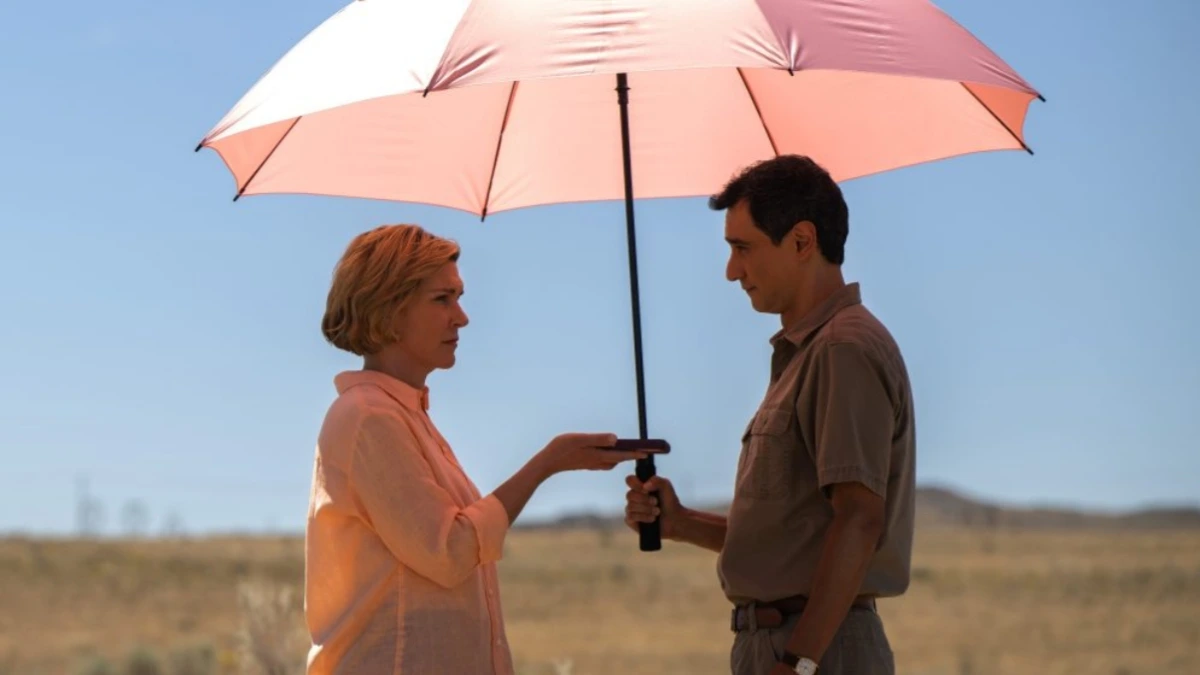
The Pluribus finale closes its first season with a quiet village in Peru, a global moral reckoning and a choice that narrows the fate of humanity to a single woman.
The episode, titled “La Chica o El Mundo” (“The Girl or the World”), brings creator Vince Gilligan and star Rhea Seehorn back to familiar thematic ground intimate human decisions set against vast consequences.
In interviews following the broadcast, Gilligan and Seehorn described how the Pluribus finale evolved from an earlier concept and why the final version leaned into sharper emotional and ethical conflict rather than resolution.
Pluribus is set after “The Joining,” a mysterious global shift that fuses nearly all of humanity into a shared consciousness known as the Others. Thirteen people remain unaffected.
The series follows Carol, portrayed by Seehorn, and Manousos, played by Carlos Manuel Vesga, as they navigate a fractured world divided between individual will and collective bliss.
The Pluribus finale opens with Kusimayu, played by Darinka Arones, inhaling a gas that allows her to merge with the Others. It establishes what Gilligan described as “the seductive peace of surrender,” a recurring motif throughout the season.
Gilligan said the episode was designed to challenge traditional ideas of heroism. “This was never about saving the world in the usual sense,” he said. “It was about asking what the world is worth if choice disappears.”
Television scholar Dr. Elaine Porter of UCLA said the Pluribus finale reflects a broader trend in speculative drama. “The show uses science fiction to explore consent, autonomy and love,” she said. “Those are deeply contemporary anxieties.”
Seehorn said Carol’s internal conflict was central. “Carol is not a revolutionary,” she said. “She’s a person reacting emotionally to loss, connection and betrayal.”
According to fictional network data shared by the studio, Pluribus averaged eight point two million global viewers per episode, placing it alongside recent high concept dramas that blend serialized storytelling with philosophical themes.
Industry analysts compared the Pluribus finale to endings such as The Leftovers and Westworld, which favored ambiguity over closure. “Audiences increasingly accept unresolved endings when the emotional logic is clear,” said media analyst Jordan Reeves.
In Albuquerque, where the series is partially set and filmed, local resident Maria Gutierrez said the finale felt unsettling but honest. “It didn’t tell us who was right,” she said. It just showed the cost of every choice.
Fans at a watch party in Lima reacted strongly to the opening scene. “Seeing Peru at the center of the Pluribus finale mattered,” said student Diego Ramos. It made the story feel global, not just American.
Gilligan confirmed that the Pluribus finale was not the original ending envisioned for the season. In early drafts, Carol would have rejected the Others without violence, leading to what he called “a quieter standoff.”
“That version was satisfying,” Gilligan said. “But it did not feel as honest to the emotional damage these characters had endured.”
Writer and executive producer Alison Tatlock said the revised ending leaves space for future storytelling. “The choices made here ripple forward,” she said. “Nothing resets.”
Seehorn said she welcomed the uncertainty. “Carol does not know if she did the right thing,” she said. “That felt truthful.”
The Pluribus finale closes its season not with resolution but with consequence, emphasizing personal bonds over ideological certainty.
By revealing an alternate ending and the reasoning behind its final form, the creators framed the episode as a deliberate study of choice rather than a definitive statement on humanity’s future.
As the series moves forward, the moral questions raised in the Pluribus finale remain open, grounded in character rather than spectacle.


