
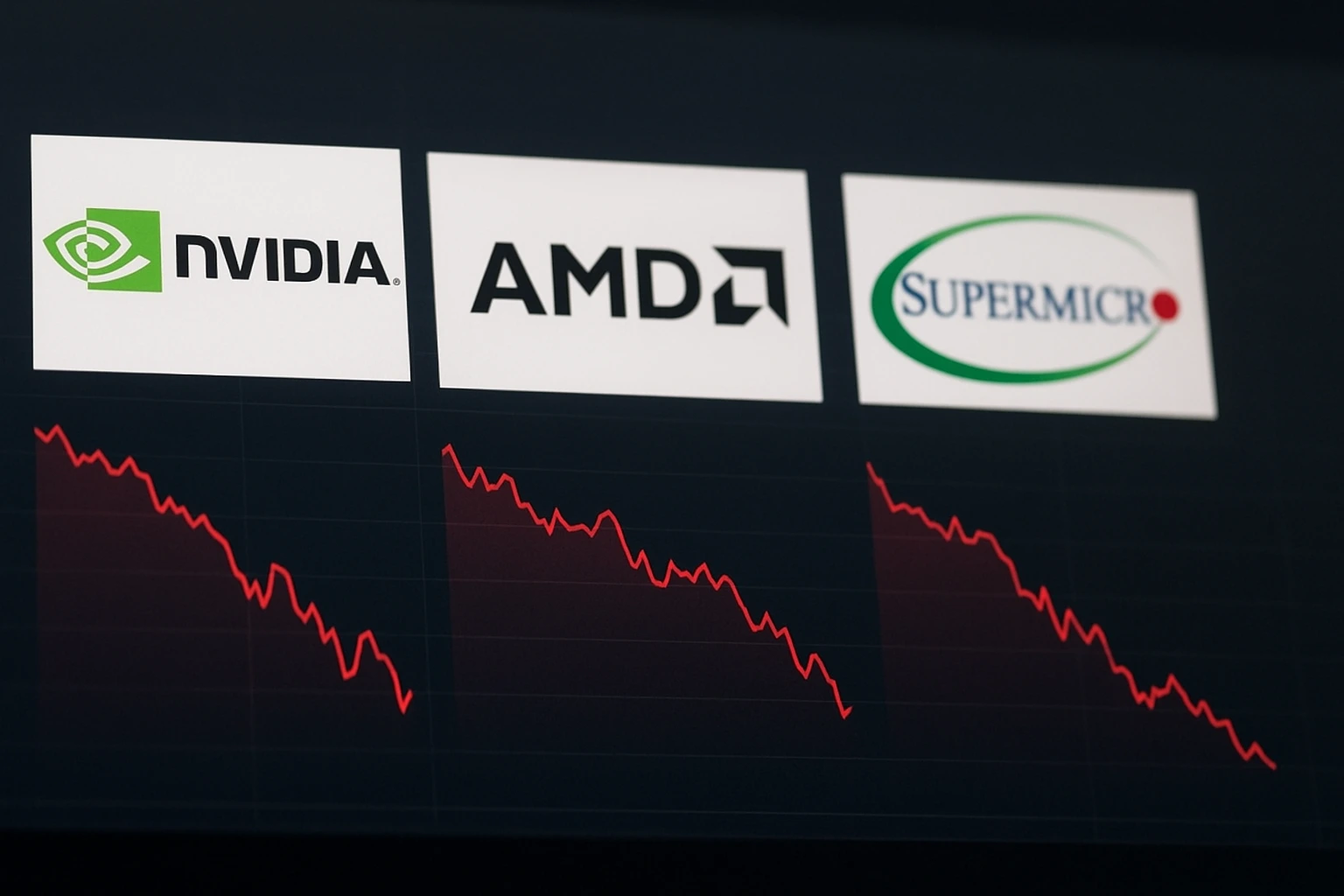
Shares of Nvidia, AMD and Super Micro Computer fell sharply Wednesday as intensifying competition in the artificial intelligence hardware market rattled investors and overshadowed broader gains in the technology sector.
The declines came amid reports that Google and Meta are expanding their chip ambitions, raising fresh questions about how long Nvidia can maintain its dominant lead.
The downturn marked a swift reversal for Nvidia, which reported strong quarterly earnings less than one week ago. The company’s stock dropped as much as four percent and briefly dipped below the $170 level, erasing roughly $300 billion in market value at one point during intraday trading.
Analysts linked the sell off to reports that Meta Platforms is in advanced discussions to buy billions of dollars’ worth of Google’s tensor processing units, known as TPUs, for its next generation AI data centers.
The move signals that large tech firms may increasingly rely on their own chip ecosystems or diversify their suppliers, a trend that could weigh on Nvidia’s long-term growth.
Super Micro Computer also slipped as investors questioned whether slower server orders or shifting chip preferences could affect near term demand. AMD traded lower in sympathy, widening its one month decline after briefly recovering earlier in the week.
“Any perception that major cloud providers might reduce their dependence on Nvidia is enough to trigger market anxiety,” said Daniel Brooks, a semiconductor analyst at San Francisco based Turner Research.
“The AI market is still expanding, but competition is rising quickly, and investors are recalibrating expectations.” Industry researchers said Meta’s discussions with Google underscore a broader shift.
“Companies want to control more of their infrastructure and reduce single supplier risk,” said Priya Anand, an AI infrastructure researcher at the Digital Systems Institute.
“That puts Nvidia, AMD and Super Micro Computer under more scrutiny, even if the overall demand for AI hardware remains strong.”
Nvidia attempted to reassure investors by posting on social media that it remains “a generation ahead” of rivals and continues supplying solutions to Google despite the competition.
The company also emphasized that its platform supports every major AI model, a point it has echoed repeatedly during earnings calls.
AMD, meanwhile, has been working to close the performance gap with Nvidia through its MI300 series accelerators. But analysts noted that the company faces stronger headwinds as customers evaluate alternatives and as hyperscalers develop proprietary chips.
Nvidia, AMD and Super Micro Computer have been among the most closely watched stocks in the AI expansion cycle. Nvidia alone has added more than a trillion dollars in market value over the past year, driven by record demand for its H100 and upcoming Blackwell GPUs.
But Wednesday’s sell off cut sharply into those gains. Nvidia fell more than four percent, AMD slid over six percent and Super Micro Computer dipped roughly five percent during afternoon trading.
The declines contrasted with a modest rise in the broader Nasdaq Composite, which was lifted by gains in software and communication names.
Market data from the Semiconductor Industry Association showed global chip sales rising nine percent year over year in the most recent quarter, though analysts noted that spending is becoming more concentrated in a handful of AI focused product categories.
Traders described a jittery mood across the market as headlines about shifting chip strategies circulated.
“When big players like Google and Meta start adjusting their procurement plans, it makes everyone stop and reassess,” said Jonathan Hale, a floor trader at a New York brokerage.
“People are not selling because the AI story is broken. They are selling because the competitive landscape is changing faster than expected.”
Workers in Silicon Valley echoed similar concerns about volatility. “Every few months, the chip race resets,” said Linda Reyes, a software engineer in Mountain View. “One day Nvidia is untouchable.
The next day Google is pushing TPUs and Meta is testing new architectures. It’s all moving fast.” Server distributors also noted shifting customer sentiment.
“Some clients are asking more questions about delivery times, power efficiency and integration options,” said Eric Dalton, operations manager at a data center equipment supplier in Los Angeles.
“Nvidia, AMD and Super Micro Computer are still top choices, but buyers are exploring more options than before.” Analysts expect volatility to continue as generative AI adoption accelerates and major cloud companies deepen their chip development strategies.
Competition is likely to intensify heading into next year as Google scales its TPU v6 platform and Meta advances its in house silicon initiatives.
Still, many experts believe Nvidia, AMD and Super Micro Computer remain central players in the AI hardware ecosystem, even if the market becomes more fragmented.
“The long term demand for compute power is undeniable,” Anand said. “There will be multiple winners, and no single company will dominate every part of the stack.”
Investors are watching how Nvidia responds to competitive threats, how AMD executes its product roadmap and how Super Micro Computer manages its rapid expansion as AI server demand evolves.
The downturn in Nvidia, AMD and Super Micro Computer reflected growing unease about shifting chip alliances and the rapid evolution of the AI ecosystem.
While the companies remain core players in the global buildout of AI infrastructure, their sharp declines signaled that investors are preparing for a more competitive landscape.
Market analysts said the broader outlook for AI hardware remains strong, but the path forward is likely to be more volatile as cloud giants diversify their technology strategies.


