
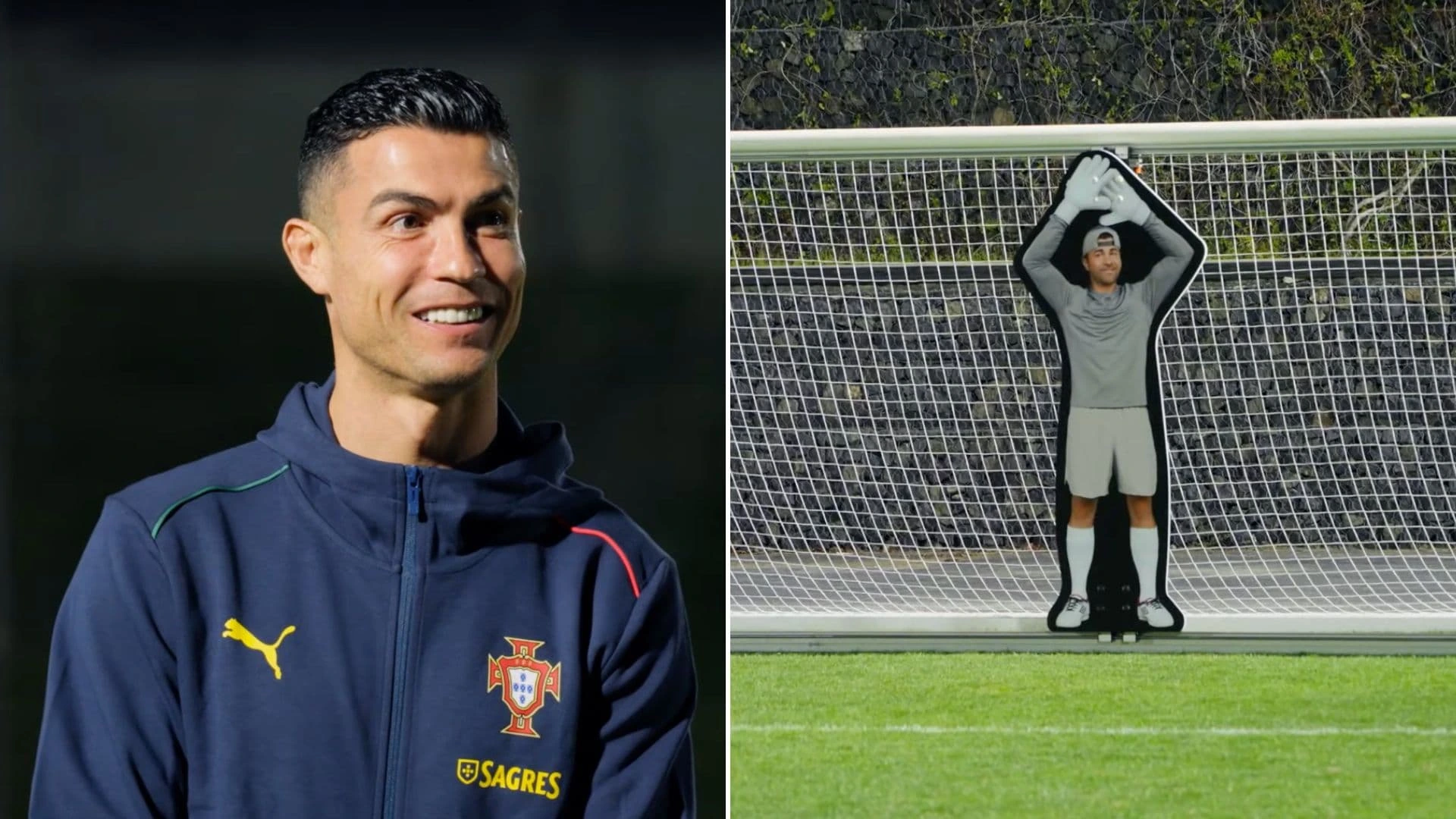
LONDON — Former NASA engineer Mark Rober has taken his signature blend of science and entertainment to the football pitch, developing a robotic goalkeeper designed to block shots from Cristiano Ronaldo, one of the world’s most celebrated footballers.
The experiment, a fusion of advanced engineering and sports technology, seeks to answer a simple question: can precision engineering outmatch elite athletic instinct?
Rober, known for viral creations ranging from glitter bombs targeting porch pirates to intricate squirrel obstacle courses, began considering a football focused project after a Sidemen charity match at Wembley Stadium.
“Scoring in front of 90,000 people felt like a moment of redemption,” Rober said. “I realized that while I couldn’t go pro, maybe I could build something that could compete.”
After consulting American soccer legend Landon Donovan for basic training advice, Rober found the athletic path out of reach. His solution turned to technology: a robot capable of reacting faster than the human eye.
The robotic goalkeeper is powered by a pair of 50 horsepower motors mounted on a carbon fiber frame that slides horizontally across the goal.
High speed OptiTrack infrared cameras track the ball at 500 frames per second, feeding real time 3D trajectory data to a computer every six milliseconds.
“Humans simply cannot process a penalty shot traveling at 80 miles per hour in under a quarter of a second,” said Dr. Amanda Liu, a robotics professor at Imperial College London.
“Machines, with the right sensors and programming, can predict and respond to these trajectories with remarkable accuracy.”
Experts caution, however, that replicating the subtleties of human motion remains a challenge. “Goalkeepers do more than just move sideways,” said sports analyst Kevin Murphy.
“They anticipate spin, adjust posture, and make split second decisions that a robot may struggle with outside controlled conditions.”
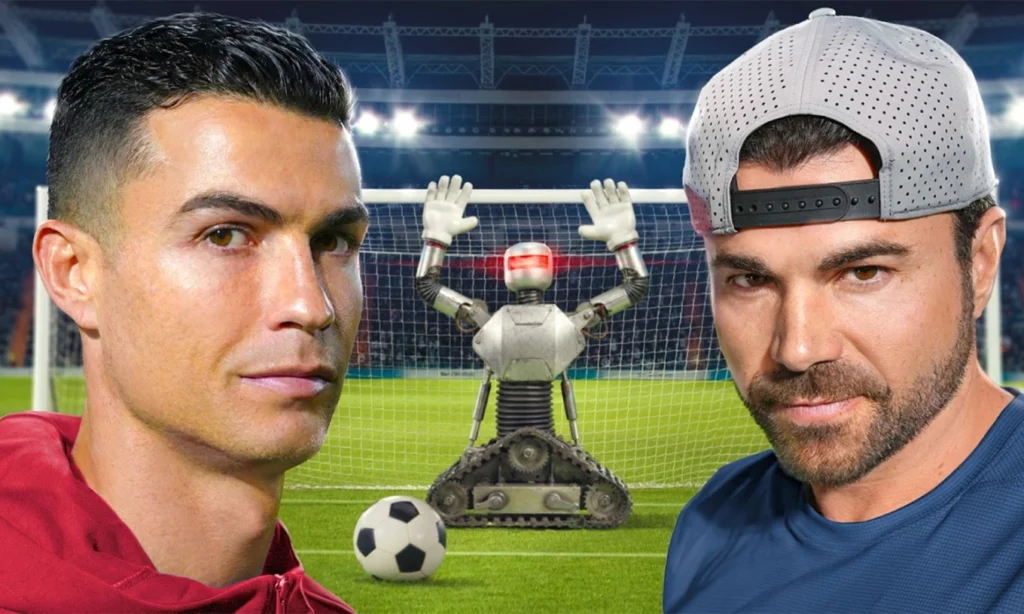
According to Rober’s team, each shot taken during testing generated thousands of data points, improving predictive algorithms. Straight line rockets, dipping volleys, and bending shots from top young US players helped refine the robot’s responses.
Some high impact attempts caused minor mechanical failures, including broken padding and snapped components, underscoring the physical limits of engineering at high speed.
The robot’s carriage can reach speeds of over 40 mph, covering the 12 yard goal mouth in milliseconds.
By comparison, human goalkeepers average reaction times of roughly 200 to 250 milliseconds for penalty kicks, leaving minimal margin for error against elite shooters like Ronaldo.
Local fans attending testing sessions at Wembley expressed amazement. “I’ve never seen anything like it,” said football enthusiast James O’Connor. “It’s fascinating to watch a robot try to compete with human instinct.”
Players involved in the trials were equally impressed. “It’s unlike any training I’ve ever had,” said young striker Miguel Torres. “The robot forces you to be precise and creative because even the slightest miscalculation gets blocked.
Rober envisions the technology extending beyond experimental setups. “Applications could include goalkeeper training, robotics competitions, and even enhancing sports analytics,” he said.
Experts note that while a fully autonomous robot competing in professional matches is unlikely in the near term, hybrid systems could support player development and injury prevention.
Robotics professor Liu added that the lessons from Rober’s project could influence fields ranging from autonomous vehicles to industrial automation. “The ability to track and react to high speed objects with millimeter accuracy has broad implications beyond sports.”
The robotic goalkeeper represents a marriage of engineering ingenuity and athletic challenge, testing the limits of both machine and human performance.
While the experiment remains a controlled showcase, it highlights the growing role of technology in sports science.
As machines increasingly complement human capabilities, experiments like Rober’s provide insight into how precision engineering can augment and sometimes rival elite athletic skill.


