
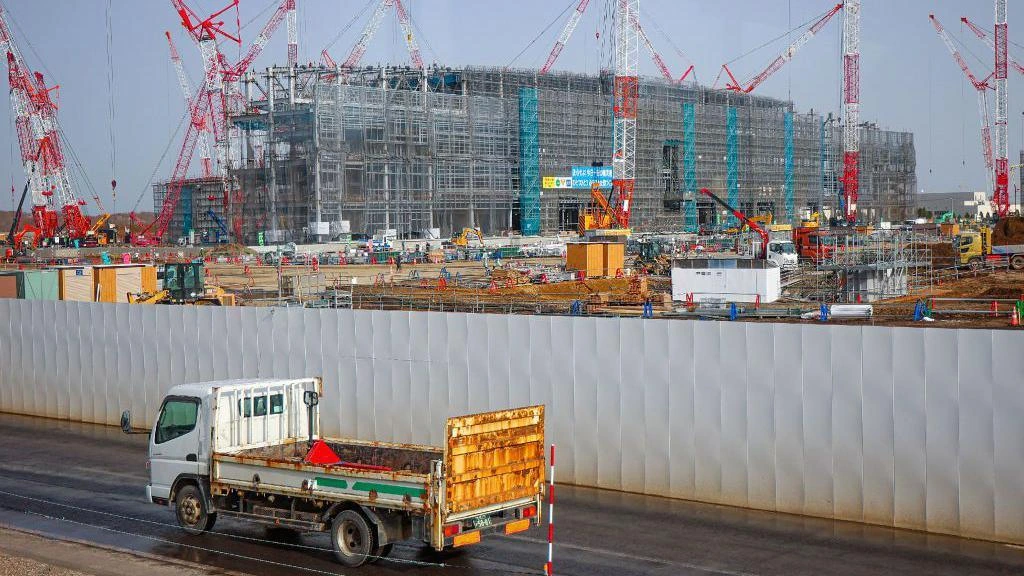
CHITOSE, Japan — Cranes tower over fields of lavender and dairy farms on the northern island of Hokkaido, where Japan has launched what officials call Japan’s high stakes gamble to rebuild its semiconductor industry and stake a claim in the global race for advanced chips.
Billions of dollars are flowing into new factories, research centers and training institutes as the government pushes to transform the agricultural region into a center for cutting edge technology.
The effort is led by Rapidus, a state backed chip maker that earlier this year produced Japan’s first prototype two nanometre transistor, a milestone that placed the country back into a contest long dominated by Taiwan and South Korea.
“We are attempting something that has not been done in Japan for decades,” Rapidus chief executive Atsuyoshi Koike said. “This region offers water, power and stability that are critical for advanced chips.”
For years, Hokkaido has been known for dairy herds, scenic ski resorts and summer flower fields rather than technology.
More than half of Japan’s dairy supply comes from the island, which locals often describe as a place with limited industrial opportunities outside farming and tourism.
The government’s new plan aims to change that. Under Japan’s high stakes gamble, Tokyo has earmarked massive subsidies to revive domestic chip production after decades of losing ground to global competitors.
Officials believe the country must secure its own chip supply to reduce dependence on foreign manufacturing. “Semiconductors are the backbone of every major industry,” said Naoko Ishida, a senior analyst at the Ministry of Economy, Trade and Industry.
“Japan cannot stand on the sidelines.” Rapidus chose Chitose in part due to its water supply, strong electricity grid and comparatively lower earthquake risk.

The company’s facility is being constructed with a grass covered roof designed to blend into the natural landscape, a reflection of Hokkaido’s environmental sensitivities.
Japan’s reentry into the global chip race will not be easy. Analysts note that competitors such as Taiwan Semiconductor Manufacturing Company (TSMC) and Samsung have decades of experience and deep networks with major electronics companies.
“Rapidus is attempting a leap that normally takes many years,” said Daniel Kroft, a semiconductor researcher at the Asia Pacific Technology Institute. “They have achieved an impressive early milestone, but mass production is a different challenge.”
CSIS previously warned that Rapidus lacks advanced manufacturing experience and has limited access to the expertise held by TSMC and Samsung.
The company has relied heavily on research partnerships, particularly with IBM, to accelerate development of two nanometre chip technologies.
Koike acknowledged the gap but said collaboration is part of the strategy. “We cannot succeed alone. Global partnerships are essential.”
The global semiconductor market is worth roughly $600 billion and is expected to grow as demand for AI driven devices increases.
Two nanometre chips represent the leading edge of efficiency and performance, and only TSMC and Samsung currently manufacture them at scale.
TSMC has invested heavily in yield optimization, an area where experts believe Rapidus will face its toughest challenges. “The technology is only one part,” Kroft said. “What matters is producing enough chips, at high enough yield, to be competitive.”
A 2024 report by the Asean+3 Macroeconomic Research Office estimated that Rapidus will need at least five trillion yen to reach full mass production. Current public subsidies and industry contributions fall short of that amount.
Intel, meanwhile, is bypassing two nanometre technology entirely, moving directly to one point eight nanometre designs, adding more pressure on global competitors.
In Chitose, reactions to the transformation are mixed. Some residents welcome the investment, while others worry about rapid changes to the community.
“For decades, young people left Hokkaido because there weren’t many jobs outside farming,” said dairy farmer Michio Tanaka. “If this brings opportunities, that’s good for us.”
But longtime shop owner Rie Matsumoto expressed concerns. “Construction is everywhere, prices are rising and traffic is changing. I hope we don’t lose the identity of this place.”
Local officials say the project has already attracted new universities, training programs and support industries.
“We expect thousands of skilled jobs,” said Chitose deputy mayor Haruto Nomura. “This is the biggest economic shift in the region’s modern history.”
Rapidus plans to begin mass production of two nanometre chips by 2027, a timeline experts describe as ambitious but not impossible.
The company received one of its most critical pieces of equipment this year ASML’s extreme ultraviolet lithography system which is essential for producing ultra thin transistor layers.
To meet its goals, Rapidus must secure additional financing, expand partnerships and win customers in a highly competitive market.
“Without long term demand from global electronics makers, the business case becomes difficult,” Kroft said.
Still, government officials say the national interest goes beyond profit. “This is not only about economics,” Ishida said. “It is about securing the technologies that will drive the next generation.”
Locals hope the changes will spark new educational and economic opportunities that keep younger residents on the island. “If this succeeds, Hokkaido could become a completely different place,” Tanaka said.
Japan’s attempt to turn Hokkaido into a global semiconductor hub represents one of the country’s most significant industrial bets in decades.
Whether Japan’s high stakes gamble will elevate the nation into the top tier of chip making remains uncertain, but the push has already reshaped the island’s landscape and ambitions.
As factories rise alongside fields of lavender and snow covered peaks, Hokkaido stands at a crossroads between its agricultural past and a high tech future.


