
SUMMARY
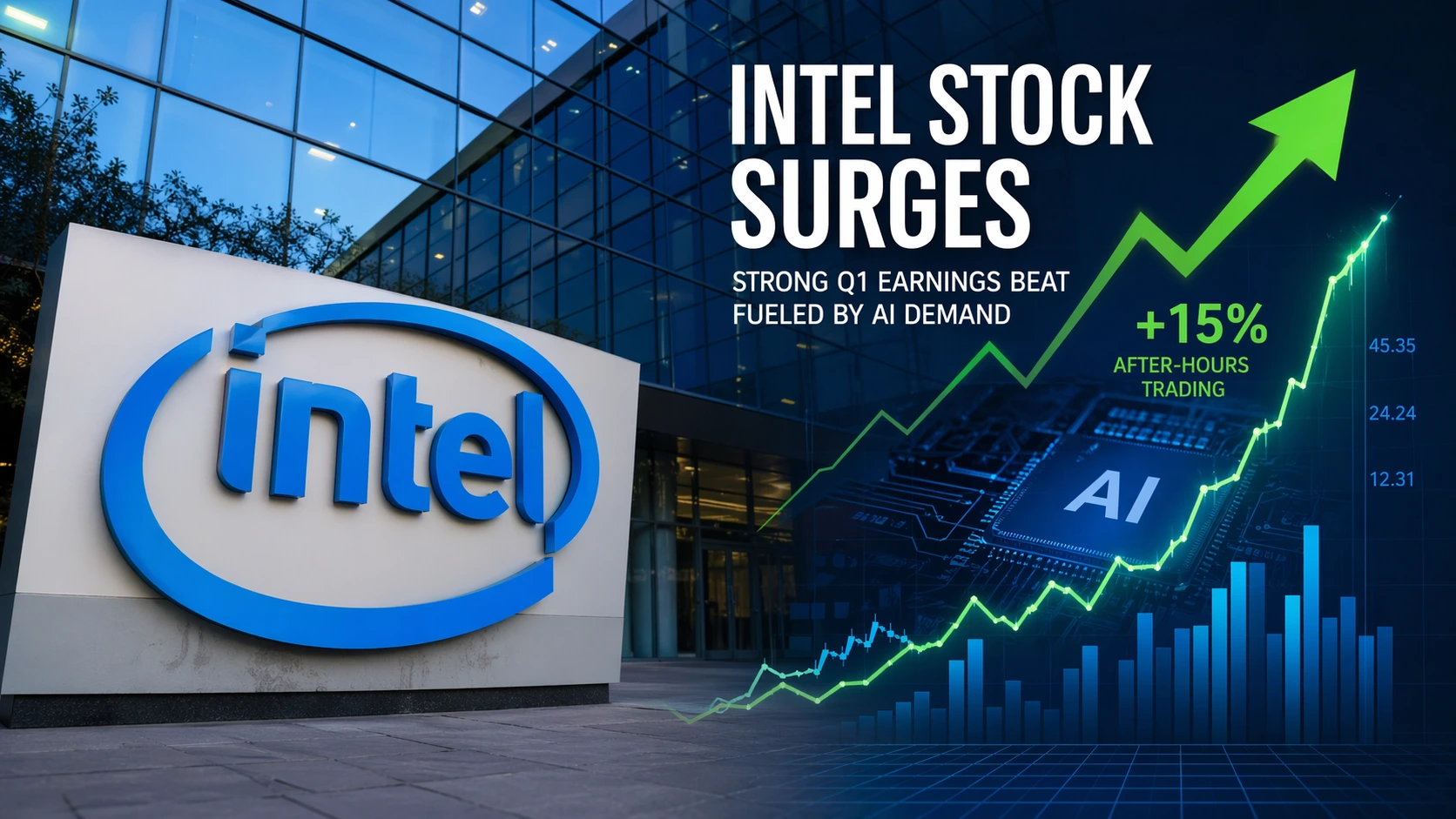
- Intel stock rises on AI demand optimism signaling renewed confidence in semiconductor industry recovery.
- Data center CPU growth strengthens Intel amid broader foundry expansion strategy.
- Intel stock momentum remains tied to yield performance and competition with TSMC in advanced chips.
Global markets are watching Intel stock in March 2026 as the company attempts a turnaround in semiconductor competition. Its earnings beat suggests stabilization after volatile performance.
Investors are weighing whether AI chips demand and data center growth can offset manufacturing challenges across global supply chains.
Market participants are also assessing geopolitical implications of semiconductor supply chain concentration in Taiwan and the United States as governments push diversification strategies to reduce future disruption risk long term.
Intel stock trends shifted through 2024–2025 as it lagged AI rivals Nvidia and AMD while investing in new fabs. CEO Lip-Bu Tan prioritized foundry customers and advanced nodes like 18A and 14A.
US incentives and institutional equity support strengthened its capital position ahead of latest earnings.
Patrick Moorhead of Moor Insights & Strategy said Intel stock reflects renewed confidence in its 18A roadmap and AI-driven CPU demand shift toward broader workloads beyond GPUs.
Stacy Rasgon of Bernstein Research said Intel stock progress depends on yield gains and foundry execution against TSMC competition in advanced manufacturing.
Moorhead added that diversification of AI compute away from GPU dominance is reshaping the semiconductor industry, while Rasgon emphasized that sustained data center CPU demand will determine whether Intel can convert design wins into long term revenue stability.
Michael Chen, Texas supply chain manager, said Intel stock optimism has improved order visibility. “We see longer commitments,” he said.
Laura Gómez, portfolio manager in Singapore, said Intel stock gains are reshaping Asia allocations. “We are rotating into U.S. chipmakers,” she said.
Ahmed Khan, Intel Arizona technician, said 18A production is progressing but yield issues remain. “We are fine tuning processes,” he said.
Over six to twelve months, Intel stock will depend on 18A yield improvements and early 14A adoption by hyperscale customers. AI workloads may increase CPU demand beyond GPU centric systems.
US manufacturing incentives could stabilize investment flows. Execution risk remains tied to process node transitions and production scaling.
Intel stock remains a key barometer for global semiconductor competitiveness as the company attempts to reestablish manufacturing leadership while competing with established foundry giants and AI-focused chip designers.
The outcome of its current transformation will influence supply chain diversification strategies across North America Europe and Asia particularly in advanced computing infrastructure.
Continued performance of Intel stock will serve as a benchmark for how legacy chipmakers adapt to AI-driven computing cycles and advanced manufacturing competition globally shaping investor confidence and industrial policy decisions across major economies 2026.
NOTE! This article was generated with the support of AI and compiled by professionals from multiple reliable sources, including official statements, press releases, and verified media coverage. For more information, please see our T&C.


