
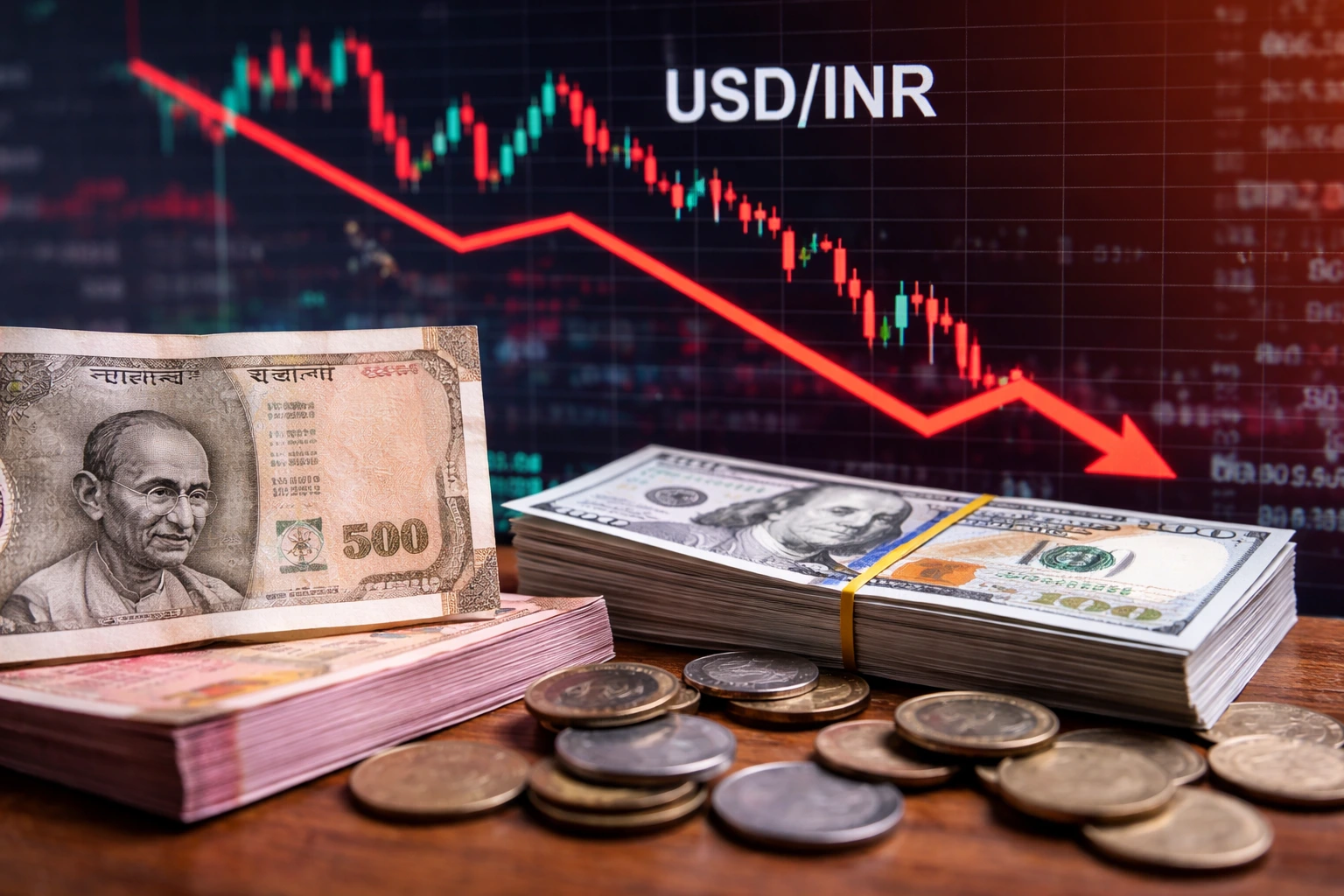
The Indian rupee slipped against the US dollar on Monday in Mumbai as concentrated dollar demand around the Reserve Bank of India’s reference rate coincided with weakness across Asian currencies.
Underscoring persistent external pressures on India’s foreign exchange market at the start of the year.
KEY POINTS
- The rupee weakened for a fourth straight session as dollar demand intensified near the RBI reference rate.
- Regional Asian currency softness and cautious investor sentiment added pressure on the rupee.
- Uncertainty around US India trade relations continues to weigh on foreign flows and near term currency stability.
The rupee ended Monday at 90.2775 per dollar, down from 90.1975 on Friday, reflecting steady dollar demand and limited supply from exporters.
The move, while modest in magnitude, highlights how technical factors such as the RBI reference rate can amplify routine corporate flows and influence short term currency direction.
The rupee traded within a narrow band of about ten paise during the session, pointing to controlled volatility even as underlying sentiment remained defensive.
India’s central bank publishes a daily reference rate that serves as the benchmark for settling a wide range of financial contracts, including derivatives.
Traders say this fixing often attracts concentrated buying or selling as banks and corporates square positions.
On Monday, the rate coincided with renewed dollar demand, following last week’s RBI intervention that helped the rupee recover from recent lows.
Market participants said that induced stability tends to be followed by pent up demand from importers, Particularly energy companies and large manufacturers, once the currency steadies.
Exporter selling, which can offset such demand, remained muted, limiting downside support for the rupee. The rupee’s movement also mirrored broader regional trends.
Asian currencies such as the Malaysian ringgit and Philippine peso weakened, while the dollar remained firm against a basket of peers.
Although Asian equity markets rose on renewed interest in artificial intelligence linked stocks, currency markets took little comfort from the equity rally.
Traders and analysts said the rupee’s retreat reflects a recalibration after last week’s recovery rather than a disorderly selloff.
According to market participants, routine corporate hedging demand was sufficient to push the currency lower in the absence of exporter offers.
Analysts at ICICI Securities Primary Dealership said the RBI may remain tolerant of a sharp rebound in the rupee if one emerges, as allowing appreciation could deter speculative short positions.
At the same time, they cautioned that the balance of risks still favors a weaker rupee until clarity emerges on external trade relations and foreign portfolio flows improve.
Investor sentiment toward India has been tempered by trade related uncertainty.
Concerns persist over the absence of a comprehensive US India trade agreement and ongoing tariff rhetoric linked to India’s purchases of Russian crude oil.
US President Donald Trump has warned of higher tariffs on India, and the United States doubled import tariffs on Indian goods to fifty percent last year in response to India’s energy imports from Russia.
These measures have raised questions among global investors about the durability of India’s export competitiveness and access to its largest trading partners.
| Metric | Latest | Prior Reference |
|---|---|---|
| Spot rupee close | 90.2775 per dollar | 90.1975 per dollar (Friday) |
| Consecutive sessions weaker | Four | Three previously |
| Intraday trading range | About ten paise | Similar narrow ranges last week |
| Forward premium trend | Rising | Bottomed |
A senior foreign exchange dealer at a private bank said the rupee’s movement was “largely flow driven, with importer demand dominating the session and little exporter selling to counterbalance it.”
Another trader at a state run bank said regional cues played a role.
“When peers like the ringgit and peso soften together, the rupee rarely decouples unless there is strong domestic support,” the trader said.
An economist at a Mumbai based brokerage said the RBI’s approach appears aimed at smoothing volatility rather than defending a specific level.
“The central bank seems comfortable letting market forces play out within a range, stepping in mainly to prevent abrupt moves,” the economist said.
Market participants expect the rupee to remain sensitive to global dollar trends, crude oil prices and developments in trade negotiations.
While oil prices dipped on expectations that US military action in Venezuela would not disrupt a well supplied energy market.
Any sustained rise in crude could renew pressure on India’s import bill and currency. Foreign portfolio flows are also seen as a key determinant.
Analysts said a clearer signal on US India trade relations or a revival of global risk appetite could help stabilize the rupee.
Until then, traders expect range bound trading with intermittent bouts of dollar demand around technical levels such as the RBI reference rate.
The rupee’s latest dip underscores how technical benchmarks, regional currency trends and unresolved trade issues continue to shape India’s foreign exchange market.
While volatility remains contained, the currency’s direction reflects broader uncertainties facing emerging markets as they navigate shifting global trade dynamics and dollar strength.
Author’s Perspective Adnan Rasheed
In my analysis, the rupee’s weakness near the RBI reference rate reflects steady structural dollar demand rather than market stress.
I believe this signals a shift toward tighter but persistently weaker trading ranges.
I predict that the rupee will remain range bound yet biased weaker as trade uncertainty and selective foreign inflows reshape India’s currency dynamics.
Importers should hedge in phases instead of waiting for sharp RBI driven rebounds, which may prove short lived.
NOTE! This report was compiled from multiple reliable sources, including official statements, press releases, and verified media coverage.


