
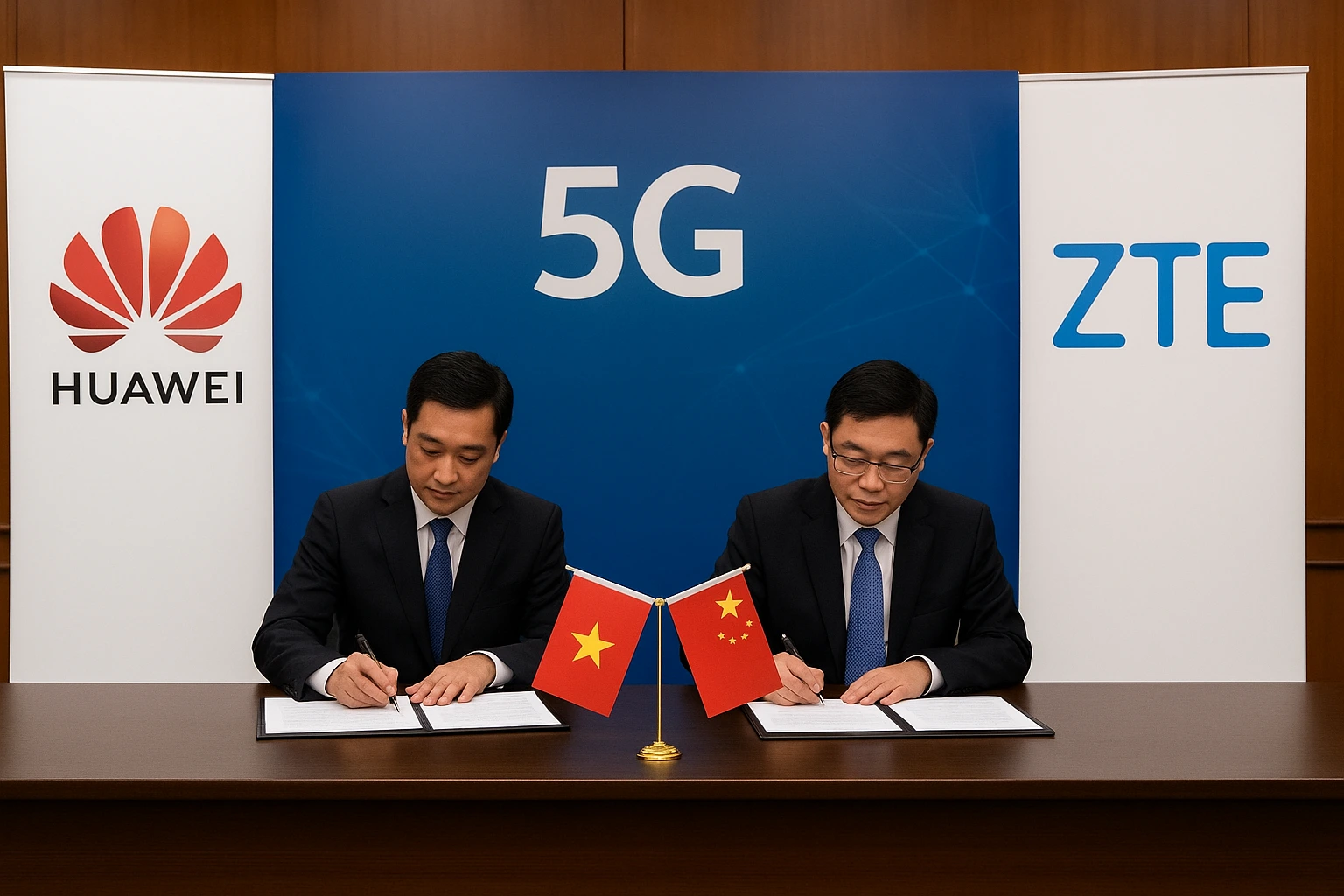
HANOI, Vietnam — China’s telecom giants Huawei and ZTE have secured a series of 5G equipment contracts in Vietnam this year, marking a notable shift in the country’s infrastructure strategy and signaling warmer ties with Beijing even as relations with Washington grow tense.
The Huawei and ZTE 5G deals in Vietnam come as Hanoi balances global pressure over security concerns with economic and geopolitical realities, according to seven people with direct knowledge of the negotiations.
For years, Vietnam avoided Chinese firms in its critical digital networks. But recent procurement data reviewed by reporters shows the state is now allowing limited Chinese participation in 5G rollout projects, raising questions among Western officials who have long urged Hanoi to exclude Chinese technology from sensitive systems.
The Huawei and ZTE 5G deals in Vietnam coincide with escalating trade friction between Hanoi and Washington after the White House imposed tariffs on Vietnamese goods earlier this year.
Shortly after the measures took effect, a consortium including Huawei won a contract worth about $23 million for 5G equipment in April, while ZTE secured two separate tenders totaling more than $20 million.
Vietnam previously relied almost entirely on European providers such as Sweden’s Ericsson and Finland’s Nokia, with US chipmaker Qualcomm supplying network hardware.
The shift toward Chinese vendors represents a strategic recalibration for a country that has historically kept Beijing at arm’s length due to sovereignty disputes and domestic public skepticism.
Washington has long viewed Vietnam’s digital infrastructure as a critical arena for influence in Southeast Asia. US officials have warned that the presence of Chinese telecom firms could undermine future technology collaborations.
Huawei and ZTE are barred from US networks over national security risks, while several European nations enforce similar restrictions.
Still, Vietnam has also deepened cooperation with China on other sensitive development projects, including cross border railways and special economic zones previously shelved over security concerns.
Analysts say the Huawei and ZTE 5G deals in Vietnam reflect Hanoi’s pragmatic approach as it attempts to maintain economic stability and diplomatic balance amid intensifying global competition.
“Vietnam has always walked a tightrope between the US and China, but these new deals show increasingly visible tilt toward Beijing,” said Nguyen Hung, a supply chain researcher at RMIT University Vietnam.
“Although Western partners want Vietnam to avoid Chinese technology, Hanoi has its own priorities, including cost, speed and political stability.”
Another analyst, Pham Doan Binh of the Hanoi Institute for Policy Strategy, said Chinese firms often offer more flexible financing than Western competitors.
“Chinese telecom vendors are fast, inexpensive and persistent. Vietnam cannot ignore those advantages, especially during a period of economic uncertainty,” he said. Security concerns, however, remain a central issue.
Western officials who spoke on background said the new contracts pose “long term strategic risks,” particularly if Chinese vendors gain deeper access to network infrastructure. But Vietnamese officials argue the new contracts are limited in scope.
“Core 5G infrastructure remains in the hands of trusted partners,” said a senior official in Vietnam’s Ministry of Information and Communications, who was not authorized to speak publicly.
“The new agreements involve peripheral systems and antennas, not sensitive control architecture.” Vietnam’s 5G deployment has lagged behind regional peers.
While Singapore, South Korea and China have pushed rapid nationwide rollouts, Vietnam remains in early deployment phases due to cost constraints and cautious policy decisions.
- More than $43 million in newly awarded contracts involving Huawei and ZTE this year
- Over 75 percent of Vietnam’s 5G core infrastructure still controlled by European providers, according to industry estimates
- Three state owned operators participating in tenders involving Chinese vendors
- One month between the enforcement of US tariffs and the first major Huawei contract win
Industry data suggests that the Huawei and ZTE 5G deals in Vietnam remain smaller compared with Chinese telecom dominance in Africa or South Asia, but their symbolic weight is significant.
Locals and business owners in Hanoi express mixed views about the shift. Tran Minh Quang, who runs a small electronics repair shop, said cost matters more than politics.
“People here want fast 5G and good prices. If Chinese companies provide cheaper technology, many Vietnamese will support it,” he said.
But cybersecurity engineer Le Thi Hoa warned that even limited integration could create vulnerabilities. “Any foreign company added into a national network increases risk, but Chinese vendors raise unique concerns because of government influence,” she said.
Some telecom workers say the market has long anticipated this outcome. “We’ve been expecting Chinese companies to return eventually,” said a technician at state owned Viettel who asked not to be named. “Vietnam cannot afford to rely on only two suppliers forever. Competition is needed.”
Experts say Vietnam will continue navigating between opposing geopolitical forces while building its digital infrastructure according to domestic priorities.
The Huawei and ZTE 5G deals in Vietnam could expand if cost pressures rise or if relations with Washington deteriorate further.
Still, many believe Hanoi will maintain a careful balance by limiting Chinese access to core systems while allowing selective participation in noncritical areas.
“Vietnam will not fully pivot to Beijing. It will continue walking the middle path,” said Binh of the Hanoi Institute. “The country wants technology, investment and stability from both sides.”
Western governments are expected to keep a close eye on future tenders, especially as Vietnam advances toward broader 5G coverage and develops new cybersecurity policies.
Vietnam’s decision to award new telecom contracts to Chinese firms marks a subtle yet significant adjustment in its regional strategy.
While the Huawei and ZTE 5G deals in Vietnam remain limited, they underscore shifting geopolitical currents and highlight Hanoi’s desire to maintain flexibility amid rising global tensions.
As Vietnam continues building out its digital networks, the balance between economic necessity and security concerns is likely to define its policy direction in the coming years.


