
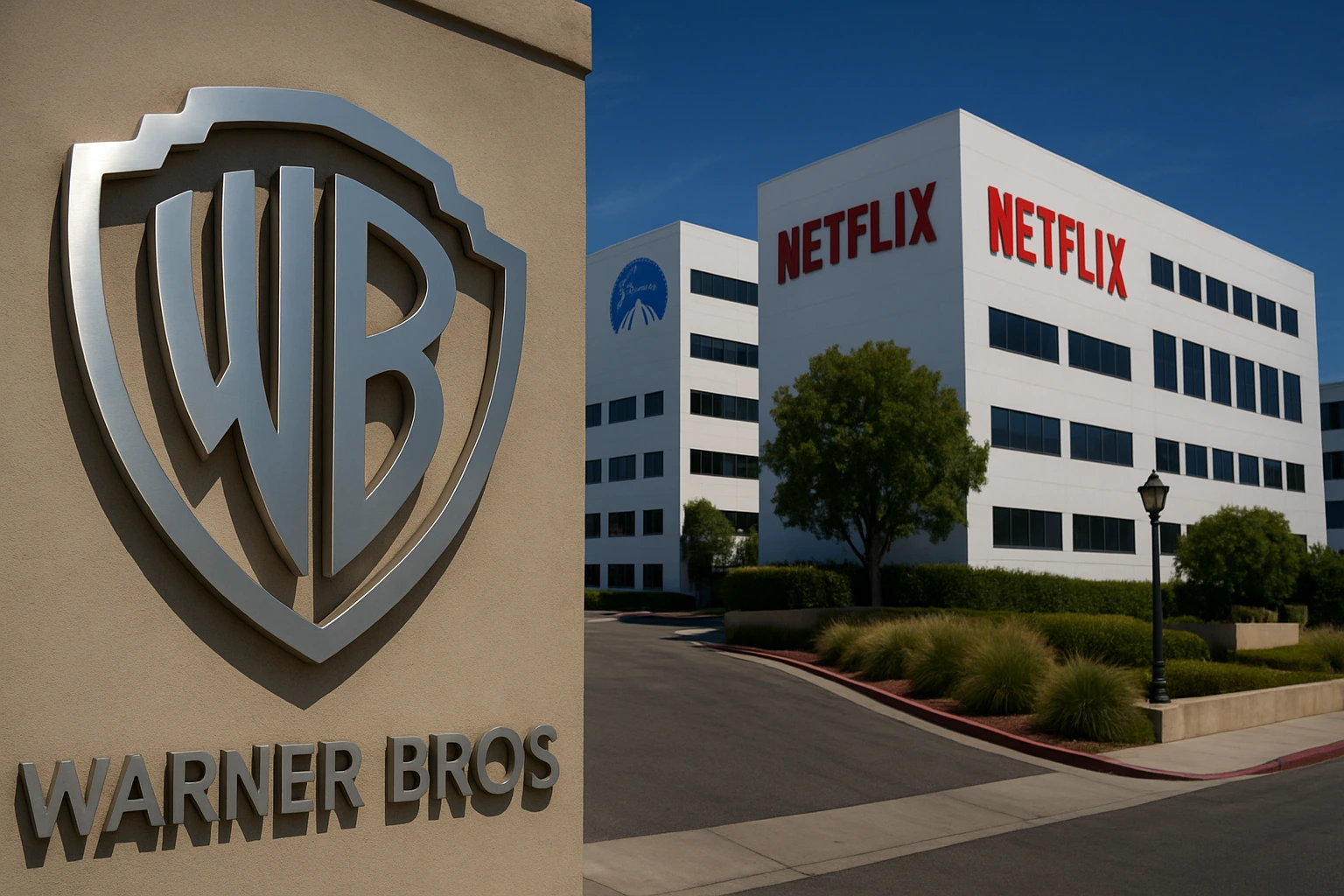
A fierce Hollywood power tussle erupted this week as Paramount Skydance launched a hostile bid valued at $108.4 billion for Warner Bros Discovery, challenging a competing proposal from Netflix and raising new questions about the future direction of one of Hollywood’s oldest studios.
The competing offers mark the company’s fourth major restructuring since 2000 and have intensified speculation across the entertainment industry.
Warner Bros Discovery, the parent company behind the Warner Bros film studio and HBO Max, has faced repeated reorganizations in the past two decades as shifting consumer habits and streaming competition reshaped the media landscape.
Its latest upheaval comes as traditional entertainment firms confront slowing subscriber growth and rising production costs.
If Paramount’s offer prevails, the combined entity would overtake Disney in box office market share in the United States and Canada.
Industry analysts said such a merger would mark one of the most significant consolidation moves since Disney acquired 21st Century Fox in 2019, reshaping the hierarchy of the entertainment sector.
This is the highest stakes merger discussion Hollywood has seen in years, said Laura Benton, a media economist at UCLA. It’s not only about content libraries but about survival in a landscape governed by scale.
The Hollywood power tussle intensified after Sensor Tower data showed Disney+ holds roughly 15 percent of global app monthly active users, trailing both Netflix and HBO Max in user engagement metrics.
Analysts said that gap underscores the struggle among legacy studios to keep pace with streaming first competitors. Paramount’s bid would strengthen its hand in the streaming wars by adding HBO Max’s critically acclaimed lineup, including “Game of Thrones,” “Succession,” “The Wire” and “The Sopranos.”
That catalog could significantly expand Paramount+ viewership and raise its profile among prestige drama audiences. “There is enormous strategic value in Warner Bros Discovery’s intellectual property,” said Marcus Field, managing director at media advisory firm Hudson Bridge Group.
“Paramount wants to bulk up its streaming platform, while Netflix’s interest reflects its goal to secure premium franchises it does not yet own.”
Netflix has not publicly disclosed the value of its competing proposal, but people familiar with the talks said the company aims to block rival studios from amassing larger content libraries that could challenge its dominance.
The Hollywood power tussle is unfolding as YouTube continues to dwarf the rest of the streaming ecosystem. Alphabet’s video platform commands the largest share of total TV viewing time in the United States, driven by a mix of advertising supported content, user-generated videos and live services.
YouTube reported in March that it had more than 125 million paying subscribers, a figure that includes users on temporary free trials. Its footprint extends far beyond traditional streaming rivals, with about 2.9 billion mobile app monthly active users this quarter.
Sensor Tower data indicates that number exceeds the combined MAUs of Netflix, Disney+, HBO Max, Paramount+ and Peacock.
“Any merger involving Warner Bros Discovery will still leave these studios fighting for attention in a world where YouTube dominates viewing time,” said Thomas Aguilar, a digital strategy professor at NYU. “Scale matters, but audience behavior matters even more.”
News of the bids has reverberated across Los Angeles, where studio workers expressed both optimism and anxiety.
“I’ve lived through three reorganizations already, and each time we worry about layoffs,” said Dana Cooper, a lighting technician who has worked on Warner Bros sets for more than twenty years.
“A deal this big could mean new opportunities, or it could mean more uncertainty.” Local business owners who rely on studio activity said they are watching developments closely.
“When production slows during merger talks, everyone feels it caterers, rental companies, even local restaurants,” said Carlos Jimenez, who runs a small equipment shop near Burbank. “We just hope the transition, whatever it is, keeps the work coming.”
The Hollywood power tussle is expected to escalate as regulators scrutinize potential antitrust implications and boards weigh the financial and strategic merits of each offer.
Analysts said any final deal could take months to negotiate, especially given the size of the assets and competing industry pressures.
Market trends suggest further consolidation is likely. Slower subscription growth, rising sports-rights costs and the fragmentation of streaming audiences have pushed studios to seek economies of scale.
Netflix’s interest signals its desire to secure more exclusive franchises, while Paramount aims to protect its position amid intensifying competition.
Still, approval from shareholders and federal regulators remains uncertain, particularly in an election year when corporate consolidation faces heightened scrutiny.
As competing bids from Paramount and Netflix move forward, the Hollywood power tussle over Warner Bros Discovery has placed unprecedented pressure on the studio system.
With market share, streaming supremacy and long term survival all at stake, the entertainment industry is bracing for a reshaped hierarchy that could redefine how Americans watch television and film for years to come.


