
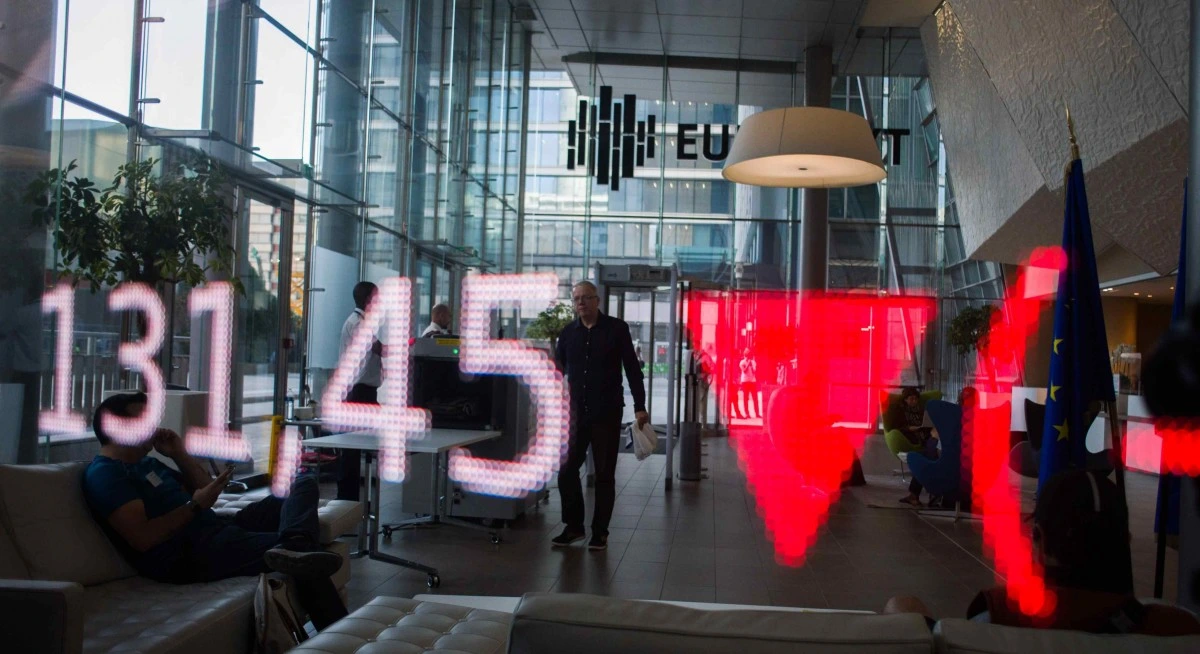
LONDON — European markets opened the final month of the year in negative territory Monday, with defense stocks leading declines as investors assessed renewed momentum in peace negotiations over Ukraine and awaited signals from the US Federal Reserve.
The Stoxx 600 slipped about 0.3 percent shortly after markets opened in London, extending pressure that had built through a volatile November.
Major European bourses closed higher Friday after a turbulent month marked by shifting expectations for artificial intelligence valuations and lingering uncertainty over monetary policy.
While sentiment had improved in late November, the tone turned cautious again as the calendar turned to December.
The possibility of a diplomatic breakthrough in the Ukraine conflict weighed heavily on defense shares, traditionally sensitive to geopolitical shifts. Traders also continued to assess the US economic outlook.
Market pricing implied an 87.4 percent probability of a quarter point rate cut when Federal Reserve officials meet Dec. 9 to 10, according to CME’s FedWatch tool.
Rate expectations have played an outsized role in recent market swings, particularly as inflation stabilizes across major economies.
Analysts said the early-session pullback reflected a mix of geopolitical uncertainty and typical year end position adjustments.
“The downturn in European markets this morning is not particularly surprising,” said Daniel Mercer, a senior strategist at Helios Capital in London.
When peace negotiations accelerate, defense stocks often react first, and we’re seeing that dynamic play out clearly today. Mercer added that monetary policy remains a central driver.
Investors are trying to game out whether the Fed stays cautious or delivers the cut markets are expecting. December historically brings lower volatility, but given the crosscurrents, traders are being careful.
Defense contractors including Rheinmetall, Renk and Hensoldt dropped between two and almost four percent as diplomats intensified efforts toward a Ukraine ceasefire.
US Special Envoy Steve Witkoff traveled to Moscow for discussions with Russian President Vladimir Putin, following Ukraine’s “in principle” approval of a revised nineteen point peace plan backed by Washington.
Elena Visser, a political risk analyst with the Rotterdam based Peterson Group, said the talks remain fragile. “Some investors read the progress as a strong signal, while others see it as one more tentative step in a long diplomatic process,” she said. “Markets are reacting before clarity emerges.”
While defense stocks lagged, mining shares helped limit broader losses. Fresnillo gained more than three percent as spot gold prices hit a six week high at $4,251.22, up nearly one half of one percent. Anglo American and Glencore also advanced early in the session.
Airbus declined over two percent after confirming that it had initiated rapid software updates across its A320 fleet following concerns that solar radiation could potentially disrupt flight control data.
The manufacturer said it acted immediately to mitigate risk, and major travel disruptions were avoided. Across Asia, markets delivered a mixed performance Monday.
Chinese manufacturing data showed an unexpected contraction in November, raising new concerns about the pace of recovery in the world’s second largest economy.
US stock futures held steady after a strong November, with Wall Street poised to wrap up what analysts expect to be one of the stronger years of the decade.
Historical seasonality also played a role in trading sentiment. The S&P 500 has averaged gains of more than one percent in December since 1950, making it one of the index’s best months, according to the Stock Trader’s Almanac.
Still, analysts warn that seasonal patterns alone may not override macroeconomic uncertainty this year. Investors across Europe described Monday’s trading tone as watchful rather than pessimistic.
People are nervous but not panicking, said Chiara Colleti, a retail investor from Milan who trades part time. “The news about Ukraine made me look at my portfolio again, especially the defense names, but I’m not making big moves yet.”
In Frankfurt, software engineer and private investor Matthias Krüger said he expects more fluctuations over the next two weeks.
“Every December feels a bit unpredictable, but this one is different because everything depends on political shifts,” he said. “If the peace process gains speed, European markets could look very different by year end.”
Traders in London echoed similar sentiments. “It’s not a sell off driven by fear,” said Sarah Bloom, a derivatives trader working near Canary Wharf.
“It’s more like everyone is waiting for direction, both from the peace talks and the Fed. The next two weeks will tell us how the year ends.”
Analysts said the market will likely remain sensitive to diplomatic developments, especially with back to back discussions involving US, Ukrainian and Russian officials.
US Secretary of State Marco Rubio described weekend talks in Florida as “very productive,” though he noted that “more work is needed.”
A clearer timeline for the Fed’s December decision could provide steadier footing for equities through the end of the year.
The expectation of easing financial conditions has supported global equity markets in recent weeks, but a surprise move or a more cautious tone from policymakers could shift market momentum.
Economic indicators from China, Europe and the United States will also help determine whether European markets can recapture late November gains. Manufacturing readings, inflation data and central bank commentary are all scheduled in the coming days.
As the final trading month begins, European markets face a confluence of geopolitical, economic and seasonal forces that could shape the closing weeks of 2025.
With defense stocks under pressure and investors watching high level Ukraine negotiations closely, early December has opened on a cautious note.
Market participants expect volatility to persist until monetary policy signals and diplomatic outcomes become clearer.


