
SUMMARY
- Billie Joe Armstrong delivered political remarks targeting ICE agents during a Super Bowl weekend party
- Green Day later performed a nonpolitical medley at the Super Bowl LX opening ceremony
- The episode highlights ongoing tensions between artists political speech and major sporting events
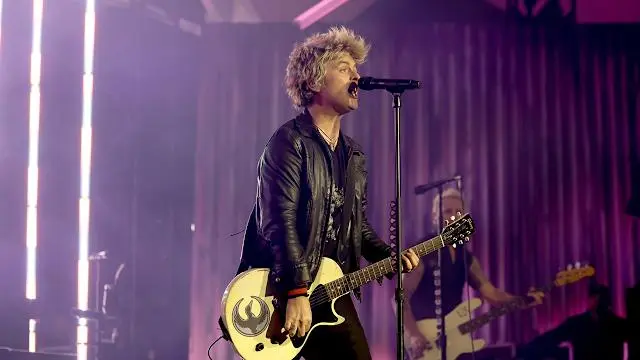
SAN FRANCISCO — Billie Joe Armstrong, the frontman of the pop-punk band Green Day, drew renewed attention during Super Bowl LX weekend after using profane language to urge Immigration and Customs Enforcement agents to resign during a private entertainment event in San Francisco, days before the band performed at the opening ceremony in Santa Clara, California.
The comments, delivered Friday at the FanDuel Party, contrasted sharply with Green Day’s Sunday performance before the championship game.
The episode underscored how high profile cultural moments tied to the Super Bowl continue to serve as flashpoints for political expression even when official broadcasts remain tightly scripted.
Green Day has a long history of opposing President Donald Trump and his policies. Billie Joe Armstrong has repeatedly altered lyrics during live performances to criticize the Make America Great Again movement.
In two thousand sixteen, the band led an anti Trump chant at the American Music Awards. More recently, Green Day released protest themed music reflecting broader political frustration.
President Trump criticized Green Day’s inclusion in Super Bowl festivities last month, telling The New York Post he believed the band “sowed hatred.” The White House did not respond Sunday to requests for comment regarding Armstrong’s remarks.
Emily VanDuyn, an associate professor of communication at the University of Texas at Austin, said artists increasingly separate official televised performances from off-stage speech.
“Large sports broadcasts prioritize neutrality, but surrounding events give musicians latitude to speak directly to niche audiences,” she said.
Robert Thompson, director of the Bleier Center for Television and Popular Culture at Syracuse University, said the Super Bowl’s scale amplifies even unofficial moments.
“Anything connected to Super Bowl weekend carries symbolic weight,” Thompson said. “Statements made nearby can influence public debate regardless of broadcast content.”
“We expect artists to have opinions, but timing matters,” said Jason Belcher, a sports marketing consultant based in Chicago.
Maria Gutierrez, an immigration policy researcher at the Migration Policy Institute, said the remarks reflect wider cultural polarization. “Entertainment figures are increasingly visible participants in policy debates,” she said.
NFL spokesperson Brian McCarthy said in an emailed statement that the league does not control speech at private events not affiliated with official programming.
As Super Bowl events expand beyond stadium walls, organizers and performers are likely to navigate ongoing boundaries between entertainment and political speech. No league policy changes were announced Sunday.
Billie Joe Armstrong’s comments, separated from Green Day’s official Super Bowl appearance, illustrate how music, politics and major global sporting events continue to intersect, reflecting broader debates about free expression and public platforms during culturally unifying moments.
NOTE! This article was generated with the support of AI and compiled by professionals from multiple reliable sources, including official statements, press releases, and verified media coverage. For more information, please see our T&C.


