
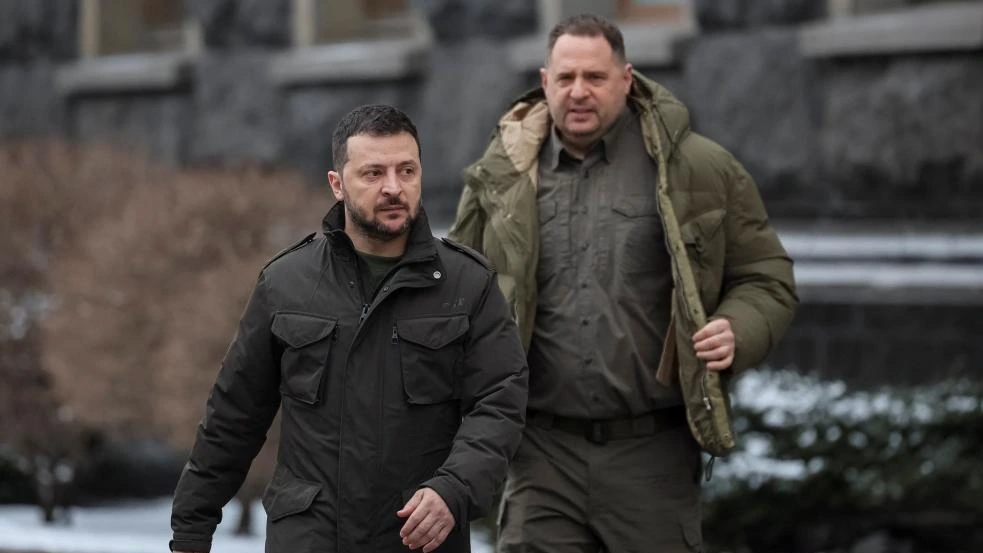
Kyiv, Ukraine — Andriy Yermak, Ukraine’s influential presidential chief of staff, resigned Friday following an anti corruption raid on his Kyiv residence, marking a sudden and destabilizing turn in the country’s wartime government.
Yermak, once considered the second most powerful figure in Ukraine, played a central role in shaping policy, negotiating international deals, and advising President Volodymyr Zelensky on critical matters.
Yermak and Zelensky first met in 2011 when the former was an intellectual property lawyer and the latter a television producer. After working closely on Zelensky’s successful 2019 presidential campaign, Yermak was appointed chief of staff and quickly became a fixture alongside the president.
He was present as Zelensky delivered his defiant “we are still here” speech at the onset of Russia’s full scale invasion in February 2022, a moment widely seen as defining the early days of Ukraine’s wartime leadership.
Over time, Yermak’s influence expanded beyond administrative duties. He reportedly helped shape foreign policy, coordinated internal political decisions, and advised on some battlefield strategies.
His proximity to the president and involvement in negotiations, including recent talks with US Secretary of State Marco Rubio in Geneva, underscored his centrality in Ukraine’s international dealings.
However, public sentiment toward Yermak had deteriorated amid growing scrutiny of Ukraine’s inner circles. In July, Zelensky moved to bring the country’s anti corruption agencies, the National Anti Corruption Bureau (NABU) and the Special Anti Corruption Prosecutor’s Office (SAPO), under direct government control.
While the president framed the move as a protective measure against Russian interference, critics inside Ukraine and abroad, including the European Union, condemned the shift. Mass demonstrations later prompted Zelensky to reverse the decision.
By autumn, both agencies released findings implicating several high ranking officials in siphoning $100 million from energy sector projects.
While Yermak was not formally named in the investigation, authorities reportedly seized laptops and mobile devices from his residence, fueling speculation about his awareness of the corruption scheme.
“Yermak’s resignation signals a moment of accountability for Ukraine, even amid war,” said Dr. Olena Kovalenko, a political analyst at Kyiv’s Institute for Governance Studies.
“It shows that independent institutions retain some influence, and no official, however close to the president, is entirely immune to scrutiny.”
Some experts warn, however, that his departure could have operational consequences. “Removing a figure so central to foreign negotiations and internal coordination could create a temporary vacuum,” said Mark Townsend, a European security analyst based in Brussels.
“Ukraine is balancing war time exigencies with domestic governance reforms, and transitions like this must be carefully managed.”
Ukraine’s political leadership has faced intense public scrutiny during wartime, particularly regarding energy and defense management.
With Russia targeting infrastructure ahead of a fourth winter of war, energy disruptions have compounded public frustration. For instance, Kyiv endured nearly an 11 hour power outage on Friday alone, leaving more than 500,000 residents without electricity.
This combination of wartime strain and corruption allegations has intensified calls for transparency in government operations.
Residents expressed mixed reactions to Yermak’s resignation. Iryna, a Kyiv teacher, said, “We are going through one of the most difficult times in our history. Families are losing loved ones, and we need leaders we can trust.”
Others saw the resignation as a sign of institutional strength. “It’s good news for Ukraine’s democracy,” said Oleksandr Petrov, an independent journalist in Lviv. “Even during war, agencies can investigate the most powerful people. That matters to people here and abroad.”
Yermak himself reportedly communicated to the New York Post that he intends to join the front line, asserting his innocence. “I am going to the front and am prepared for any reprisals. I am an honest and decent person,” he said, according to the report.
Following Yermak’s departure, Defence Minister Rustem Umerov is leading the Ukrainian delegation in ongoing US talks. Analysts caution that continuity in negotiations will be critical for Kyiv, particularly as international aid, military support, and potential peace proposals are under discussion.
“The government must demonstrate it can maintain stability while transitioning leadership roles,” said Dr. Kovalenko. “The challenge is balancing reform, accountability, and wartime decision making.”
The broader political impact remains uncertain, but many observers agree the move reflects both domestic pressures for anti corruption measures and the difficulties of governing during an ongoing war.
Andriy Yermak’s resignation underscores the complex interplay between wartime governance and domestic accountability in Ukraine.
While his departure may create short term disruption in government operations and international negotiations, it also highlights the capacity of Ukraine’s institutions to investigate powerful figures.
As the country navigates military, political, and economic challenges, the situation serves as a reminder of the ongoing tension between power, transparency, and public trust in a nation at war.


