
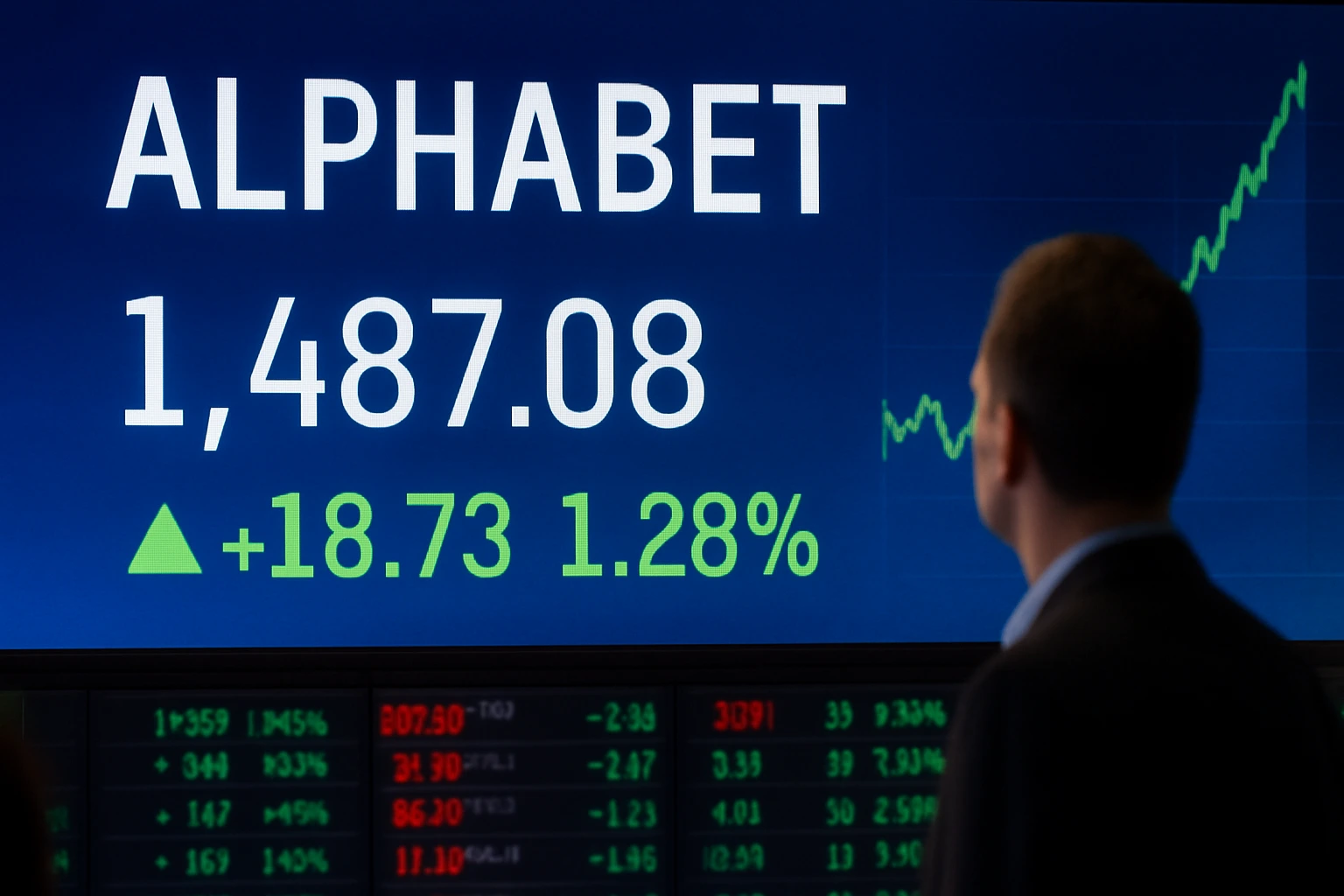
Alphabet hits record highs in early trading as Wall Street’s recovery rally continues, even as new warnings from investor Michael Burry, intensifying Ukraine peace negotiations and shifting expectations at the Federal Reserve reshape sentiment across global markets.
The renewed optimism pushed the Dow more than 660 points higher Tuesday, extending a rebound fueled by hopes of another interest rate cut at the Fed’s December meeting.
Alphabet hits record highs at a time when markets are recalibrating to political and economic developments in Washington and abroad.
Traders increased expectations of a rate cut after Bloomberg reported that White House economic adviser Kevin Hassett was a leading contender to replace Jerome Powell as Fed chair.
According to CME Group’s FedWatch tool, the likelihood of a December reduction climbed to eighty four percent, up from roughly fifty percent a week earlier.
At the same time, Ukraine signaled willingness to move forward with a US backed framework for a peace agreement with Russia.
President Donald Trump said at the White House that negotiators were “getting very close to a deal,” though he noted there were “a few remaining points of disagreement.” His remarks came as US envoy Steve Witkoff prepared for a trip to Moscow next week.
In markets, attention also turned to Michael Burry. The “Big Short” investor deregistered his hedge fund and launched a blog warning that the artificial intelligence boom is becoming a bubble.
Nvidia privately disputed those claims in a memo sent to analysts, highlighting a deepening divide between skeptics and AI’s most vocal champions.
The rally that lifted Alphabet hits record highs earlier this week has drawn mixed interpretations. Some analysts view the push as a natural rebound after months of volatility, while others caution that economic uncertainty remains unresolved.
“Markets are trading on the belief that monetary policy will loosen sooner than expected,” said Dana Whitcomb, senior economist at New York Global Strategies.
“If the Fed truly signals a December cut, we may see a more sustained lift in tech giants like Alphabet, but the risk is that markets are getting ahead of themselves.”
Burry’s renewed scrutiny of AI valuations added a layer of skepticism. Phil Clifton, a former associate at Scion Asset Management and one of the figures influencing Burry’s views, has questioned whether the massive infrastructure buildout can justify today’s prices.
“We’re looking at an environment where capital spending is enormous and returns are not guaranteed,” Clifton said in a recent note.
Meanwhile, geopolitical experts warned that Ukraine’s willingness to accept terms seen as favorable to Russia could present long-term diplomatic challenges.
Even if a deal is reached, it will be fragile, said Alina Markovich, a conflict analyst at the European Peace Institute. “Both sides will need robust security guarantees, and the US role will be central.”
Alongside the momentum that pushed Alphabet hits record highs, broader economic data painted a mixed picture.
Redfin reported that nearly eighty five thousand US homeowners pulled their listings in September, the highest for the month in eight years. Roughly fifteen percent of delisted properties were at risk of selling at a loss.
Consumer confidence also slipped. The Conference Board said its index dropped to the lowest level since April, citing weak employment prospects as a key factor. “Households are feeling the strain of an uncertain economy,” the group noted in its release.
Still, tech stocks remained resilient, buoyed by rising investor expectations of further AI adoption. Nvidia’s quiet rebuttal of Burry’s claims underscored the company’s effort to reassure analysts that demand remains strong despite concerns about overvaluation.
Across the country, workers, homeowners and small business owners described a mix of relief and uncertainty as Alphabet hits record highs and economic indicators pointed in different directions.
“It’s encouraging to see the markets recovering, but people here are still cautious,” said Trevor Simmons, owner of a manufacturing firm in Ohio.
“Large companies like Alphabet hitting record highs doesn’t automatically mean the economy feels stable on Main Street.”
In Philadelphia, homeowner Lisa Rivera said the decision by thousands of sellers to delist properties reflected the anxiety she sees among neighbors. “People are worried that prices aren’t going to hold,” Rivera said. “I’m staying put for now.”
Meanwhile, in Washington, some expressed optimism about Ukraine peace negotiations but noted the complexity of the talks. “If there’s even a small step toward ending the war, that’s significant,” said Ray Coleman, a nonprofit worker focused on Eastern European aid. “But no one is pretending the deal will be easy.”
Markets will closely watch signals from the Federal Reserve as December approaches. If easing expectations strengthen, analysts expect tech stocks to maintain momentum while rate sensitive sectors may see renewed activity.
Diplomatic efforts related to the Ukraine conflict will also carry major implications. US envoy Steve Witkoff’s Moscow visit, scheduled for next week, could mark a turning point in negotiations. A senior Russian aide said Wednesday that Moscow had not yet received a revised draft of the peace proposal.
As for the debate around artificial intelligence, analysts expect continued friction between optimists and skeptics. Burry’s warnings will likely fuel scrutiny of valuations, even as companies like Nvidia defend the durability of demand.
The week’s developments from Alphabet hits record highs to Burry’s AI concerns and Ukraine’s shifting diplomatic stance reflect a moment of renewed market confidence tempered by global uncertainty.
With economic data mixed and geopolitical tensions evolving, investors and policymakers face a landscape shaped by both opportunity and caution.


