
SUMMARY
- Mobile app failures accounted for nearly eighty percent of reported issues during the Chime outage.
- Users dependent on Chime for primary banking faced payment and transfer disruptions.
- Lack of immediate communication heightened concerns over fintech reliability and transparency.
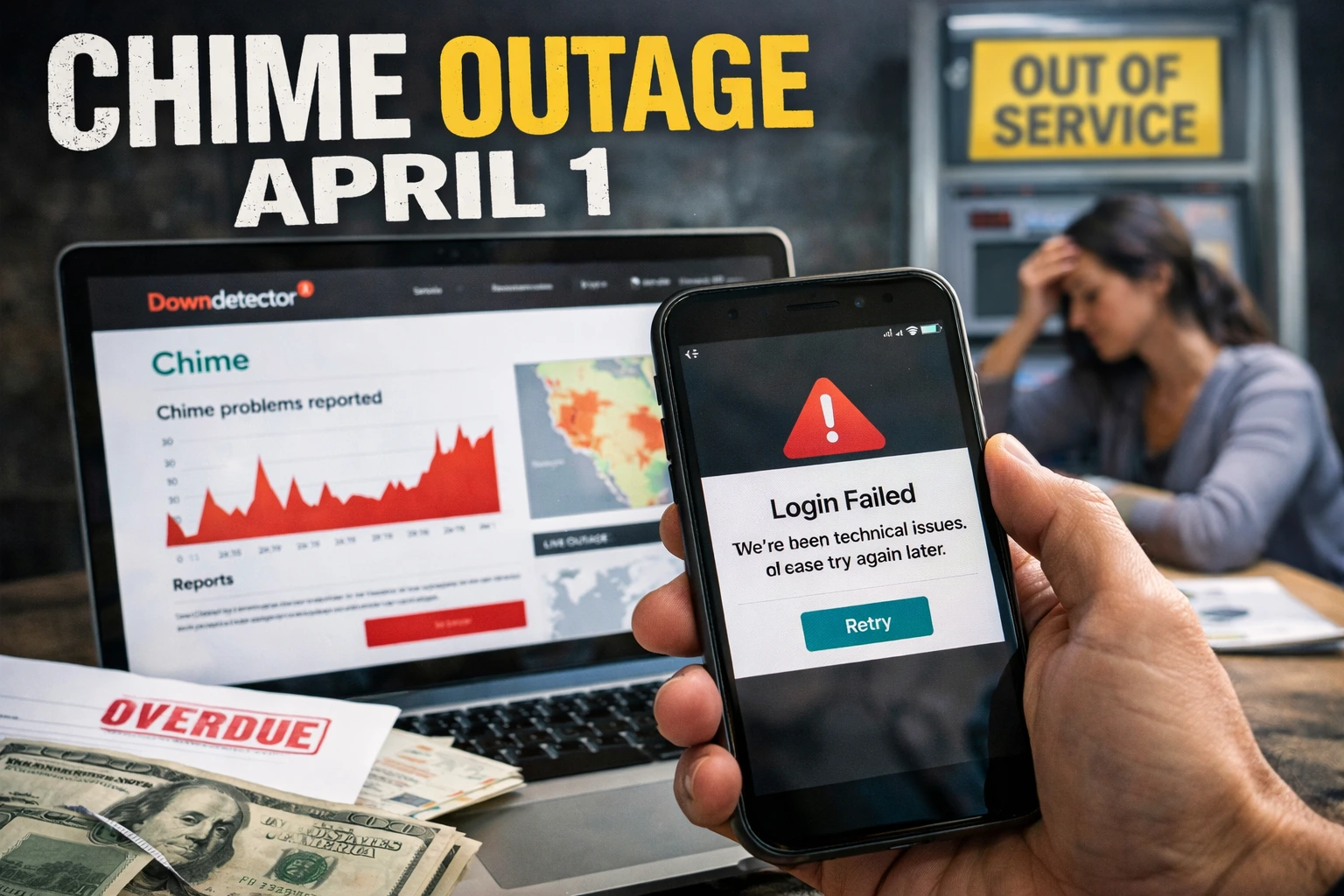
A widespread Chime outage on April 1 disrupted mobile banking access for thousands of users across the United States, with no immediate resolution timeline provided by the fintech platform.
The April 1 Chime outage underscores growing global dependence on app-based banking systems.
As fintech platforms replace traditional banking infrastructure, even short disruptions can trigger widespread financial and operational consequences for users worldwide.
Chime, founded in 2012, scaled rapidly by offering fee free banking through mobile first services. By 2025, it had attracted more than twenty million users, many relying exclusively on its digital ecosystem.
Previous minor outages were localized, but the April 2026 incident reflects a broader system-level vulnerability affecting core services simultaneously.
Jason Mikula, publisher of Fintech Business Weekly, said the outage highlights structural risks in neobanking models.
“When a single app becomes a user’s entire financial interface, downtime is no longer a technical glitch it becomes a liquidity event,” he noted.
Darryl West, senior fellow at the Brookings Institution, pointed to regulatory gaps. “Fintech firms operate with lighter oversight compared to traditional banks, yet their systemic importance is increasing.
Incidents like the Chime outage will accelerate calls for stricter operational resilience standards,” he said. The disruption also exposes economic ripple effects.
Payment delays can cascade into missed bill deadlines, late fees, and reduced consumer confidence in digital only banks. Unlike traditional institutions, fintech firms lack physical branches, limiting fallback options during outages.
“I couldn’t send rent money on time,” said Marcus Lee, a freelance designer in Atlanta. “Everything I use financially is tied to Chime.”
Angela Ruiz, a nurse in Phoenix, described similar issues. “My paycheck hit, but I couldn’t access it. That’s stressful when bills are due the same day.”
A customer support manager at a major utility provider, who requested anonymity, noted increased call volume. “We saw a spike in payment delay requests tied directly to the Chime outage.”
Over the next six to twelve months, fintech firms are likely to face increased scrutiny from regulators such as the Consumer Financial Protection Bureau.
Industry analysts expect investments in redundancy systems and real time outage communication tools to rise.
Market competition may also shift, as users reconsider reliance on single platform banking.
Hybrid models combining fintech convenience with traditional bank safeguards could gain traction.
The April 1 Chime outage signals a critical inflection point for digital banking reliability. As fintech adoption expands globally, operational resilience and regulatory alignment will shape the sector’s long term stability.
NOTE! This article was generated with the support of AI and compiled by professionals from multiple reliable sources, including official statements, press releases, and verified media coverage. For more information, please see our T&C.


