
SUMMARY
- Supreme Court decision prioritizes free speech over state restrictions on conversion therapy for minors.
- Potentially affects state regulation of medical and counseling practices nationwide.
- Highlights growing intersection of religious rights, mental health policy, and youth protections in US law.
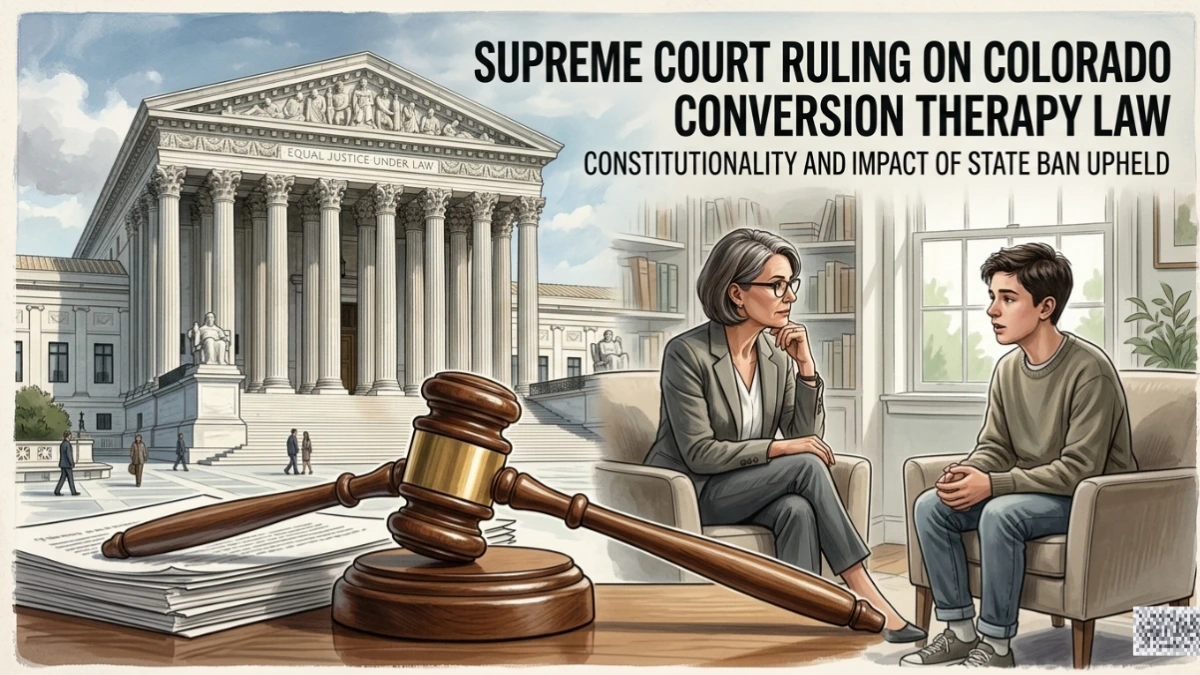
WASHINGTON — On Tuesday, the US Supreme Court ruled 8-1 that Colorado’s law banning mental health professionals from offering conversion therapy to L.G.B.T.Q. minors violates the First Amendment, in a decision with national implications for similar laws in more than 20 states.
The ruling comes as policymakers, healthcare providers, and civil rights advocates reassess legal boundaries between professional medical standards and constitutional speech protections.
Global observers are monitoring how US jurisprudence may influence regulatory approaches to speech based therapies in other democratic nations.
Colorado’s statute, enacted in 2019, prohibited “any practice or treatment” aimed at altering a minor’s sexual orientation or gender identity.
Kaley Chiles, an evangelical therapist, filed suit in 2022, arguing the law prevented her from counseling youth seeking guidance aligned with their religious beliefs.
The Supreme Court’s ruling overturns lower court divisions, including a 10th Circuit decision that upheld the law.
Justice Neil Gorsuch, writing for the majority, emphasized that the law directly targets speech content, stating it constitutes an “egregious assault” on First Amendment protections.
Political analyst Lindsey Graham, professor of Constitutional Law at George Washington University, noted, “The ruling sets a high bar for any state attempting to regulate speech within therapeutic contexts.”
Healthcare ethics expert Dr. Sharon Liang, director of the Yale Child Study Center, cautioned that while the ruling protects speech.
States may need to develop alternative frameworks to safeguard minors from harmful practices, suggesting licensure and informed consent protocols as potential mitigations.
Kaley Chiles stated, “This decision allows me to help young patients pursue goals consistent with their faith without fear of legal penalties.”
Colorado AG Phil Weiser remarked, “Our capacity to protect minors from discredited practices has been significantly limited.”
Human Rights Campaign President Kelley Robinson said, “Children in multiple states now face increased vulnerability to unproven therapies.”
Analysts expect states may introduce revised guidelines distinguishing speech from actionable medical interventions.
Court challenges in other states, including Florida and Texas, are anticipated over regulatory authority. Healthcare institutions may expand consent-based counseling frameworks.
The ruling underscores the enduring tension between constitutional free speech and public health regulation.
Its implications extend beyond Colorado, influencing the legal treatment of professional guidance, youth mental health, and religiously informed counseling nationwide.
NOTE! This article was generated with the support of AI and compiled by professionals from multiple reliable sources, including official statements, press releases, and verified media coverage. For more information, please see our T&C.


