
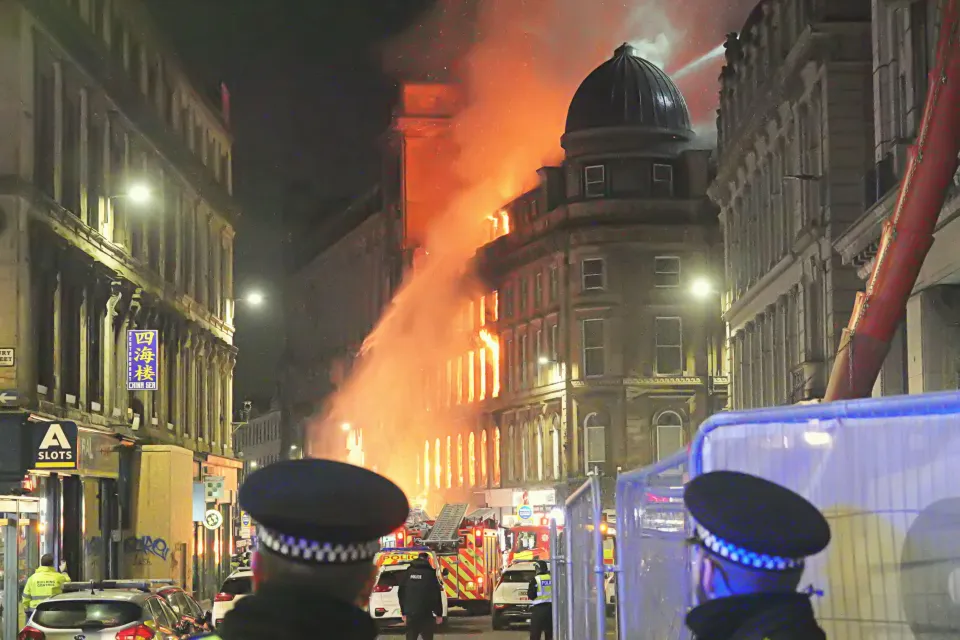
SUMMARY
- Fire erupted on the ground floor of a four story historic building on Union Street around 3:45 PM local time.
- Glasgow Central Station has been closed temporarily, affecting regional and national train services.
- No casualties have been reported, though specialist firefighting equipment and 15 fire appliances were deployed.
A massive fire engulfed a historic commercial building near Glasgow Central Station on Sunday afternoon, causing partial collapse and widespread disruption to rail services across Scotland and the United Kingdom, according to emergency officials.
The Glasgow fire near one of Scotland’s busiest transport hubs highlighted both the vulnerability of historic urban infrastructure and the swift response of emergency services.
Dozens of firefighters tackled the blaze through the night, using high reach vehicles and water rescue teams to control flames curling around the building’s domed roof.
Authorities urged the public to avoid the area and follow travel guidance as rail operations remain suspended.
Glasgow Central Station is a critical junction linking Scotland with London, Edinburgh, and other parts of the UK.
The building affected by the fire is part of a historic commercial district dating back to the late 19th century.
According to the Glasgow City Council archives, this area has previously faced minor structural fires but never a blaze of this scale.
The incident underscores challenges in maintaining older urban structures while accommodating modern transport needs.
“The structural integrity of older commercial buildings is often underestimated in fire risk assessments,” said Dr. Fiona McIntyre, senior lecturer in urban planning at the University of Glasgow.
“Rapid deployment of high-reach firefighting vehicles likely prevented a complete collapse, but the economic and logistical impact is already significant.”
John Swinney, Scotland’s First Minister, thanked emergency responders in a post on X and emphasized continued adherence to safety and travel protocols.
According to Ian Livingston, a transport analyst at the Centre for Rail Studies in London, “Closure of Glasgow Central affects thousands of commuters daily.
Even temporary service disruption can ripple through national supply chains and passenger schedules.”
Paul Carmichael, a firefighter with Scottish Fire and Rescue Service, said, “The flames were intense, but our crews worked methodically to prevent further collapse.”
Laura Bennett, a commuter stranded at the station, described the scene “We saw orange flames through the windows. It was frightening, but the firefighters were incredible. They got control faster than we expected.”
Authorities are conducting structural assessments to determine the full extent of damage.
Scotland’s Fire and Rescue Service has indicated a phased reopening of nearby streets once safety is confirmed.
Rail operators are coordinating alternative transport options and assessing the impact on long term scheduling.
The Glasgow fire has drawn attention to the risks historic buildings face in densely populated urban centers and the critical role of coordinated emergency response.
While no casualties have been reported, the incident demonstrates both immediate and systemic implications for transportation, urban safety, and heritage conservation in Scotland.
This is a breaking news story. Check back for updates.
NOTE! This article was generated with the support of AI and compiled by professionals from multiple reliable sources, including official statements, press releases, and verified media coverage. For more information, please see our T&C.


