

SUMMARY
- Daylight saving time 2026 started March eight at two AM across most of the United States.
- The clock change shifts an hour of daylight from morning to evening affecting work schedules commuting patterns and sleep cycles.
- Most Americans will return to standard time November one when clocks fall back.
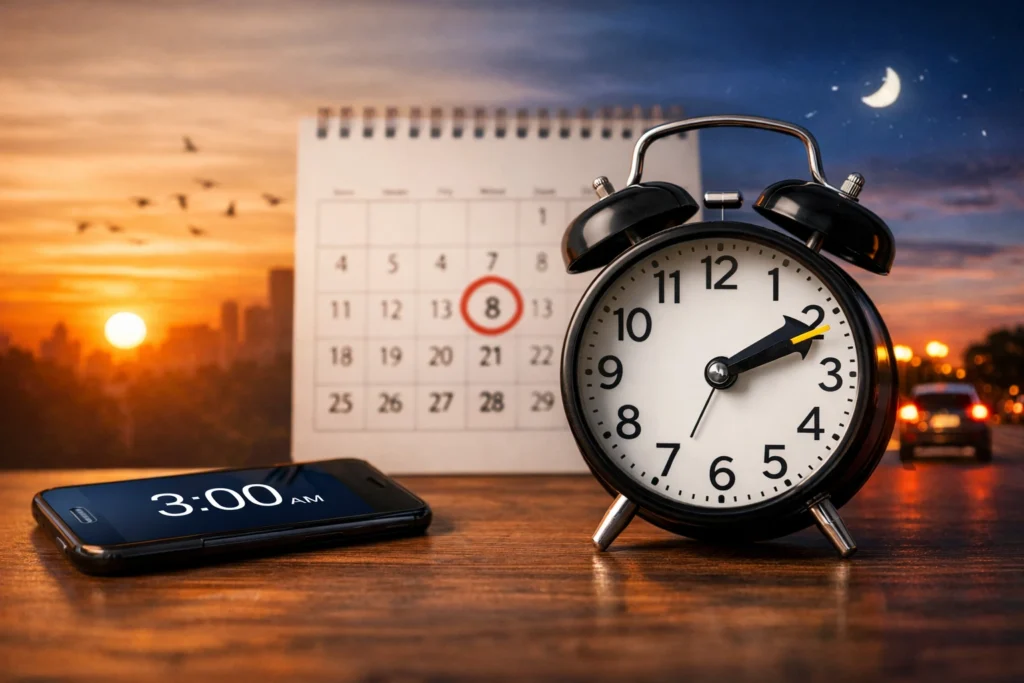
Americans across most of the United States lost an hour of sleep early Sunday as daylight saving time 2026 began at two AM local time shifting clocks forward and extending evening daylight months before the Northern Hemisphere’s spring equinox.
For households businesses and transportation systems the biannual clock shift remains one of the most visible timekeeping adjustments in the United States even as debate continues about whether the practice still serves its original purpose.
Daylight saving time in the United States began in nineteen eighteen during World War One as a fuel conservation measure according to the Congressional Research Service.
The policy returned during World War Two and later became standardized under the Uniform Time Act of nineteen sixty six.
Michael Downing author of the book Spring Forward said the time change has historically reflected economic priorities rather than scientific consensus.
Elizabeth Klerman a professor of neurology at Harvard Medical School said shifting clocks can disrupt circadian rhythms particularly during the transition to daylight saving time.
Federal timekeeping agencies say the modern daylight saving time schedule has remained largely unchanged since two thousand seven.
James Houlahan policy director at the National Association of Convenience Stores said longer evening daylight often boosts retail and travel activity after work hours.
Meanwhile sleep researcher Mariana Figueiro of the Icahn School of Medicine at Mount Sinai said the abrupt time shift can temporarily reduce alertness especially among shift workers and teenagers.
Several states and members of Congress have proposed legislation to make daylight saving time permanent though any nationwide change would require federal approval.
For now daylight saving time 2026 will continue through autumn giving Americans brighter evenings but preserving the long running debate over whether the clock change should continue.
Public opinion surveys in recent years have shown mixed views with many Americans supporting an end to the twice yearly clock changes while remaining divided over whether permanent standard time or permanent daylight saving time would be preferable.
Until federal law changes the seasonal ritual will continue each March and November when millions of phones watches and computers automatically adjust reminding Americans how a one hour shift can ripple through daily life.
The debate ensures daylight saving time remains both a practical scheduling tool and a persistent policy question. For now the clocks stay forward until early November across most states.
NOTE! This article was generated with the support of AI and compiled by professionals from multiple reliable sources, including official statements, press releases, and verified media coverage. For more information, please see our T&C.


