
KEY POINTS
- Tesla announced a $2 billion investment in Elon Musk’s artificial intelligence startup xAI, deepening integration between the EV maker and AI ventures.
- The company will discontinue the Model S and Model X, while preparing to launch its third generation Optimus robot later in 2026.
- Tesla reported $24.9 billion in revenue for the fourth quarter, slightly exceeding analyst estimates, but vehicle deliveries face pressure amid rising competition.
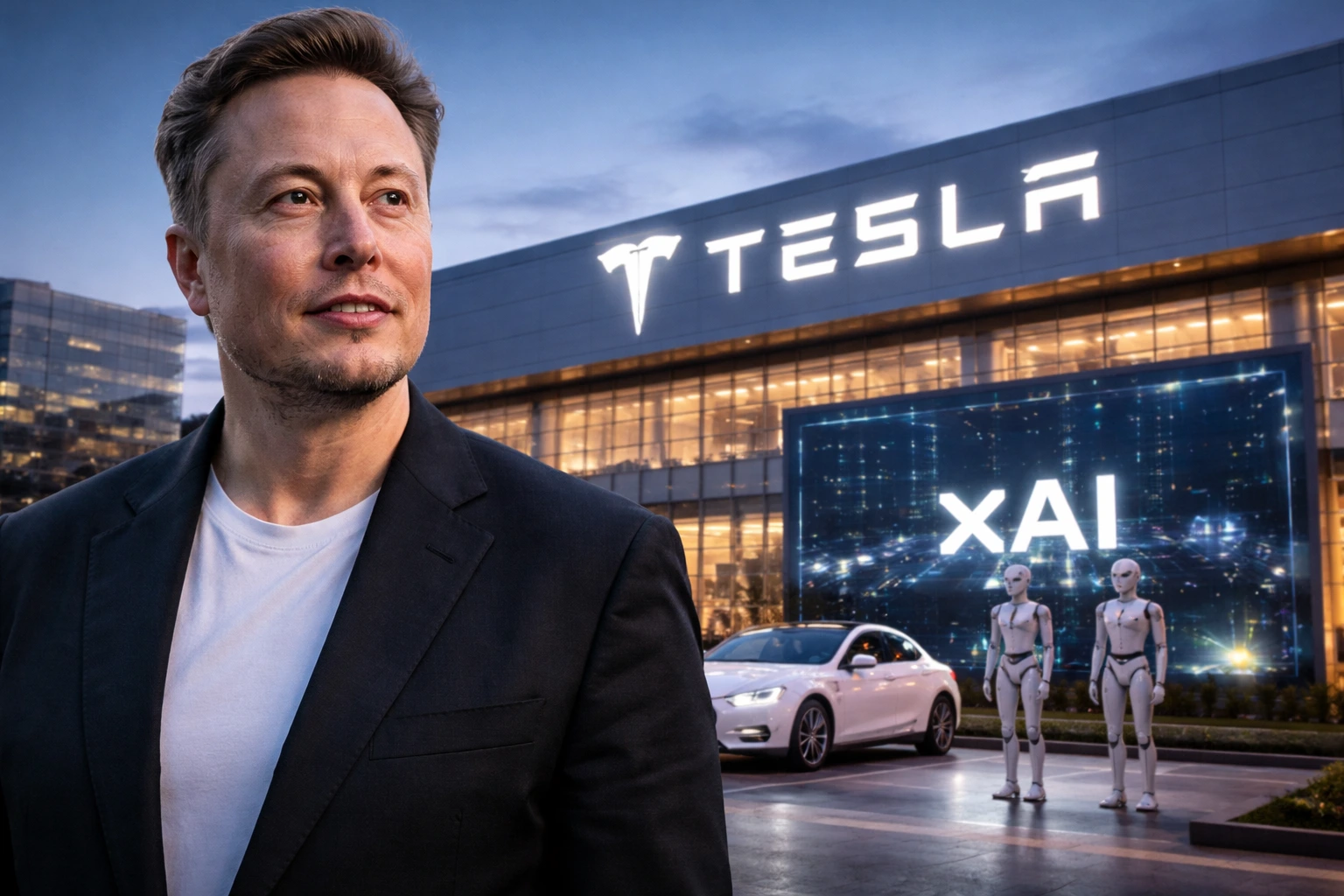
Austin, Texas — Tesla Inc. said Wednesday it plans to invest approximately $2 billion in Elon Musk’s artificial intelligence startup xAI, signaling a strategic pivot toward autonomy and robotics as traditional vehicle sales face growing pressure.
The announcement accompanies the discontinuation of Tesla’s long running Model S and Model X sedans, which Musk described as receiving an “honorable discharge.”
The investment in xAI, detailed in a framework agreement, positions the EV manufacturer to leverage AI technologies for its self driving ambitions and robotics programs.
Tesla also plans to unveil its third generation Optimus humanoid robot later this quarter, underlining its commitment to physical AI applications.
Tesla’s move comes amid a mixed financial quarter. The Austin based company reported $24.9 billion in revenue for the three months ending Dec. 31, exceeding the $24.79 billion analysts’ estimate, according to LSEG data.
Adjusted earnings per share were $0.50, above Wall Street expectations. Despite the gains, Tesla’s vehicle business is under strain as competitors release lower priced EV models, and a US tax incentive for electric vehicles has ended.
The $2 billion xAI investment follows a 2025 shareholder vote that failed to approve a previous AI funding initiative.
Musk has increasingly framed AI as central to Tesla’s transformation from a hardware focused company to a robotics and autonomy driven enterprise.
“Tesla is effectively signaling that its future growth will rely on software and AI-driven products rather than traditional vehicles alone,” said Brett Smith, senior analyst at Automotive Research Group.
“The xAI investment reflects an alignment between Tesla’s autonomy roadmap and Elon Musk’s broader AI ambitions.”
John Cooper, professor of technology management at Stanford University, added, “Investing in AI startups allows Tesla to accelerate development in robotaxis and autonomous delivery systems, while differentiating itself from legacy automakers that remain hardware centric.”
| Metric | Q4 2026 | Q4 2025 | Change |
|---|---|---|---|
| Revenue | $24.9B | $22.7B | +9.7% |
| Adjusted EPS | $0.50 | $0.43 | +16.3% |
| Energy storage deployed | 14.2 GWh | 11.0 GWh | +29% |
| Vehicle deliveries forecast | 1.77M units | 1.64M units | +8.2% |
Elon Musk emphasized during the earnings call that Tesla’s “transition from a hardware centric business to a physical AI company” is well underway.
He highlighted the company’s plan to begin production of the Cybercab robotaxi in April 2026, describing it as a fully autonomous vehicle without a steering wheel or pedals.
Industry observers note the potential implications for both investors and consumers.
“Tesla’s pivot to AI and robotics is bold but necessary,” said Laura Chen, portfolio manager at GreenWave Capital.
“Traditional EV margins are compressing, and future revenue may increasingly depend on software and autonomous services.”
Tesla expects the transition to AI-focused products to be gradual. Musk warned that production of both the Cybercab and Optimus robot will be “agonizingly slow” initially, suggesting a cautious ramp up.
Analysts anticipate Tesla will continue leveraging lower priced Model 3 and Model Y versions to expand its user base while software and autonomy offerings mature.
Tesla’s $2 billion xAI investment underscores the company’s strategic shift toward AI and robotics, aligning its long term vision with Musk’s broader technological ambitions.
As traditional vehicle sales face competitive and regulatory pressures, Tesla’s focus on autonomous systems, energy storage, and humanoid robotics may increasingly define the company’s market positioning and investor sentiment in 2026 and beyond.
NOTE! This report was compiled from multiple reliable sources, including official statements, press releases, and verified media coverage.


