
KEY POINTS
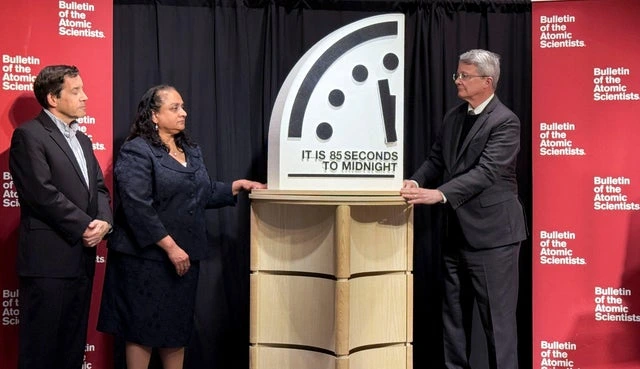
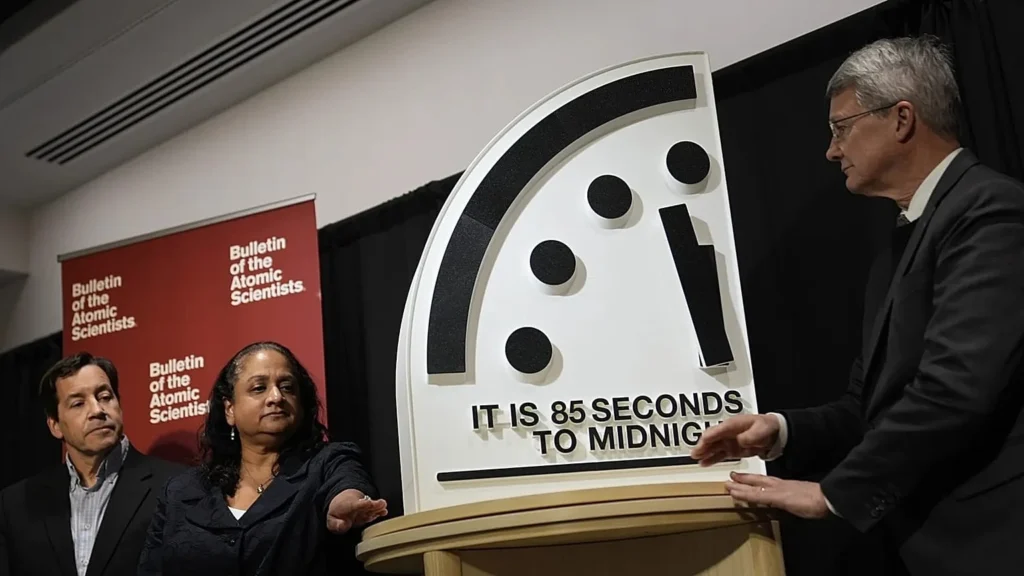
- The Doomsday Clock now stands at eighty five seconds to midnight, the closest ever recorded.
- Scientists cite nuclear risk, climate change, biotechnology and artificial intelligence as converging threats.
- The Bulletin of the Atomic Scientists says global leadership failures are worsening existential dangers tied to the Doomsday Clock.
The Doomsday Clock was moved to eighty five seconds to midnight on Tuesday, the closest point in its history, as the Bulletin of the Atomic Scientists warned that escalating nuclear tensions.
Accelerating climate change and poorly governed emerging technologies have pushed humanity nearer to a human caused global catastrophe.
The symbolic clock, unveiled annually by the Chicago based Bulletin of the Atomic Scientists, is designed to communicate how close the world is to destroying itself through its own inventions.
Midnight represents a point at which Earth would become unlivable due to human actions.
The decision to advance the clock by four seconds reflects what the group described as a sharp deterioration in global security conditions over the past year.
The Doomsday Clock was created in 1947, shortly after the United States dropped atomic bombs on Hiroshima and Nagasaki.
Artist Martyl Langsdorf designed the original image for the Bulletin’s journal cover to convey urgency about nuclear weapons at the dawn of the Cold War.
The clock initially stood at seven minutes to midnight, a time chosen for visual impact rather than scientific calculation.
Over nearly eight decades, the clock has moved both forward and backward in response to geopolitical shifts.
It moved farther from midnight at the end of the Cold War but began inching closer again in the early twenty first century as concerns expanded beyond nuclear weapons.
Climate change was formally added to the clock’s assessment criteria in 2007, followed later by disruptive technologies such as cyberwarfare and artificial intelligence.
Alexandra Bell, president and chief executive officer of the Bulletin of the Atomic Scientists, said the decision reflected cumulative global failures.
“Humanity has not made sufficient progress on the existential risks that endanger us all,” Bell said during the announcement.
She cited renewed nuclear brinkmanship among major powers, insufficient climate action and rapid technological advances outpacing regulation.
Rachel Bronson, a former Bulletin president and a senior fellow at the Brookings Institution, said the clock’s movement is not a prediction but a risk signal.
“The clock measures trends, not moments,” Bronson said. “What is different now is that multiple risks are interacting, making shocks harder to absorb.”
The Bulletin pointed specifically to Russia’s war in Ukraine, heightened US China tensions and the erosion of arms control agreements as drivers of nuclear risk.
It also warned that climate driven disasters are increasing instability in vulnerable regions, compounding security challenges.
| Year | Doomsday Clock Setting | Primary Drivers |
|---|---|---|
| 1947 | Seven minutes to midnight | Nuclear weapons emergence |
| 1991 | Seventeen minutes to midnight | End of Cold War |
| 2023 | Ninety seconds to midnight | Ukraine war, nuclear threats |
| 2024 | Ninety seconds to midnight | Gaza war, climate impacts |
| 2026 | Eighty-five seconds to midnight | Nuclear, climate, AI risk |
Juan Manuel Santos, former president of Colombia and a Nobel Peace Prize laureate who serves on the Bulletin’s board, said the clock reflects policy choices.
“These dangers are not abstract,” Santos said. “They are the result of decisions made by governments that can also choose cooperation over confrontation.”
Sharon Squassoni, a research professor at George Washington University’s Elliott School of International Affairs, emphasized arms control erosion.
“We are operating with fewer guardrails than at almost any point since the nineteen eighties,” she said, pointing to the collapse of several US Russia nuclear agreements.
Daniel Holz, chair of the Bulletin’s Science and Security Board and a professor at the University of Chicago, said artificial intelligence introduces new uncertainties.
“AI can compress decision times in military systems,” Holz said. “That increases the risk of miscalculation in already tense situations.”
The Bulletin outlined steps it says could move the clock away from midnight, including renewed nuclear arms talks, stronger global biosecurity rules and coordinated limits on military uses of artificial intelligence.
It also called for accelerated investment in renewable energy to reduce climate-related instability. While the clock is adjusted only once a year, Bell said the underlying risks evolve constantly.
“Every second counts,” she said, adding that progress depends on sustained international engagement rather than crisis driven responses.
At eighty five seconds to midnight, the Doomsday Clock reflects a world facing overlapping, human made threats that scientists say are growing faster than efforts to control them.
Though symbolic, the clock remains a stark measure of global risk, underscoring how decisions made today shape humanity’s long term survival.
FAQs: Doomsday Clock
Q: What is the Doomsday Clock?
A: The Doomsday Clock is a symbolic clock created by the Bulletin of the Atomic Scientists that shows how close humanity is to a global catastrophe. Midnight means total human made destruction.
Q: Why is the Doomsday Clock important?
A: It highlights urgent global risks like nuclear war, climate change, and emerging technologies to encourage action before disaster strikes.
Q: How is the Doomsday Clock time decided?
A: Scientists on the Bulletin’s Science and Security Board assess threats each year and set the clock based on global risk trends.
Q: What does it mean if the clock moves closer to midnight?
A: It signals that humanity is at greater risk from human made disasters and that urgent action is needed to reduce threats.
Author’s Perspective
In my analysis, the Doomsday Clock’s advance to 85 seconds highlights an unprecedented convergence of nuclear, climate, and AI driven risks reshaping global security paradigms.
I predict that multilateral nuclear arms dialogue will formalize binding AI safeguards in military command systems, establishing a new international compliance standard.
For individuals and businesses, this signals heightened geopolitical volatility affecting energy and supply chains.
NOTE! This report was compiled from multiple reliable sources, including official statements, press releases, and verified media coverage.


