
KEY POINTS
- Falcon 9 deployed 29 Starlink satellites, expanding SpaceX’s global broadband constellation
- First stage booster completed its 24th flight, landing on drone ship A Shortfall of Gravitas in the Atlantic Ocean
- Weather conditions improved to 90 percent favorable by launch time after a cold front moved through Florida’s Space Coast
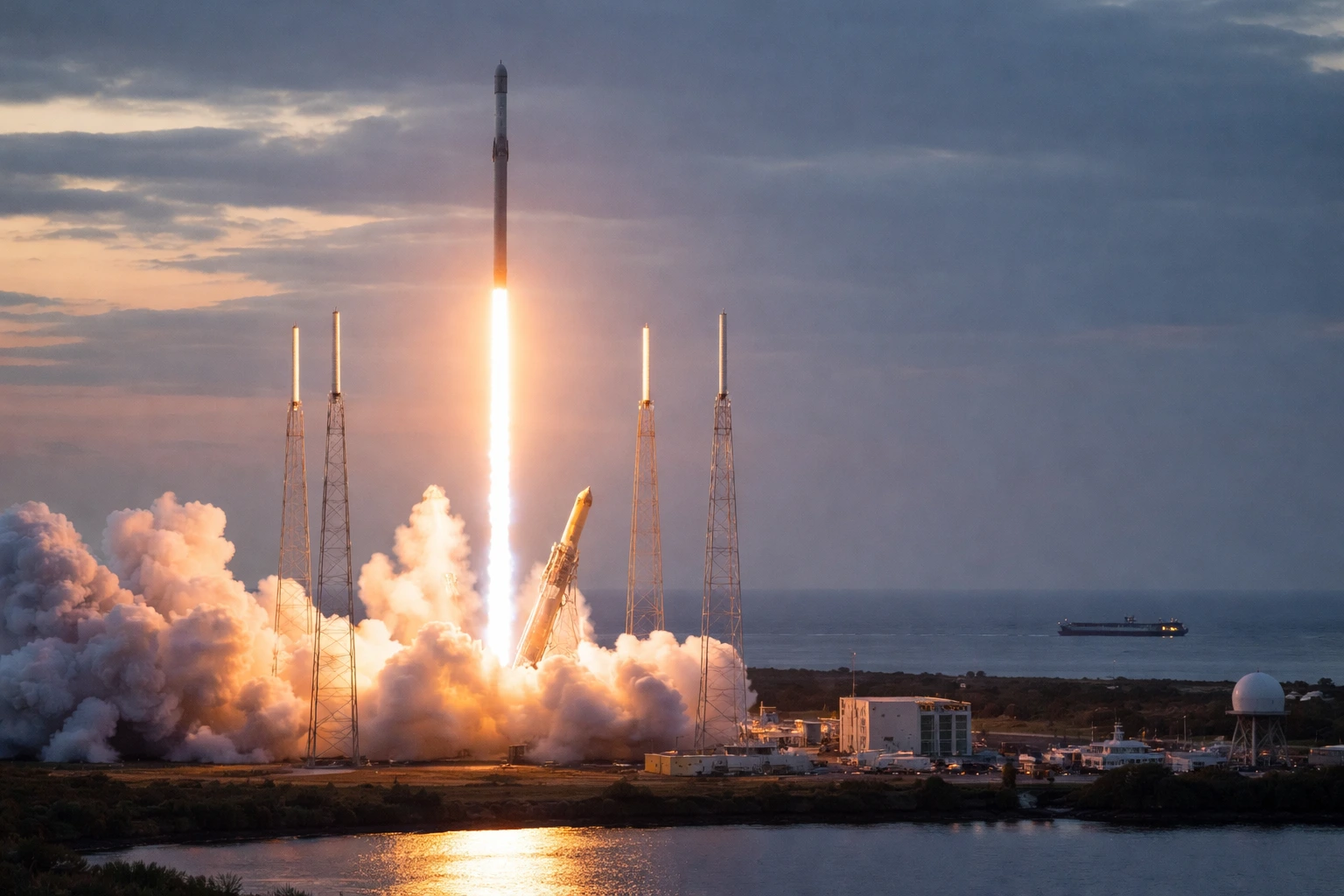
Cape Canaveral, Florida — SpaceX successfully launched its Falcon 9 rocket Sunday evening from Launch Complex 40 at Cape Canaveral Space Force Station, deploying 29 Starlink satellites into low Earth orbit as part of the Starlink 6-100 mission.
Liftoff occurred at 6:31 pm, following the expiration of a National Weather Service high wind warning that had threatened earlier attempts.
The launch underscores SpaceX’s continued pace in deploying satellites to enhance global internet coverage, particularly in underserved regions.
The mission marks the latest iteration of the Starlink 6 series, aimed at bolstering bandwidth capacity and improving network redundancy.
SpaceX began deploying the Starlink constellation in 2019, rapidly expanding to thousands of satellites in low Earth orbit.
The company’s reusable Falcon 9 boosters have allowed frequent launches while lowering operational costs.
Booster No. B1051, used in Sunday’s mission, has flown 24 previous missions, demonstrating the increasing reliability of reused space hardware.
Meteorological challenges are common in Florida, where sudden cold fronts, cumulus cloud cover, and high winds often delay liftoffs.
Sunday’s mission proceeded without sonic booms in Brevard County, despite public concerns about overflights and atmospheric noise.
“Each additional Starlink launch strengthens SpaceX’s ability to deliver high-speed broadband globally,” said Dr. Laura Chen, aerospace analyst at the Center for Orbital Studies.
“Repeated booster reuse not only reduces cost but also signals a shift toward sustainable orbital operations.”
Economically, Starlink’s expansion is likely to increase competition in satellite broadband markets, affecting traditional internet providers, particularly in remote regions lacking fiber infrastructure.
“Watching a Falcon 9 launch never gets old. The precision of landing the booster after 24 flights is incredible,” said Cape Canaveral resident Michael Ortiz.
SpaceX spokesperson Karen Liu noted, “Our teams monitored weather closely to ensure safe liftoff and satellite deployment.”
SpaceX plans additional Starlink missions in the coming weeks to maintain orbital coverage and enhance service quality.
Reusable booster operations remain a cornerstone of the company’s cost reduction strategy, with potential implications for future commercial and government launches.
Sunday’s launch reinforces SpaceX’s leadership in satellite broadband deployment, marking a steady progression in low Earth orbit infrastructure expansion.
In my analysis, Starlink 6-100 reinforces SpaceX’s dominance in low Earth orbit broadband infrastructure, accelerating the satellite internet economy.
I predict global regulators will adopt unified spectrum sharing policies to optimize orbital traffic. End users gain faster connectivity, while businesses can explore remote operations. Monitor booster reusability metrics closely.
NOTE! This report was compiled from multiple reliable sources, including official statements, press releases, and verified media coverage.
Adnan Rasheed, Lead Research Analyst


