
KEY POINTS
- Sabalenka claimed her third Brisbane title, strengthening her status as a leading favorite for the Australian Open.
- The world No. 1 extended her unbeaten head to head record against Kostyuk without dropping a set.
- The final also served as a platform for Kostyuk to highlight the humanitarian crisis in Ukraine.
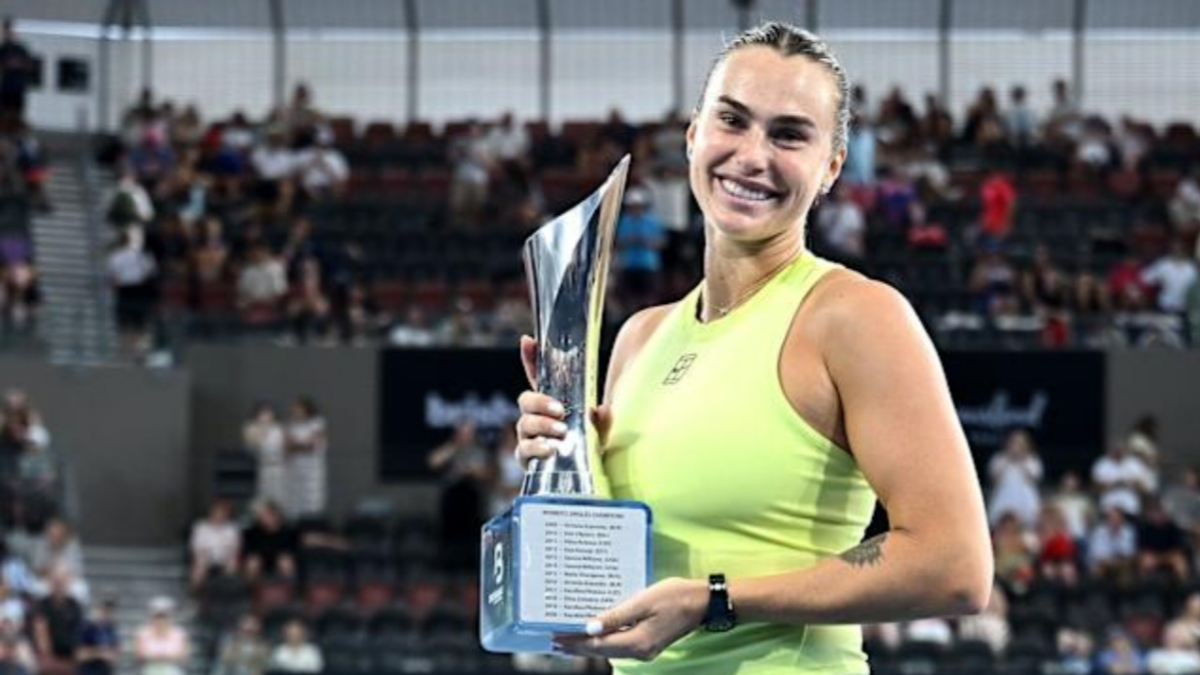
World No. 1 Aryna Sabalenka secured her third Brisbane title on Sunday, defeating Ukraine’s Marta Kostyuk 6-4 6-3 in the Brisbane International final at the Queensland Tennis Centre, completing a dominant warm up run ahead of the Australian Open, which begins Jan. 18 in Melbourne.
The Sabalenka Brisbane title marked a decisive start to the Belarusian’s 2026 season, reinforcing her position at the top of the women’s rankings and underlining her consistency on hard courts.
The 79 minute final offered few surprises, with Sabalenka’s aggressive baseline play and heavy serve overwhelming Kostyuk in key moments.
Sabalenka broke a 4-4 deadlock in the first set by winning five consecutive games, seizing control of the match and never relinquishing it.
The victory was her first tournament title since her US Open triumph in September and her twenty-second career WTA singles crown.
The Brisbane International has become a familiar proving ground for Sabalenka. She first won the tournament in 2023, defended it successfully last year and now adds a third trophy to her collection.
The event traditionally serves as a key tune up for players targeting early success in Melbourne, where Sabalenka has already claimed two titles in the past four years.
Kostyuk, ranked No. 26, was playing her first WTA final in two years and was seeking just her second career singles title.
Despite showing resilience early in the match she struggled to contain Sabalenka’s pace and depth from the baseline, particularly on return games.
The final also carried emotional weight. Kostyuk used her on court interview to draw attention to the ongoing humanitarian crisis in Ukraine.
Describing severe winter conditions and damaged infrastructure following Russian bombardments.
Tennis analysts say the Sabalenka Brisbane title reflects more than early season form. It highlights the evolution of her game into one built not only on power but also on improved movement, shot selection and mental composure.
“Sabalenka’s ability to step up at pressure moments is what separates her right now,” said former WTA coach Elena Voronina.
“Her serve remains a weapon, but her return game has become equally dangerous, especially against players who rely on rhythm.”
Sports performance specialist Dr. Mark Ellison said Sabalenka’s scheduling also played a role. “She is peaking early without overplaying. That balance is crucial before a Grand Slam,” he said.
| Category | Sabalenka Career Total | Brisbane Titles | Grand Slam Titles |
|---|---|---|---|
| Singles titles | Twenty-two | Two | Four |
| Australian Open wins | Two | N/A | N/A |
| Current ranking | No. 1 | N/A | N |
Sabalenka congratulated her opponent after the match, saying, “I wish you all the best this season. It looks like great tennis is coming, and I hope we meet again in more finals.”
Kostyuk, fighting back tears, addressed the crowd. “I play every day with pain in my heart,” she said.
“There are thousands of people without light and warm water right now. My sister is sleeping under three blankets because of how cold it is at home.”
Tournament director Cameron Pearson said the event aims to balance elite competition with global awareness. “Moments like this remind everyone that sport does not exist in isolation,” he said.
With the Sabalenka Brisbane title secured, attention now shifts to Melbourne, where she will attempt to claim a third Australian Open championship in four years.
Her early season form suggests she will enter the tournament as one of the most stable contenders on the tour.
For Kostyuk, the run to the final provides valuable ranking points and confidence. Officials close to her team said the focus will be on maintaining consistency across the early hard court swing.
In the men’s doubles final, Britain’s Julian Cash and Lloyd Glasspool were edged out 6-3 3-6 10-8 by Francisco Cabral of Portugal and Austria’s Lucas Miedler.
The Sabalenka Brisbane title reinforced her dominance on hard courts and her readiness for the season’s first Grand Slam.
While the final showcased elite level tennis, it also underscored the broader human stories that often intersect with sport.
As the tour moves to Melbourne, Sabalenka’s commanding start positions her as a central figure in the early narrative of the 2026 season.
Author’s Perspective
In my analysis, Sabalenka’s Brisbane win signals how modern tennis is being shaped by data led conditioning, load management and early season peaking strategies rather than pure match volume.
I predict the WTA will introduce standardized performance tracking benchmarks across major tournaments, making player workload optimization a formal part of competition planning.
For everyday fans and aspiring players, this shift means longer prime careers and fewer injury driven absences.
Watch how top players structure their early season schedules those skipping smaller events to peak for majors are setting the new professional standard.
NOTE! This report was compiled from multiple reliable sources, including official statements, press releases, and verified media coverage.


