
KEY POINTS
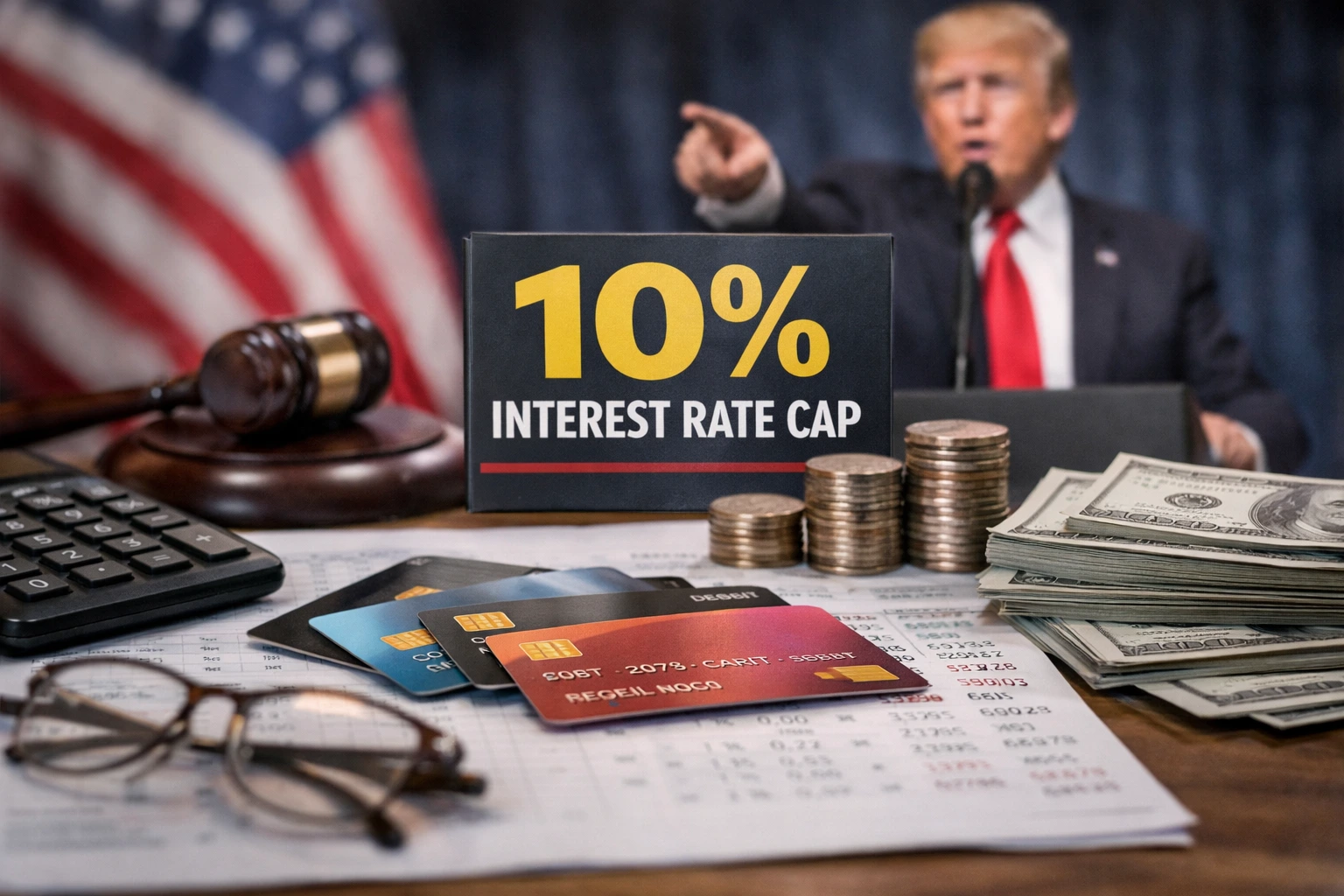
- The proposed Trump credit card interest rate cap would limit annual percentage rates to ten percent for one year starting Jan. 20.
- Lawmakers, banking groups and economists are divided over whether the cap would lower costs or restrict access to credit.
- The announcement arrives amid record high US credit card balances and renewed scrutiny of consumer lending practices.
President Donald Trump said this week he would impose a one year cap limiting credit card interest rates to ten percent.
A move that immediately raised questions about its legal authority, practical enforcement and potential effects on consumers and lenders across the United States.
Trump’s announcement, delivered through a late night social media post, promised swift relief for consumers facing interest rates that often exceed twenty percent.
He did not, however, specify the legal mechanism he would use to impose the Trump credit card interest rate cap or explain how federal agencies would enforce compliance among thousands of private lenders.
The proposal comes as US households carry historically high revolving debt, with balances climbing steadily since the pandemic.
Consumer advocates say interest charges are eroding household budgets, while financial institutions argue that pricing reflects risk, fraud and regulatory costs.
The federal government has not set a universal ceiling on credit card interest rates for decades.
Instead, most rate limits are governed by state usury laws, many of which were weakened after a series of Supreme Court rulings in the late twentieth century allowed banks to export interest rates from states with looser rules.
Trump first floated the idea of a ten percent ceiling during his 2024 campaign, framing it as a measure to protect working families from what he called predatory lending.
After taking office, he did not immediately pursue legislation, leaving the idea dormant until this week’s announcement.
In February, Sens. Bernie Sanders of Vermont and Josh Hawley of Missouri introduced a bipartisan bill proposing a five year national cap at ten percent.
That bill stalled amid strong opposition from banking trade groups, which argued that rigid limits would reduce credit availability for higher risk borrowers.
Trump’s statement appeared to echo that proposal but differed in one key respect: it would be imposed unilaterally for one year. Legal scholars said that distinction could prove decisive.
“There is no clear statute that gives the president authority to set interest rate ceilings across the entire credit card market,” said Mehrsa Baradaran.
A banking law professor at the University of California, Irvine. “Historically, those caps have required congressional action.”
Supporters of the Trump credit card interest rate cap say it could provide immediate relief for consumers struggling to keep up with rising costs of housing, food and health care.
Average US card rates now exceed twenty percent, according to the Federal Reserve. Critics, including many lenders, argue that a flat ceiling would lead banks to pull back from higher risk customers, potentially pushing them toward payday lenders or other high cost alternatives.
“Interest rates on credit cards are not arbitrary,” said Karen Shaw Petrou, managing partner at Federal Financial Analytics.
“They reflect expected losses, fraud, servicing costs and capital requirements. If those cannot be covered, the product disappears for certain borrowers.”
Billionaire hedge fund manager Bill Ackman, a Trump supporter, voiced similar concerns on social media, warning that millions of cardholders could lose access to credit.
Sen. Elizabeth Warren of Massachusetts questioned whether Trump could implement the policy without congressional approval. She said prior efforts to rein in card rates had failed in part because of intense industry lobbying.
The White House has not clarified which agency would administer the cap or whether existing regulators, such as the Consumer Financial Protection Bureau, would play a role. Trump has previously sought to scale back the bureau’s authority.
| Year | Total US Credit Card Debt | Average APR |
|---|---|---|
| 2021 | $770 billion | About 16% |
| 2023 | $1.05 trillion | About 19% |
| 2024 | $1.17 trillion | Above 20% |
Source: Federal Reserve Bank of New York and Federal Reserve Board
Economists note that even a temporary cap could alter lending behavior quickly. Card issuers typically adjust credit limits and approval criteria within weeks of regulatory changes.
For many consumers, the Trump credit card interest rate cap represents potential relief from mounting balances.
“I pay more in interest some months than I do on groceries,” said Maria Lopez, a retail worker in Phoenix who carries about $6,000 in card debt. “If rates were lower, I could actually make progress.”
Small business owners, who often rely on cards for short term financing, expressed mixed reactions.
“A lower rate would help with cash flow,” said James Turner, who runs a catering business in Atlanta. “But if banks cut limits or close accounts, that would be worse.”
Banking groups released a joint statement warning that the cap could “reduce credit availability and be devastating for millions of American families and small business owners.”
Any attempt to implement the Trump credit card interest rate cap is likely to face legal challenges. Industry groups could argue that the president lacks authority to impose such a restriction without congressional approval.
If Congress chooses to act, lawmakers would need to reconcile competing goals: lowering costs while maintaining broad access to credit.
Analysts say that could involve exemptions for certain products, tiered rates based on risk or federal subsidies.
Internationally, several countries impose stricter limits on consumer lending, but their systems differ.
In the European Union, for example, caps are often paired with stronger social safety nets and public banking options.
Trump’s proposed one year cap on credit card interest rates has reopened a long running debate over how the US should regulate consumer lending.
While the plan aims to reduce borrowing costs, its legality, enforcement and long term effects remain uncertain.
As lawmakers, regulators and courts weigh in, the outcome could reshape how millions of Americans access and use credit well beyond the next year.
Author’s Perspective
From a strategic perspective, the proposed Trump credit card interest rate cap reflects rising political pressure to rein in consumer debt as household finances tighten nationwide.
I expect the US to move toward risk-based lending limits rather than flat caps, reshaping how banks price consumer credit. For everyday borrowers, this could mean lower costs but tighter approval standards.
NOTE! This report was compiled from multiple reliable sources, including official statements, press releases, and verified media coverage.


