
KEY POINTS
- Netflix stock valuation continues to trade above key rivals despite a prolonged decline.
- Investors remain focused on the financial and regulatory implications of a potential Warner Bros. deal.
- Analysts say uncertainty around long term growth guidance is weighing on sentiment.
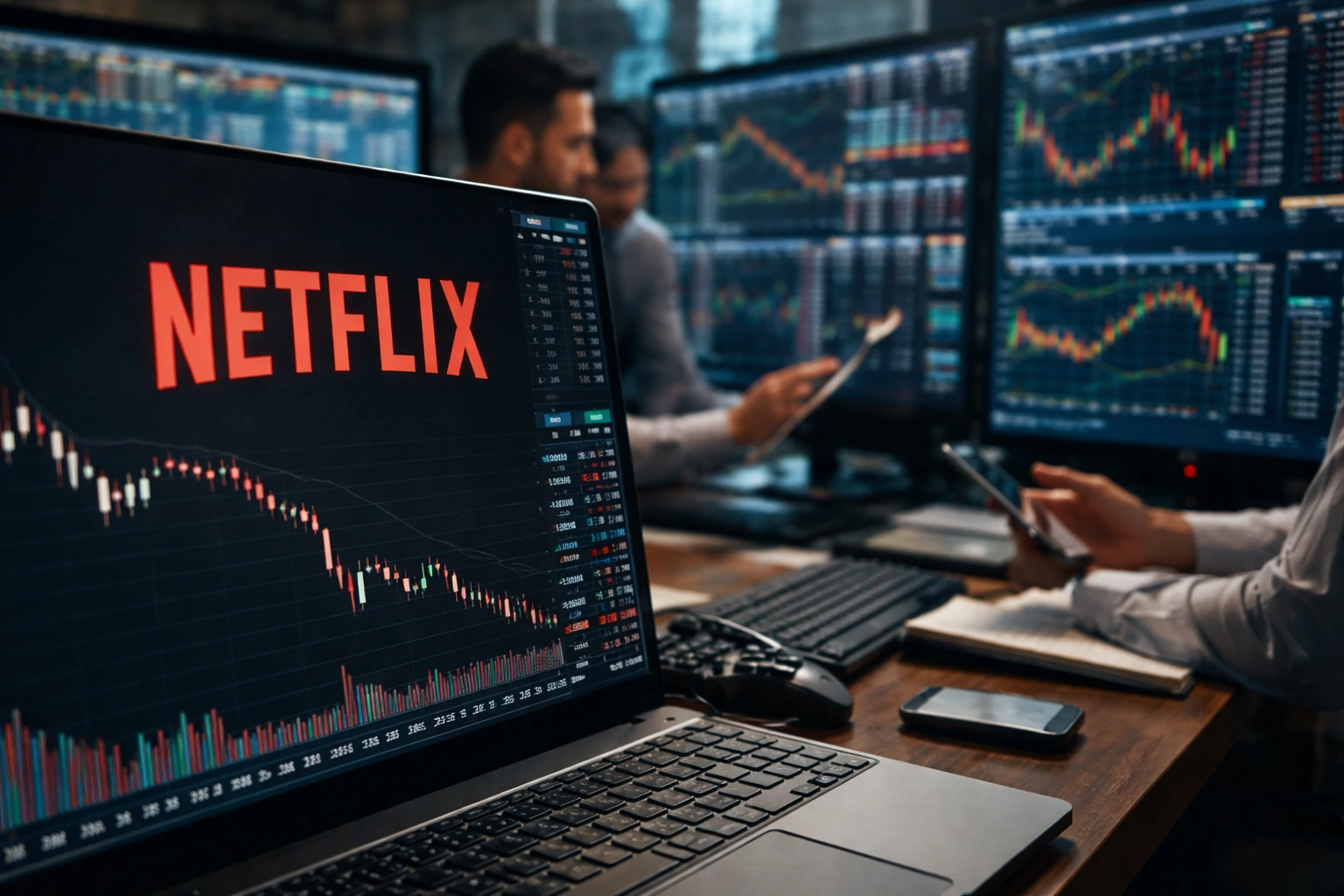
Netflix shares have fallen sharply since October amid investor unease over the company’s potential pursuit of Warner Bros. Discovery but analysts say the selloff has not fully resolved concerns about valuation, growth visibility and deal risk.
Despite a drop of roughly twenty eight percent in less than three months Netflix stock valuation remains higher than most of its major streaming and technology peers.
Netflix Inc. has spent more than a decade reshaping the global entertainment industry, but its current market challenge is less about content and more about confidence.
Since October the company’s shares have slid to their lowest levels since early April, reflecting investor skepticism over its reported interest in acquiring Warner Bros. Discovery and broader doubts about how the streaming leader will sustain growth in an increasingly crowded market.
The stock’s decline has been steep, yet market strategists say the pullback has not made Netflix inexpensive by conventional measures.
At around twenty eight times projected earnings for the next twelve months Netflix stock valuation remains well above that of Walt Disney Co., Amazon.com Inc., Alphabet Inc. and the broader S&P five hundred and Nasdaq one hundred.
Netflix became a dominant force by pioneering subscription based streaming, investing heavily in original programming and expanding rapidly into international markets.
That growth story supported premium valuations for years, with investors willing to pay for scale, brand recognition and pricing power.
The company’s recent performance has been more uneven. Subscriber growth has slowed in several mature markets, competition has intensified and content costs remain high.
Management has introduced advertising supported tiers and expanded into live programming and gaming, but analysts say those initiatives will take time to materially affect earnings.
Concerns intensified after reports that Netflix could be among the bidders for Warner Bros. Discovery, a deal that would bring together a vast film and television library, the HBO Max platform and several cable networks.
Warner Bros. Discovery is valued at about eighty two point seven billion dollars, making any transaction transformative for Netflix.
For many shareholders the issue is not only the price tag but also execution. Netflix has limited experience with large scale mergers, and a deal of this size could draw intense regulatory scrutiny in the United States and abroad.
Christopher Brown, a financial adviser in private wealth management at Synovus Securities, said the stock’s recent decline does not automatically make it a bargain.
“Netflix is not a screaming buy at the current price levels,” Brown said. He noted that while the company has strong brand loyalty and global reach, investors are demanding clearer signals about future growth and capital discipline.
Joel Kulina, managing director for TMT trading at Wedbush Securities, said uncertainty has become a defining feature of the stock’s narrative.
“Even before the Warner Bros. discussion the story was losing momentum,” Kulina said.
“A lack of explicit guidance for twenty twenty six has been an overhang, and large strategic moves tend to amplify that uncertainty rather than resolve it.”
Analysts say Netflix stock valuation reflects a market still pricing in long term dominance, even as competitors narrow the gap.
Disney has integrated its streaming platforms more tightly with its theme parks and franchises.
Amazon bundles Prime Video with its broader retail ecosystem and YouTube continues to dominate short form and creator driven content.
| Company | Forward Price to Earnings Multiple | Primary Streaming Platform |
|---|---|---|
| Netflix Inc. | ~28 | Netflix |
| Walt Disney Co. | ~21 | Disney+ |
| Amazon.com Inc. | ~24 | Prime Video |
| Alphabet Inc. | ~23 | YouTube |
| Paramount Skydance Corp. | <13 | Paramount+ |
| S&P 500 Average | ~20 | N/A |
Source: Market estimates compiled from publicly available analyst forecasts.
The table highlights why some investors remain cautious. Even after its decline Netflix stock valuation exceeds that of most peers, a sign that markets still expect it to outperform.
Over the past five years the company’s average multiple has been closer to thirty four, suggesting the stock is cheaper than its own history but not necessarily cheap in absolute terms.
Media industry consultant Laura Martin of Needham & Co. said the strategic logic of a Warner Bros. deal is complex.
“On paper the content libraries would be complementary,” Martin said. “But the integration challenges, overlapping operations and regulatory risks could distract management for years.”
An executive at a major European broadcaster, who spoke on condition of anonymity due to client relationships, said international regulators would likely scrutinize any deal closely.
“European authorities are increasingly focused on media concentration,” the executive said.
“A combined Netflix and Warner entity would control an extraordinary share of premium content in multiple markets.”
Retail investors are also watching closely. Mark Hernandez, a software engineer in Austin who has held Netflix shares since twenty eighteen, said he is reluctant to add more at current levels.
“I still believe in the company,” Hernandez said. “But I want to see more clarity on how they plan to grow without taking on massive debt.”
Netflix is expected to release updated subscriber and revenue guidance with its next earnings report.
Analysts say management’s tone will be as important as the numbers. Clearer long term targets could help stabilize sentiment, while continued ambiguity may keep pressure on the stock.
Regulatory developments will also matter. Any formal bid for Warner Bros. Discovery would likely trigger antitrust reviews in multiple jurisdictions, a process that could take months or longer.
Meanwhile competition in the streaming sector shows no signs of easing. New entrants continue to experiment with pricing models.
Advertising integration and live content, forcing Netflix to defend its leadership position through innovation rather than scale alone.
Netflix remains one of the most influential companies in global media, but its stock now reflects a more cautious market.
Despite a significant selloff, Netflix stock valuation remains elevated compared with most peers, underscoring lingering doubts about growth visibility and deal related risks.
For investors and industry observers alike the coming months will test whether the company can translate its strategic ambitions into sustained financial confidence without sacrificing stability.
Author’s Perspective
In my analysis, Netflix’s current valuation reflects both its historic premium and investor caution around large scale mergers and regulatory hurdles.
From a strategic perspective, the potential Warner Bros. deal marks a shift from organic growth to content consolidation, impacting global streaming competition.
I predict regulators will set clearer merger standards for digital media, reshaping acquisition valuations and creating selective investment opportunities. For consumers, this could mean more content but potential price adjustments.
Track subscriber guidance and regulatory updates closely to identify market entry or exit points.
NOTE! This report was compiled from multiple reliable sources, including official statements, press releases, and verified media coverage.


