
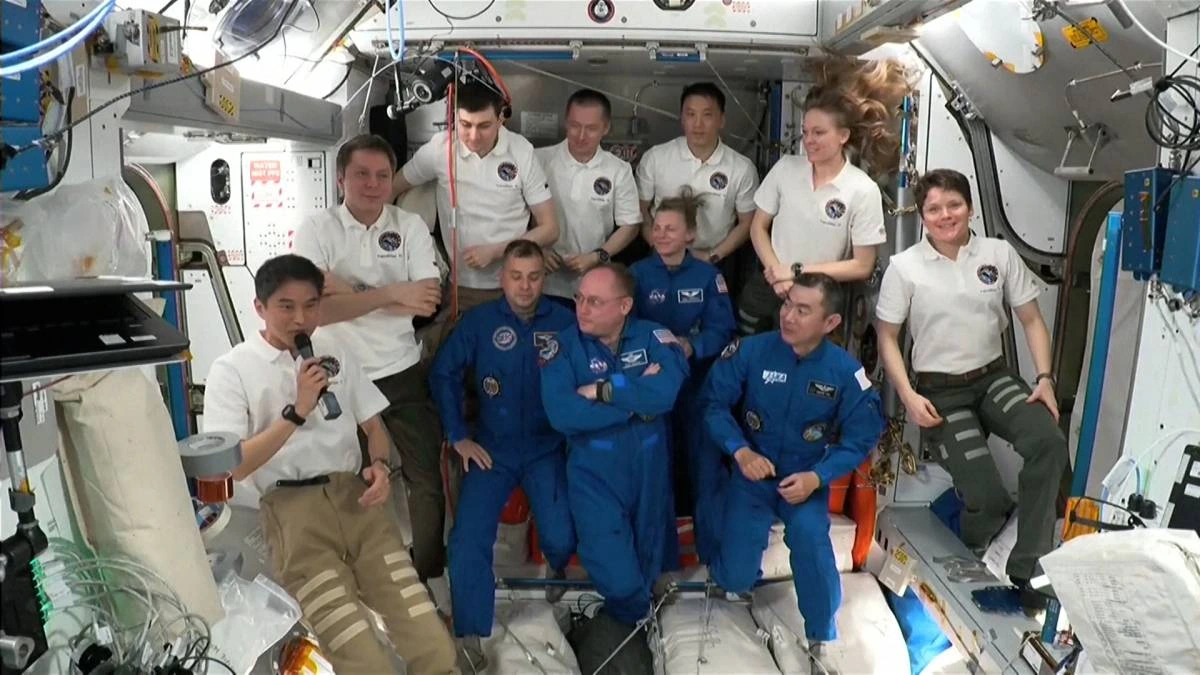
NASA is considering bringing its Crew‑11 astronauts home from the International Space Station earlier than scheduled following a medical situation involving one of the crew members.
The astronaut, whose identity has not been disclosed, is reportedly stable, and a planned spacewalk was postponed as a precaution.
KEY POINTS
- NASA postponed a spacewalk scheduled for January 8 after a Crew‑11 astronaut experienced a medical issue.
- The agency is evaluating an early return of the crew, a rare measure in ISS operations.
- Crew‑11’s mission, launched in August 2025, was originally planned to last six months.
NASA confirmed the medical situation late Wednesday, emphasizing that crew safety remains the top priority.
The potential early return of Crew‑11, which includes NASA astronauts Michael Fincke and Zena Cardman.
JAXA astronaut Kimiya Yui, and Roscosmos cosmonaut Oleg Platonov, reflects the agency’s preparedness for unexpected on orbit events.
The situation has prompted the postponement of an extravehicular activity that was planned to support power system upgrades on the station.
Crew‑11 reached the ISS aboard a SpaceX Crew Dragon in August 2025 for a planned 6 month mission.
The team had been scheduled to return to Earth in early February 2026. Spacewalks, known formally as extravehicular activities, require extensive preparation and are physically demanding.
The spacewalk set for January 8 would have lasted over six hours and been conducted by Fincke and Cardman.
NASA has protocols for medical contingencies in space, including options for early return if a crew member’s health could be compromised.
Such measures are rare, as most medical issues can be managed on orbit with telemedicine support from Earth.
Medical incidents aboard the ISS are uncommon but taken seriously due to the unique environment of microgravity, limited onboard medical resources, and the need to maintain mission operations.
According to Jonathan Clark, a former NASA flight surgeon, “Even stable medical conditions require careful monitoring in space.
Microgravity can complicate treatments that would be routine on Earth, making early return a valid safety consideration.”
NASA has stated that it continuously trains astronauts and mission controllers for these scenarios.
Experts note that early return decisions are influenced not only by health concerns but also by orbital mechanics, re-entry scheduling, and the impact on subsequent missions.
Janet Petro, NASA ISS Program Manager, said, “Safely conducting our missions is our highest priority, and we are actively evaluating all options, including the possibility of an earlier end to Crew‑11’s mission.
These are the situations NASA and our partners train for and prepare to execute safely.”
Dr. Laura Pence, a space medicine consultant, added, “Even when astronauts appear stable, limited medical resources in orbit require careful consideration.
Decisions to return crew members early are precautionary but essential to ensure both individual health and mission integrity.”
NASA is expected to provide updates regarding the astronaut’s condition and the timing of any mission adjustments in the coming days.
An early return would require coordination with ground recovery teams, re-entry planning, and alignment with the schedule of Crew‑12, which is slated to launch no earlier than mid February.
The situation highlights the complexities of long duration human spaceflight and the need for contingency planning.
The decision to potentially return Crew‑11 early underscores NASA’s commitment to prioritizing astronaut health while maintaining operational safety aboard the ISS.
Author’s Perspective
In my analysis, NASA’s possible early return of Crew‑11 highlights the growing emphasis on real time health monitoring and risk management in long-duration space missions.
I predict that AI assisted medical protocols will become standard aboard the ISS and commercial spacecraft, setting a new benchmark for crew safety and mission reliability.
For the public, improved astronaut health systems today will make future space travel safer and more accessible.
Track NASA’s updates on in orbit health policies early adoption of AI assisted diagnostics could influence commercial space operations.
NOTE! This report was compiled from multiple reliable sources, including official statements, press releases, and verified media coverage.


