
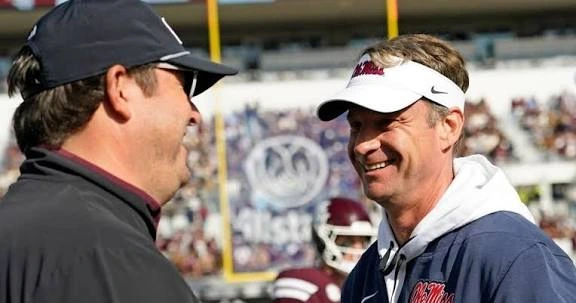
Jimbo Fisher criticized Lane Kiffin on Wednesday, calling him “the villain” over how his departure from Ole Miss to LSU unfolded as the Rebels prepared for their College Football Playoff semifinal in the Fiesta Bowl.
Fisher said the timing of Kiffin’s move and the departure of multiple offensive assistants created unnecessary disruption for a team still competing for a national championship.
KEY POINTS
- Jimbo Fisher said Lane Kiffin’s Ole Miss departure created instability during the College Football Playoff, calling him “the villain” for its impact on the team.
- Several Ole Miss offensive assistants are not coaching in the Fiesta Bowl as they transition to LSU.
- Interim coach Pete Golding has emphasized continuity and program stability as the Rebels pursue their first national title in more than six decades.
The criticism from Fisher, a former national championship coach at Florida State and former Texas A&M coach, adds a national spotlight to what has become one of the most scrutinized coaching transitions of the postseason.
As Ole Miss prepares to face Miami in the Fiesta Bowl, the Rebels are doing so without two of their offensive assistants who are joining Kiffin at LSU.
The situation has raised questions across the sport about competitive balance, playoff fairness and the growing influence of early coaching hires during championship runs.
The focus has centered on the Lane Kiffin Ole Miss departure and how it has intersected with the sport’s most visible stage.
Kiffin, who led Ole Miss to its first College Football Playoff appearance, accepted the LSU job shortly after the regular season.
The move came as LSU sought a high profile offensive mind following a turbulent year. For Ole Miss.
The decision triggered a rapid leadership transition just as the program entered the most significant postseason run in its modern history. Four offensive assistants are expected to join Kiffin at LSU.
While offensive coordinator Charlie Weis Jr. and running backs coach Kevin Smith remained with Ole Miss for the semifinal, tight ends coach Joe Cox and wide receivers coach George McDonald did not.
The changes forced Ole Miss to redistribute responsibilities on short notice, a challenge made more complex by the high stakes environment of the playoff.
Speaking on the ACC Network’s “Inside ACCess,” Fisher said Kiffin did not anticipate Ole Miss advancing this far, adding that the Rebels’ continued success had complicated the optics of his exit.
Fisher suggested that Kiffin believed LSU offered a clearer path to a national title, only for Ole Miss to remain alive in the race.
The Lane Kiffin Ole Miss departure has become a case study in how modern coaching searches increasingly overlap with playoff competition.
College football analysts say the timing of coaching changes has become one of the sport’s most pressing governance issues.
With early signing periods, transfer portal windows and NIL negotiations accelerating the calendar, schools often feel pressure to secure coaches before rivals do.
“Programs are now hiring based on recruiting cycles rather than competitive calendars,” said Mark Ellison, a sports management professor at Tulane University.
“That creates scenarios where teams still alive for championships are effectively operating in transition mode.”
Administrators have debated whether the NCAA should impose restrictions on when assistants can formally leave during the playoff, but no such rule exists.
Schools, not the governing body, control contracts and release terms. For Ole Miss, the Lane Kiffin Ole Miss departure created both logistical and emotional challenges.
Players who committed to Kiffin’s system suddenly found themselves playing under a new voice with a national title at stake.
Coaches remaining with the team were tasked with preserving continuity while simultaneously reassigning duties.
The broader implication is how these transitions may influence future playoff formats.
With the College Football Playoff expanding, more teams will face similar scenarios, increasing pressure on conference offices and television partners to protect competitive integrity.
Coaching Transitions During Playoff Runs
| Season | Team | Coach Who Departed | New Job |
|---|---|---|---|
| 2024 | Ole Miss | Lane Kiffin | LSU |
| 2022 | Cincinnati | Luke Fickell | Wisconsin |
| 2020 | Notre Dame | Brian Kelly | LSU |
Source: School announcements, media reports
The Lane Kiffin Ole Miss departure fits a growing pattern, though the number of assistants leaving before a semifinal remains relatively rare.
Ole Miss interim coach Pete Golding said Wednesday that he wants to build a program where no single person can destabilize long term success.
“This is about the players and the culture,” Golding said. “One person, one player or anything like that shouldn’t derail what we’re building.”
Several players echoed that sentiment in team media sessions, emphasizing preparation and focus.
Senior linebacker Jamal Peters said the staff has tried to maintain routine. “We’re not thinking about who’s leaving or who’s not. We’re thinking about winning,” Peters said.
Fisher, however, framed the issue differently, suggesting that leadership carries responsibilities beyond personal career advancement.
“When you’re still in it, you owe it to those kids,” Fisher said on the broadcast.
The Lane Kiffin Ole Miss departure has sparked similar conversations among former coaches, some of whom argue that contracts should include clearer playoff continuity clauses.
Ole Miss faces Miami with a chance to reach the national championship game, a milestone the program has not achieved since the early 1960s.
Golding, previously the defensive coordinator, has the opportunity to become the first coach to win three playoff games with the Rebels before Kiffin ever appears in one.
LSU, meanwhile, is moving quickly to integrate Kiffin’s staff and finalize recruiting classes ahead of signing deadlines. The school has not publicly commented on Fisher’s remarks.
Administrators across the sport are expected to revisit policies on assistant mobility and contract timing during the offseason.
While no formal changes have been announced, several conference officials have acknowledged that the current system places teams in vulnerable positions during the most important weeks of the year.
The Lane Kiffin Ole Miss departure is likely to remain part of that conversation. Fisher’s remarks have amplified a debate that extends beyond one coach and one team.
As Ole Miss continues its playoff run under new leadership, the program has become a visible example of how modern coaching dynamics intersect with championship competition.
Whether the sport ultimately changes its rules or not, the situation has underscored the growing tension between career mobility and competitive continuity at the highest level of college football.
Author’s Perspective
In my analysis, the reaction to the Lane Kiffin Ole Miss departure highlights a growing tension in college football between competitive integrity and the accelerated coaching market shaped by NIL economics and early recruiting cycles.
This is no longer just about strategy it is about institutional stability and athlete trust.
I predict that major conferences will introduce formal postseason staff retention rules to prevent playoff teams from losing key personnel mid run, creating a new compliance standard across elite programs.
For players, these shifts disrupt development and exposure; for fans and host cities, they impact attendance, tourism and long term loyalty.
Track coaching continuity, not just recruiting rankings teams with stable staffs consistently perform better in postseason execution metrics.
NOTE! This report was compiled from multiple reliable sources, including official statements, press releases, and verified media coverage.


