
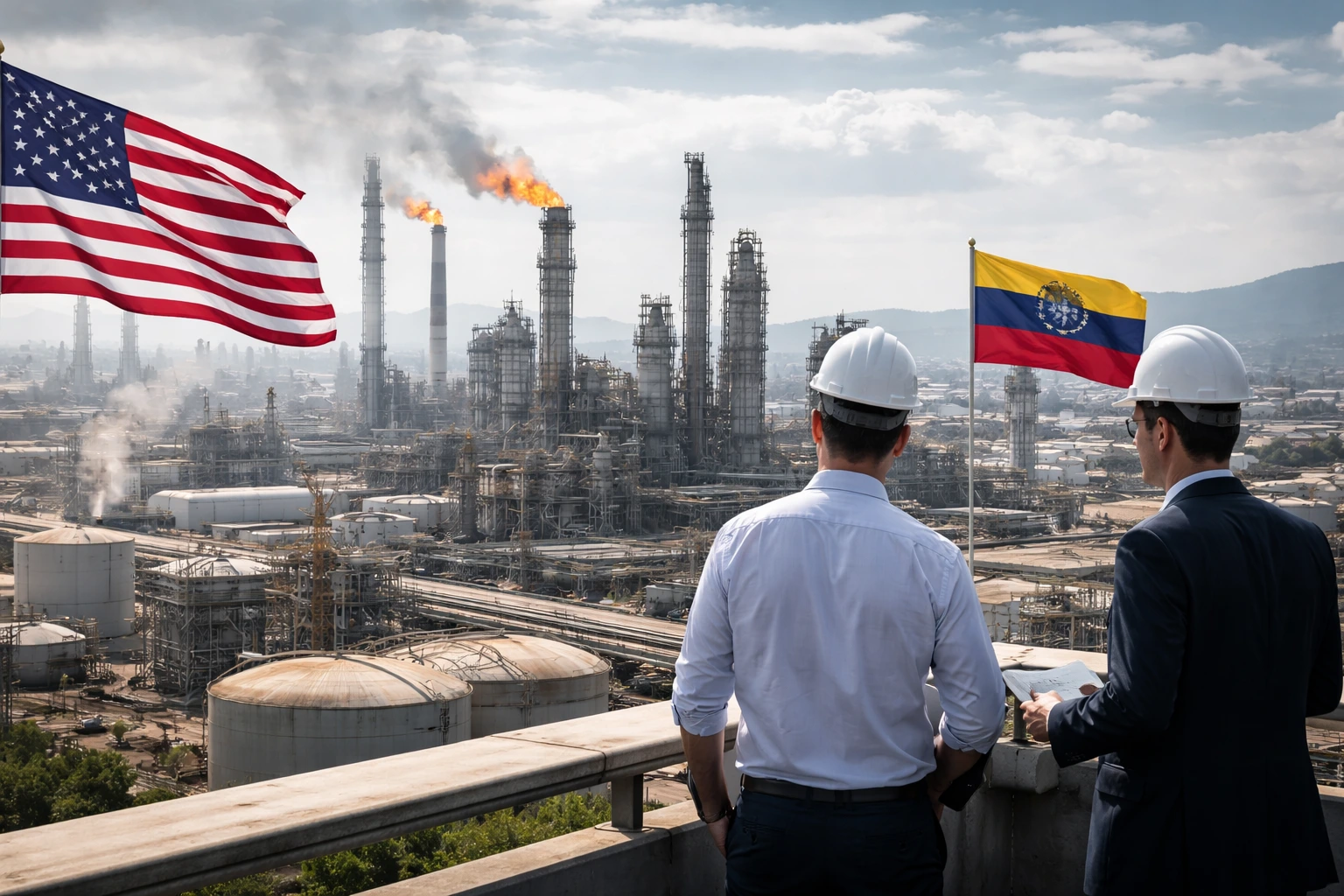
US oil companies are responding cautiously to President Donald Trump’s push to re-enter Venezuela’s oil sector following the capture of former President Nicolás Maduro.
Weighing political instability, sanctions uncertainty and the high cost of rebuilding one of the world’s most degraded energy industries.
KEY POINTS
- US oil companies say no major investment decisions on Venezuela have been made despite Trump’s public claims.
- Venezuela’s oil infrastructure requires years of repairs and tens of billions of dollars before meaningful production gains.
- Political uncertainty under interim President Delcy Rodríguez remains a central risk for energy investors.
President Donald Trump has framed recent US actions in Venezuela as both a geopolitical and economic opportunity.
Arguing that American oil companies are ready to rebuild the country’s oil infrastructure and reclaim what he has described as “stolen American oil.”
While markets briefly reacted positively, oil executives and analysts say the reality facing investors is far more complex, and enthusiasm inside boardrooms remains limited.
The administration’s messaging has placed Venezuela’s oil reserves at the center of its post Maduro strategy.
Yet industry leaders and energy experts caution that structural damage, sanctions constraints and unresolved political questions continue to shape.
How oil companies are responding to Trump’s Venezuela oil strategy.
Venezuela holds the world’s largest proven crude oil reserves, estimated at more than three hundred billion barrels.
Once a major global supplier, the country’s oil output collapsed over the past decade due to sanctions, corruption, under investment and mass emigration of skilled workers.
US sanctions imposed in stages since 2017 restricted financial transactions and joint ventures with state owned oil company PDVSA.
Chevron remains the only major US oil producer operating in Venezuela through limited licenses, while ExxonMobil and ConocoPhillips exited years earlier.
Trump has repeatedly argued that lifting sanctions would unlock billions of dollars in private investment.
However, according to Reuters and company statements, several major oil firms say they have not yet held direct talks with the administration about post Maduro investment plans.
Energy analysts say oil companies are responding cautiously because Venezuela’s challenges extend well beyond political leadership.
Amrita Sen, founder and director of market intelligence at Energy Aspects, said companies are focused on risk rather than opportunity.
She noted that rebuilding production even modestly requires years of planning, regulatory clarity and infrastructure restoration.
Marcos Falcone, a policy analyst at the Cato Institute, said market reactions suggest investors are not pricing in a rapid Venezuelan recovery.
He said uncertainty surrounding interim President Delcy Rodríguez, a longtime figure within the Maduro government, complicates expectations of lasting reform.
Oil companies also face technical hurdles. Venezuela’s crude is extra heavy, high in sulfur and carbon content, requiring specialized processing and large volumes of lighter oil to transport.
These factors raise production costs compared with shale or offshore projects elsewhere.
| Metric | Early 2000s | 2024-2025 |
|---|---|---|
| Oil production (barrels per day) | About 3 million | Less than 1 million |
| Global production share | About 4% | About 0.5% |
| Estimated investment needed for +500,000 bpd | N/A | About $10 billion |
| Time to restore production to 2.5 million bpd | N/A | 7 to 10 years |
Chevron said it remains focused on operational compliance rather than expansion.
Bill Turenne, head of public policy communications, said the company continues to operate “in full compliance with all relevant laws and regulations.”
ConocoPhillips said it is monitoring developments but declined to comment on future investments, citing ongoing uncertainty.
Phillips 66 Chief Executive Mark Lashier said the company’s Gulf Coast refineries are technically capable of processing Venezuelan crude if production resumes.
Highlighting downstream benefits even if upstream investment remains limited.
Continental Resources, led by Trump ally Harold Hamm, has publicly expressed conditional interest.
Hamm told the Financial Times that future investment would depend on regulatory stability and government reforms.
Energy experts say any largeBscale re-entry by US oil companies depends on formal sanctions relief, legally binding contracts and sustained political stability.
Even under favorable conditions, production increases would likely be incremental rather than immediate.
Delcy Rodríguez has signaled willingness to engage with Washington despite condemning Maduro’s capture.
Analysts say her ability to unify competing factions within Venezuela’s political and military elite will shape investor confidence more than public statements from Washington.
Oil companies are responding to Trump’s Venezuela oil strategy with measured restraint, balancing the scale of Venezuela’s reserves against years of operational decay and unresolved political risk.
While the country’s oil potential remains vast, industry leaders and analysts agree that rebuilding Venezuela’s energy sector will be a long term process shaped more by structural realities than political rhetoric.
Author’s Perspective
In my analysis, oil companies are prioritizing risk control over reserve size, signaling that Venezuela’s political shift alone is not enough to unlock major capital.
I believe the real constraint is infrastructure decay and legal uncertainty, not willingness to invest.
I predict that US oil involvement in Venezuela will stay limited to tightly licensed projects, with production growth remaining modest and well below political promises.
Watch sanctions licenses and infrastructure contracts, not headlines, to gauge real progress.
NOTE! This report was compiled from multiple reliable sources, including official statements, press releases, and verified media coverage.


