
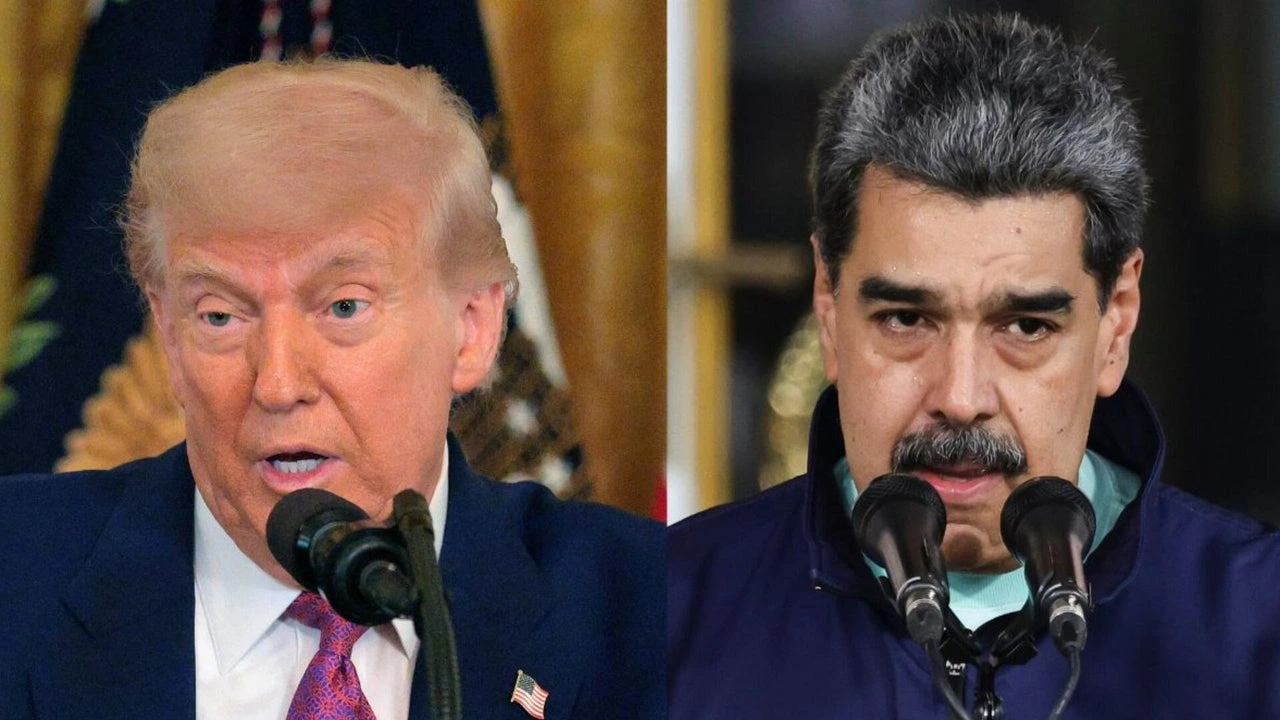
CARACAS, Venezuela — The United States launched a large scale military operation in Venezuela early Saturday, resulting in the reported capture of President Nicolás Maduro and his wife, Cilia Flores, US President Donald Trump announced.
The move represents the most direct US military intervention in Latin America since the 1989 invasion of Panama.
Trump said on his social media platform that the operation was conducted “in conjunction with US law enforcement” and promised further details during a press briefing at his Mar-a-Lago resort.
Key Points
- President Trump confirmed that Maduro and his wife were captured and removed from Venezuela following coordinated strikes.
- Explosions and aircraft activity were reported in Caracas and nearby regions, prompting Venezuelan authorities to declare a national emergency.
- The US action has sparked immediate international scrutiny over its legality and potential regional consequences.
The reported capture of Maduro marks a historic escalation in US Venezuela tensions. Early Saturday, residents of Caracas witnessed explosions, black smoke, and aircraft flying at multiple altitudes.
Venezuelan authorities responded by mobilizing troops and calling a national emergency.
While Trump framed the operation as a successful law enforcement effort, Venezuelan officials insisted that the attacks violated national sovereignty and demanded proof of life for the president and first lady.
Maduro has ruled Venezuela since 2013, following the death of Hugo Chávez. His government has faced repeated allegations of corruption, election fraud, and involvement in international drug trafficking.
The Trump administration has previously imposed sanctions and conducted limited strikes on vessels accused of smuggling narcotics.
Direct military intervention by the US in Latin America is rare, with the most recent comparable operation being the 1989 invasion of Panama to remove General Manuel Noriega.
Historically, such actions have provoked regional backlash and criticism from international organizations.
Experts note that the US operation raises questions under international law. Military action on foreign soil without United Nations approval or clear congressional authorization could trigger legal challenges.
Political analysts also highlight the potential for heightened instability in the region, as neighboring countries like Colombia prepare for possible humanitarian consequences, including refugee flows.
Economically, Venezuela’s oil production and exports may be affected in the short term, particularly as Maduro’s removal adds uncertainty to OPEC member stability.
Residents described chaotic scenes as explosions shook Caracas. Carmen Marquez, a Caracas resident, said, “We could see flashes in the sky and hear loud explosions.
No official information is coming from the government it is terrifying.”
Republican US Senator Mike Lee cited Secretary of State Marco Rubio as saying that Maduro is expected to face criminal charges in the United States.
However, no official timeline or details of legal proceedings have been released.
The situation remains fluid. US officials are expected to clarify the legal basis of the operation and next steps during Trump’s scheduled press briefing.
Regional experts suggest that Venezuela’s political landscape could shift rapidly, with implications for oil markets, regional security, and humanitarian conditions.
The reported capture of Nicolás Maduro signals a dramatic escalation in US Venezuelan relations, challenging international norms regarding sovereignty and military intervention.
The coming days are likely to bring intense diplomatic engagement as governments, organizations, and observers evaluate the legality and impact of the operation.
Author’s Perspective Adnan Rasheed
In my analysis, the reported capture of President Maduro represents more than a tactical US victory it underscores the increasing willingness of Washington to directly engage in Latin America, a region long considered geopolitically sensitive.
I believe the operation will not only reshape Venezuela’s internal power dynamics but also force neighboring countries to reassess their security and energy strategies.
I predict that Venezuela’s oil export patterns will shift dramatically, as foreign investors and regional actors adjust to a government in transition.
This could create both opportunities and volatility in global oil markets, potentially reshaping alliances with countries like China, Russia, and Iran, who have historically supported Maduro’s administration.
For analysts and investors, closely monitor Venezuelan oil shipments and regional trade agreements over the next 12 months; early insights could offer critical indicators of emerging energy market shifts.
NOTE! This report was compiled from multiple reliable sources, including official statements, press releases, and verified media coverage.


