
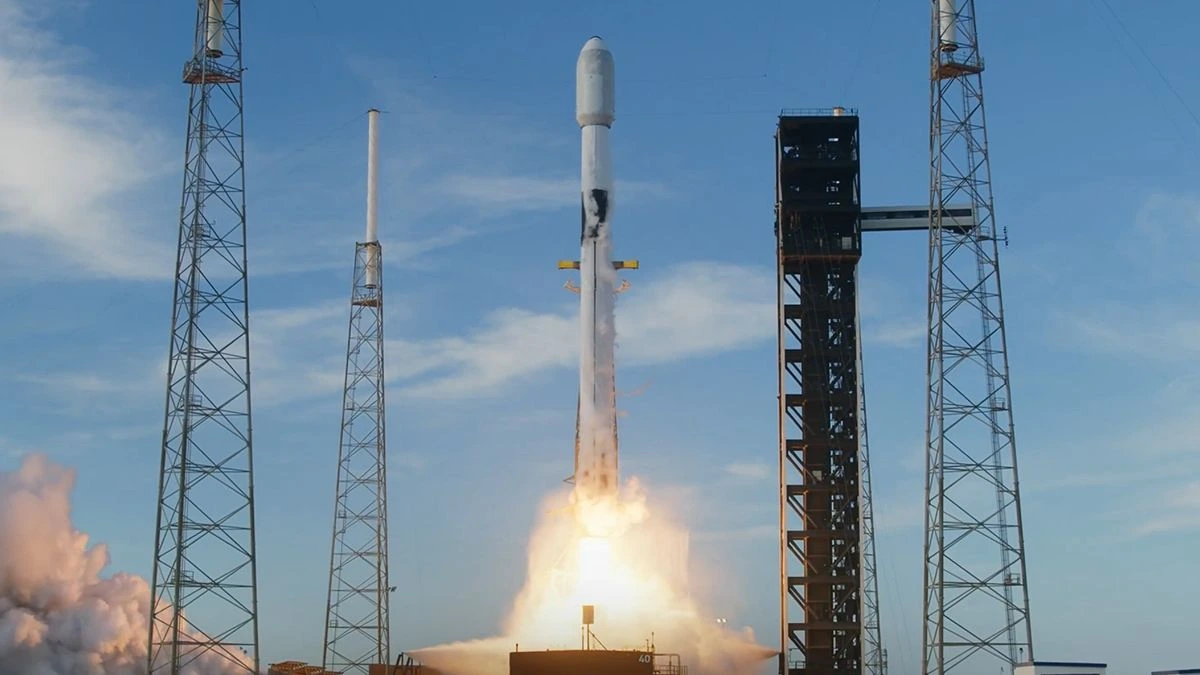
VANDENBERG SPACE FORCE BASE, Calif. — SpaceX launched its first orbital mission of 2026 Friday night, deploying an Italian Earth observing satellite aboard a Falcon 9 rocket from California’s Vandenberg Space Force Base.
The liftoff marks the beginning of another high tempo year for the private space company and international satellite operations.
The Falcon 9 rocket lifted off at 9:09 pm Eastern Standard Time (6:09 pm local time 0209 GMT Saturday) carrying the COSMO SkyMed Second Generation Flight Model 3 (CSG-3) satellite.
About eight and a half minutes after liftoff, the rocket’s first stage successfully returned to a landing pad at Vandenberg, completing its 21st flight.
A few minutes later, the second stage released the satellite into a low Earth orbit at approximately 620 kilometers (385 miles).
The CSG-3 satellite, built for the Italian Space Agency and the Italian Ministry of Defence, is designed to provide high resolution radar imagery of Earth under all weather conditions and at any time of day.
Its data will support applications ranging from environmental monitoring and agriculture management to disaster response and maritime surveillance.
Key Points
- SpaceX successfully launched the first orbital mission of 2026, placing Italy’s COSMO SkyMed CSG-3 satellite into orbit.
- The Falcon 9 first stage completed its 21st flight, demonstrating SpaceX’s continued commitment to reusable rockets.
- The satellite strengthens Italy’s dual use Earth observation capabilities, supporting both civilian and defense operations.
The launch represents the opening of a new year of commercial and government satellite operations and highlights the growing role of radar equipped observation satellites in global monitoring.
CSG-3 expands Italy’s capacity to provide critical data for environmental protection, resource management, emergency preparedness, and defense planning.
COSMO SkyMed, Italy’s flagship Earth observation program, began in the mid 2000s.
The first generation satellites, launched between 2007 and 2010, provided optical and radar imaging for dual use applications.
The second generation program introduces enhanced synthetic aperture radar (SAR) sensors, increased data throughput, and longer operational life.
The first two CSG satellites were launched on different rockets CSG-1 in December 2019 on a Soyuz vehicle and CSG-2 in January 2022 on a Falcon 9.
CSG-3 continues Italy’s efforts to maintain a constellation capable of near continuous Earth observation.
Experts note that synthetic aperture radar satellites are increasingly important for both government and commercial users.
Unlike optical satellites, SAR can capture imagery through clouds and at night, making it essential for monitoring environmental disasters, climate change, and infrastructure development.
“Programs like COSMO SkyMed reflect a trend toward resilient and versatile satellite systems that provide actionable data for both security and civilian purposes,” said Dr. Lorenzo Rossi, a European space policy analyst.
The satellite’s capabilities also demonstrate the value of international partnerships in space. Data collected by COSMO SkyMed can support European Space Agency initiatives and broader scientific research, creating a shared resource for global applications.
“It is a testament to Italy’s strategic investment in space technology,” said Guido Crosetto, Italy’s defense minister, emphasizing the satellite’s role in civil and military applications.
An independent satellite policy researcher added, “This launch shows how small radar satellites are reshaping global monitoring capabilities and increasing the resilience of Earth observation networks.”
COSMO SkyMed Second Generation is planned to include additional satellites, enhancing revisit rates and real time monitoring.
SpaceX’s high launch cadence, following a record 165 orbital missions in 2025, positions the company to support both governmental and commercial missions throughout 2026.
The successful deployment of CSG-3 highlights the growing importance of all weather radar satellites for global monitoring.
It also underscores the efficiency of reusable rocket technology, combining rapid launch schedules with reliable access to space.
As the satellite constellation expands, its data will play an increasingly significant role in environmental management, disaster preparedness, and strategic planning.
Author’s Perspective Adnan Rasheed
In my analysis, SpaceX’s first launch of 2026 highlights how reusable rockets are becoming the backbone of strategic Earth observation programs worldwide.
I believe missions like COSMO SkyMed show that access to reliable, all weather satellite data is now as much a commercial advantage as it is a national priority.
I predict that more countries will shift toward shared or rapidly deployed radar satellite constellations, relying on commercial launch providers to achieve faster coverage at lower cost.
Stakeholders planning Earth observation projects should align satellite development timelines with high cadence commercial launch schedules to reduce delays and maximize data availability.
NOTE! This report was compiled from multiple reliable sources, including official statements, press releases, and verified media coverage.


