
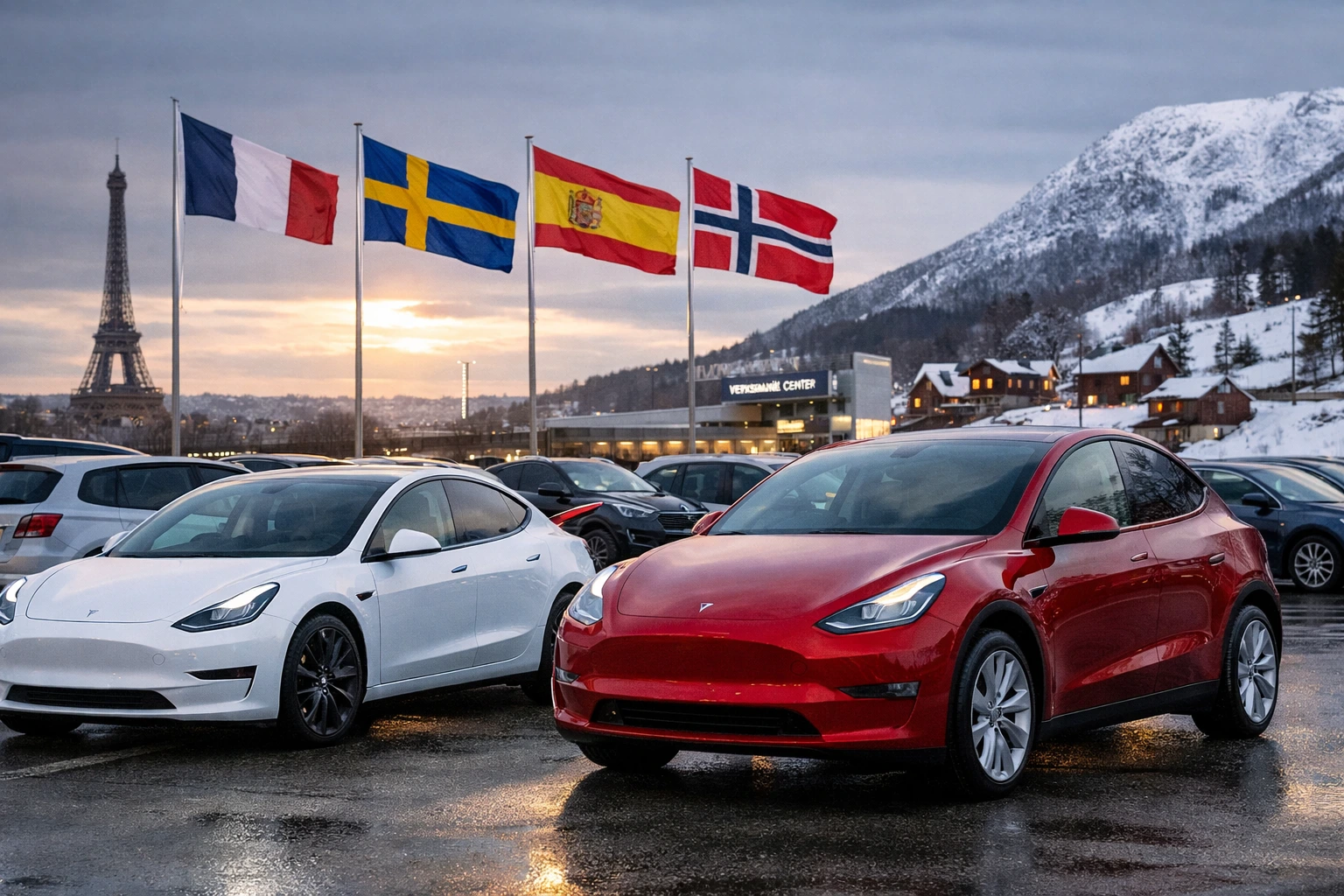
OSLO, Norway — Tesla Inc.’s electric vehicle sales showed contrasting trends across Europe at the end of 2025, with registrations falling sharply in major markets such as France, Sweden, Portugal, and Spain.
Even as the US automaker set a new annual record in Norway, where electric vehicles dominate new car sales.
The pattern highlights regional variations in demand, competition from other EV makers, and local policy effects.
Key Points
- Declining sales in major European markets, Tesla saw significant year over year drops in registrations across France, Sweden, Portugal, and Spain.
- Strong performance in Norway, Registrations surged in December, pushing Tesla to a record market share above 19 percent in 2025.
- Market share contraction across Europe, Despite growing overall EV adoption, Tesla’s share of new registrations fell, reflecting rising competition and market saturation.
Tesla’s European performance in late 2025 illustrates a dual reality. While the company struggles in several large markets, it continues to dominate in regions with high electrification rates.
Registration figures, commonly used in Europe as a proxy for vehicle sales, reveal the extent of Tesla’s uneven performance.
The European electric vehicle market has grown rapidly over the past decade, driven by emissions regulations, government incentives, and rising consumer interest in low emission vehicles.
Tesla initially led the market with its Model 3 and Model Y, but growing competition from European and Chinese automakers has narrowed its advantage.
In response to declining demand, Tesla introduced cheaper versions of the Model 3 and Model Y across Europe in 2025, but these adjustments have yet to reverse the overall downward trend in many countries.
Registration Trends Across Europe
| Country | December 2025 Registrations | Annual Change (2025 vs 2024) | Notes |
|---|---|---|---|
| France | 1,942 vehicles | -37\% | One of Europe’s largest markets saw steep declines. |
| Sweden | 821 vehicles | -70\% | Among the sharpest year-over-year drops. |
| Portugal | 1,207 vehicles | -22\% | Moderate decline across 2025. |
| Spain | 1,794 vehicles | -4\% | Declines less pronounced but still notable. |
| Norway | 5,679 vehicles | +89\% | Set a new annual record; market share above 19\%. |
Tesla’s market share across Europe, including Britain and the European Free Trade Association, fell to approximately 1.7 percent through November 2025, down from 2.4 percent during the same period in 2024.
Even as overall battery electric vehicles (BEVs) reached nearly 19 percent of new car sales. Analysts note that increased competition and market saturation are key drivers behind Tesla’s struggles.
“European consumers now have access to a wider range of EV models with competitive pricing and features,” said Elena Rossi, an automotive market analyst.
“Tesla’s older models face challenges when compared with local offerings, particularly in France and Sweden.”
Policy also plays a significant role. Norway, with generous EV incentives and almost full electrification of new car sales, continues to support Tesla’s high volumes.
“The market here is unique. Tesla benefits from both strong incentives and high consumer familiarity with EV technology,” said Anders Nilsen, a Norwegian fleet manager.
Tesla’s contrasting performance reflects regional market dynamics. Weak demand in France, Sweden, Portugal, and Spain suggests the company must adapt product offerings and pricing strategies.
At the same time, success in Norway highlights the importance of supportive policy environments for maintaining high sales levels.
The company is expected to report global fourth quarter delivery figures soon, which will provide further insight into how these European trends affect Tesla’s worldwide operations.
Tesla’s 2025 results demonstrate a complex European market: while Norway continues to deliver record sales, the company faces declining registrations and shrinking market share in several major economies.
These trends underscore the challenges of sustaining growth amid increasing competition and diverse regulatory landscapes.
Author’s Perspective Adnan Rasheed
In my analysis, Tesla’s contrasting performance across Europe highlights how policy environments and local market saturation can dramatically shape EV adoption, even for globally recognized brands.
While weak registrations in France, Sweden, and Spain indicate that brand recognition alone no longer guarantees growth.
The record breaking surge in Norway demonstrates the critical role of incentives, infrastructure, and consumer familiarity in sustaining sales.
I predict that Tesla will increasingly rely on Norway and other highly electrified markets to offset declining shares in Western Europe.
But its long term European dominance may be challenged by emerging EV brands offering localized features and aggressive pricing, forcing Tesla to innovate faster in technology, affordability, and customer experience.
Investors and EV enthusiasts should monitor regional incentive policies and infrastructure rollouts as early indicators of where Tesla and other EV brands are likely to see growth or contraction, rather than relying solely on global sales trends.
NOTE! This report was compiled from multiple reliable sources, including official statements, press releases, and verified media coverage.


